
A world beneath the waters
Svayambhuva Manu stands before Brahma with Shatarupa, ready to receive the work entrusted to them. Brahma asks Manu to bring forth a worthy generation, protect the Earth through dharma and worship the Lord.
Manu accepts the responsibility, but one question remains. The Earth, the home of living beings, is submerged in a vast expanse of water. Where can he and the people yet to come make their dwelling?
Brahma considers the difficulty. Creation requires a place where life can flourish, yet that place has disappeared beneath the flood. His thought turns toward the Lord from whom his own existence has come.
A small and wondrous beginning
While Brahma reflects, a tiny boar emerges from his nostril, no larger than the tip of a thumb. Before the astonished gathering, the small form grows in the sky until it is as large as an elephant.
Brahma, Manu and the sages wonder at what they see. Could this extraordinary being be the Lord of sacrifice, appearing in a form they had not expected?
Varaha’s roar answers their wonder. It echoes through the directions, filling Brahma and the sages with joy. Those dwelling in the higher realms offer Vedic praise. The divine boar roars again and prepares to enter the waters.
Into the cosmic depths
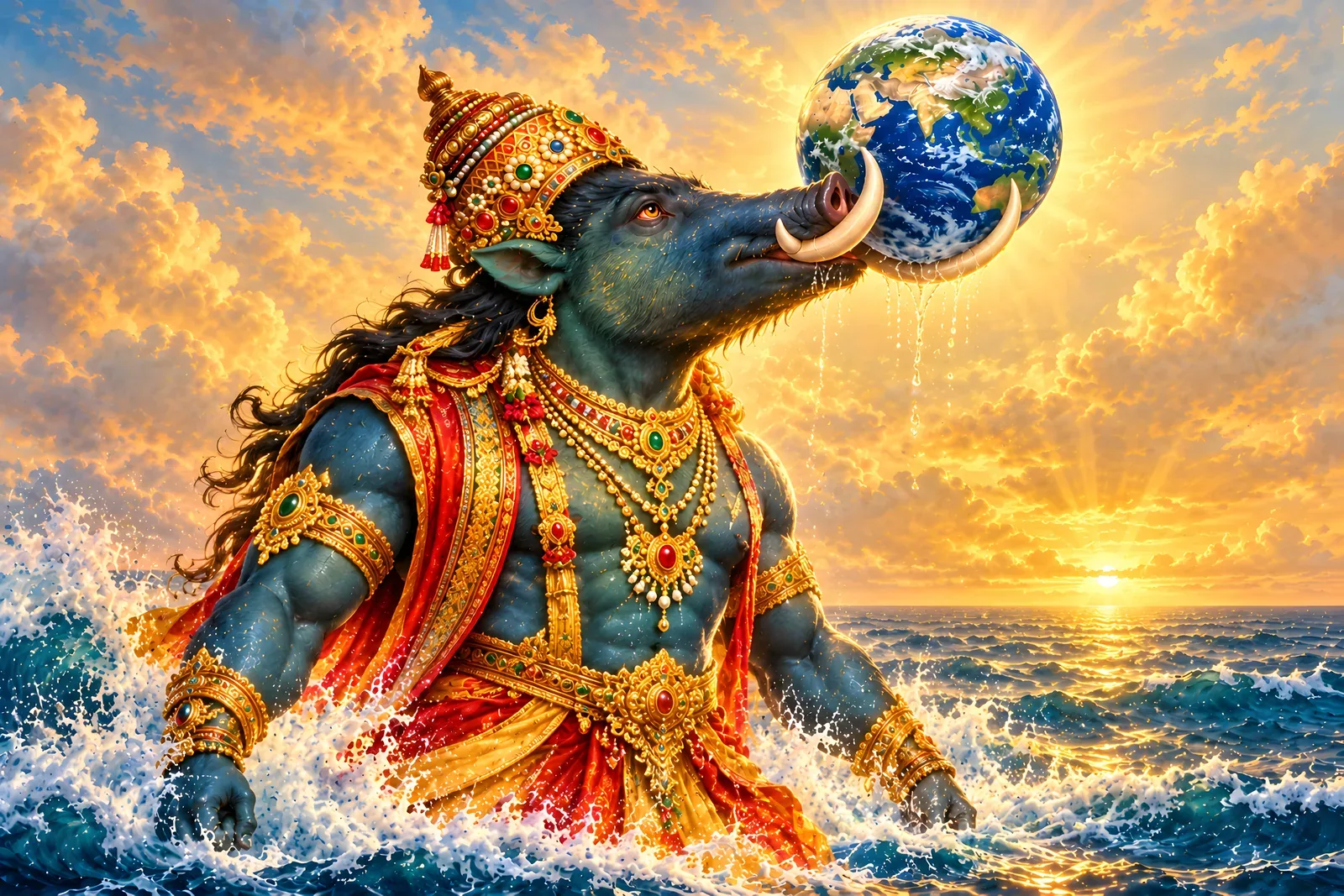
His bristles rise, his white tusks shine, and his hooves scatter the clouds. Powerful in appearance, Varaha nevertheless turns a gentle gaze toward the sages praising him.
Then he plunges into the ocean. The waters thunder beneath his descent. Taking the form of a boar, the Lord seeks the Earth by scent, moving through the immeasurable depths until he finds her in Rasatala.
He lifts the submerged Earth upon his tusks and begins to rise. The world that will sustain countless beings is itself being sustained. The sages’ praise accompanies the rescue, describing Varaha’s divine body through the sacred language of Veda and sacrifice.
A warrior seeking a rival
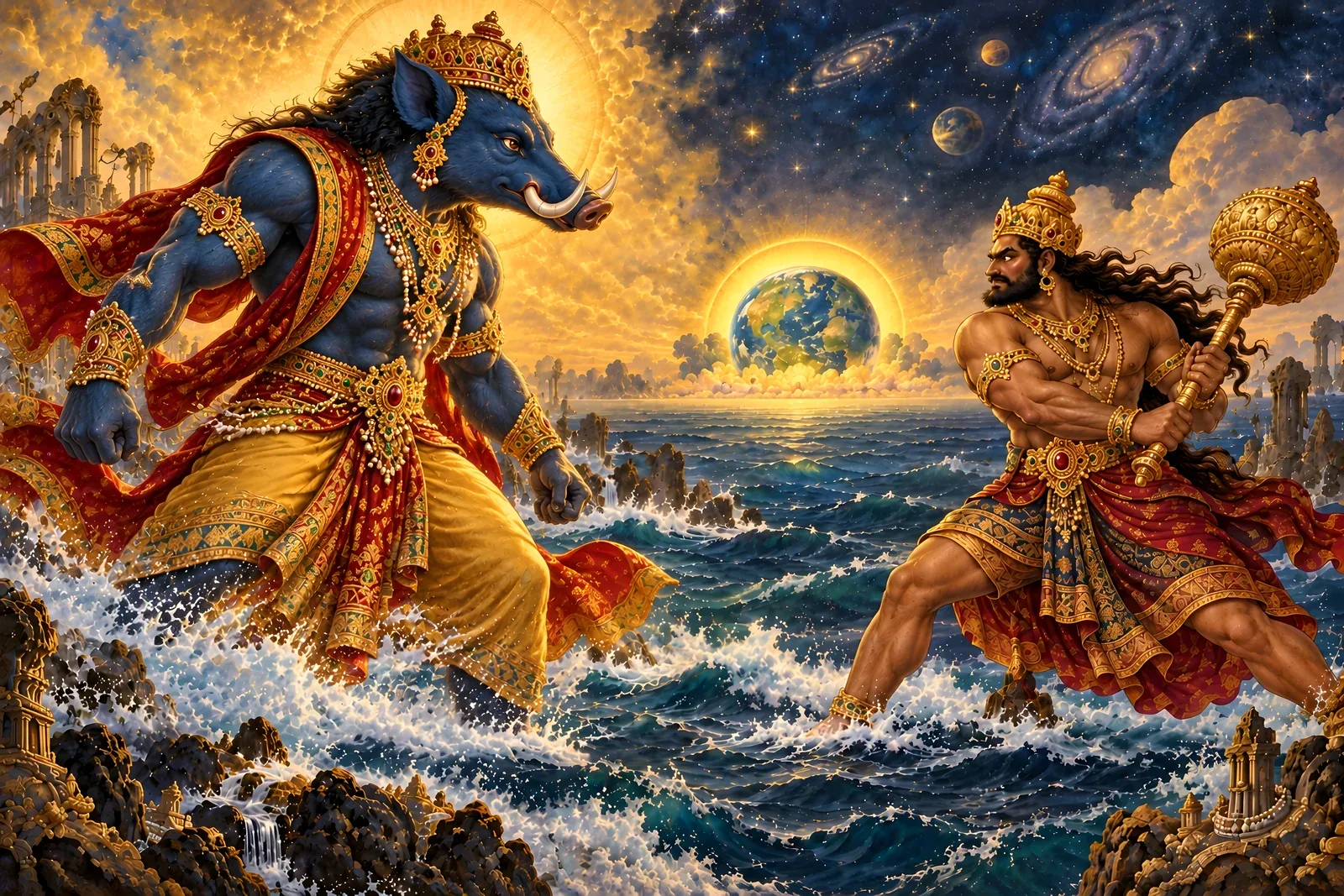
The Bhagavata then expands the account of the asura who confronts him. Hiranyaksha, born to Diti and Kashyapa, has grown into a warrior of formidable strength. Carrying a great mace, he searches for someone who will stand against him.
When the devas withdraw before him, he enters the ocean and eventually reaches Varuna. His challenge is proud and mocking: he wants battle, a rival through whom he can prove his power.
Varuna restrains his anger and tells him that the ancient Supreme Person alone can answer such a challenge. Hiranyaksha takes this as encouragement. Learning the Lord’s whereabouts from Narada, he hastens to Rasatala.
There he sees Varaha carrying the Earth upward on the tips of his tusks. Instead of recognizing the rescue, he derides the Lord’s boar form and demands that the Earth be left behind.
The Earth comes first
Hiranyaksha’s insults follow Varaha through the waters. He claims the Earth for the inhabitants of the lower realm and threatens the Lord before him.
Varaha sees the Earth’s fear and bears the taunts without allowing them to interrupt her rescue. He emerges from the water while Hiranyaksha pursues him.
Only after placing the Earth upon the waters and investing her with his supporting power does the Lord turn to his opponent. Brahma praises him and the devas shower flowers. The refuge of living beings has been secured before the duel begins.
The clash and the illusion
The challenge becomes a fierce exchange of mace blows. Hiranyaksha is a skilled opponent, and Brahma arrives with the sages to witness the encounter. He asks the Lord to bring the struggle to its conclusion.
At one moment Varaha’s mace falls from his hand. Hiranyaksha does not strike the unarmed Lord, observing the rule of combat. Varaha acknowledges that restraint and calls upon the Sudarshana discus.
The asura renews his attack. His mace is checked; his trident is cut apart by the discus. Unable to prevail through weapons, he unleashes terrifying illusions. Violent winds, darkness and apparitions make the witnesses fear that the world is ending.
But these powers cannot master the Lord of divine maya. Varaha sends forth Sudarshana, and the illusions dissolve. The terror that had filled the scene loses its hold.
The world is upheld
Hiranyaksha attacks once more at close quarters. Varaha ends the battle with a blow at the root of his ear. The great warrior falls, and the threat that had troubled the worlds comes to an end.
The devas offer praise. Their words look beyond victory in combat: the Lord has assumed this form for the preservation of the world. Earth can again be the dwelling place of life.
The account also recalls a deeper history: Hiranyaksha belongs to the Lord’s attendants who entered asura births through a curse and will eventually return. The retelling leaves that larger cycle in the background, as the Bhagavata’s conclusion does here.
Praised by Brahma and the devas, Varaha returns to his own abode. Vidura, listening to Maitreya’s telling, receives the story with joy. What began with the absence of a dwelling place has become an account of divine protection.
EDITORIAL REFLECTION / PAUSE & REFLECT
Power that carries
before it conquers.
Varaha does not set down his responsibility to answer an insult. He first makes the Earth secure. The sequence invites a question: when our pride is challenged, can we still put the well-being entrusted to us first?
TRADITIONS & INTERPRETATION
A sacred world,
restored.
This is the Bhagavata Purana’s account of Varaha, Vishnu’s boar manifestation. Chapter 13 gives the manifestation, rescue and a brief anticipation of the conflict; chapters 17–19 provide the expanded encounter with Hiranyaksha. The reader follows that structure without adding incidents from other Puranas.
The cosmic waters, Rasatala and the Earth upheld on tusks belong to the text’s sacred cosmology. The anthropomorphic form of Varaha and the globe-shaped Earth in the illustrations are artistic conventions. The paintings interpret the narrative rather than depict a scientific model or a historical event.
The sages’ sacrificial praise and the longer account of the cursed attendants are condensed. The reflection on responsibility before pride is editorial contemplation.
Read the supplied-edition references