
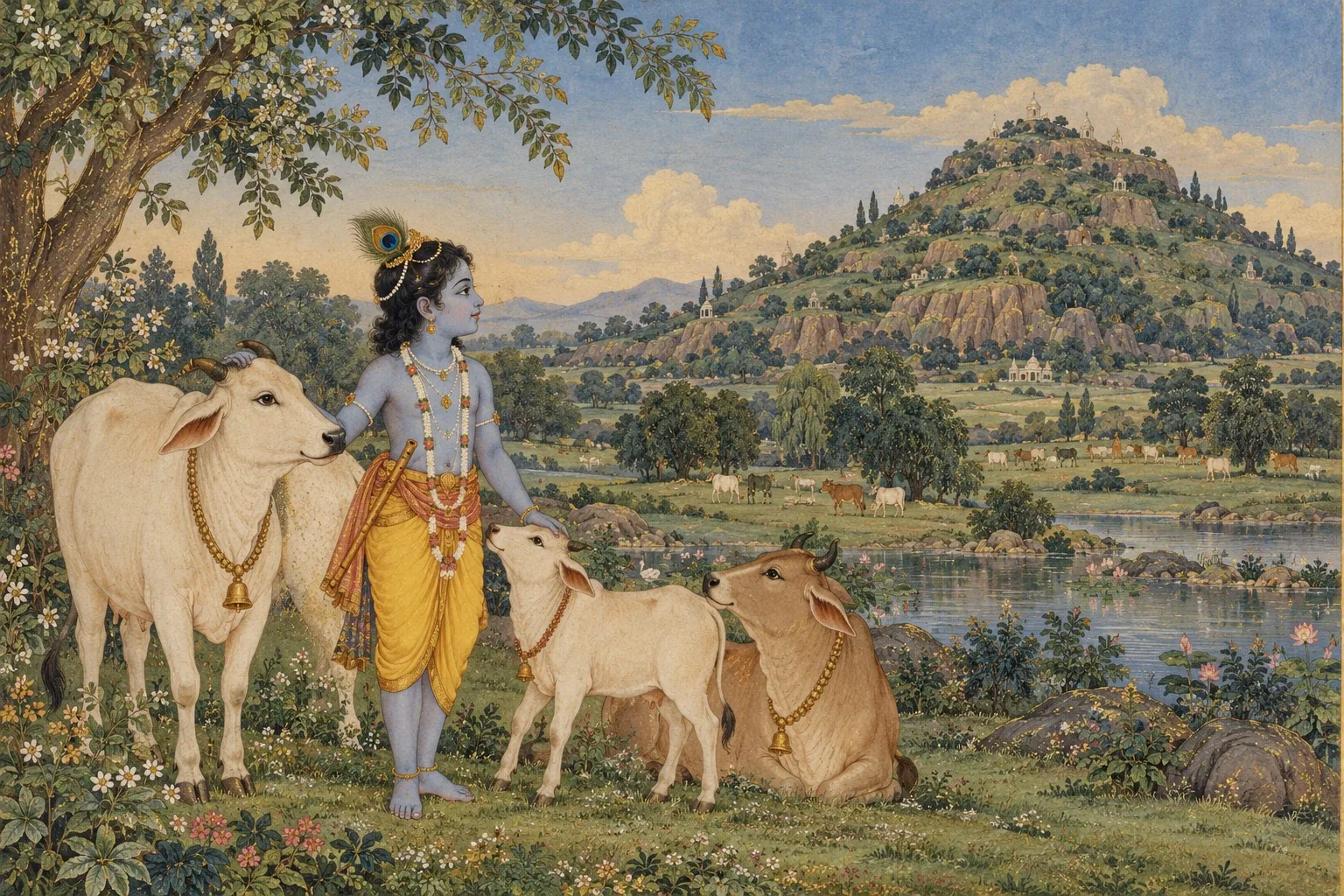
A question for the elders
The cowherds are preparing a ceremony for Indra when Krishna asks Nanda to explain it. Nanda speaks of rain: it nourishes the land and sustains the lives that depend on it. The offering expresses the community’s gratitude.
Krishna asks them to consider their own work and surroundings—the care of cows, the forests and the hills. He proposes directing the preparations toward the cows, the brahmanas and Govardhana. In the Bhagavata’s account, his purpose also includes correcting Indra’s pride.
The Govardhana offering
Nanda and the elders accept Krishna’s proposal. Food is prepared, sacred invocations are offered, people are fed and grass is given to the cows. The community goes around Govardhana with its cattle; voices of blessing mingle with song.
Then Krishna manifests an immense form, identifies himself with the hill and receives the offerings. Still among the cowherds in his familiar form, he joins them in bowing before Govardhana. The episode presents their worship as an encounter with divine presence, not simply a change in the ceremony’s destination.
Indra’s storm
Indra hears that his ceremony has been set aside. Anger overtakes him. Mistaking Krishna for an ordinary child, he sends the destructive Samvartaka clouds against Vraja.
Rain, hail and fierce winds overwhelm the pastures. People shiver in the cold; cows try to shield their calves. The familiar landscape becomes a place of danger, and the community turns to Krishna for protection.
Krishna understands who has sent the storm. His answer will protect those who seek him and expose the limits of Indra’s claim to supreme power.
Beneath the lifted hill
Krishna lifts Govardhana with one hand. The Bhagavata describes the act as effortless: the weight of the hill does not diminish his freedom or calm.
He calls the people to come beneath it with their cows. They need not fear that the hill will fall, nor remain exposed to the wind and rain. Beneath Govardhana there is room for the community—its cattle, wagons, attendants, priests and households.
The shelter gathers them together. What had received their offerings now forms a roof above them, upheld by the child toward whom they have turned.
Seven days of protection
For seven days Krishna stands holding the hill, setting aside hunger, thirst and personal comfort while the people look toward him.
Indra sees that the storm cannot overcome Krishna’s protection. His confidence breaks, and he orders the clouds to withdraw. The sky clears. Krishna tells the community that it is safe to leave; they gather their belongings and cattle and emerge from beneath the hill.
He returns Govardhana to its place. Relief becomes affection: his family and neighbours greet him, embrace him and offer their blessings.
The villagers’ wonder
After the danger passes, the cowherds bring their questions to Nanda. How can a seven-year-old hold a mountain? They remember other astonishing deeds and the affection that draws them to Krishna.
Nanda recalls what the sage Garga had told him: the child bears many names and forms, brings wellbeing to Gokula and protects those who love him. His qualities and power are likened to Narayana’s.
The villagers receive Nanda’s words with joy. Wonder does not remove their closeness to Krishna. The divine mystery stands within the relationships through which they already know him.
Indra returns
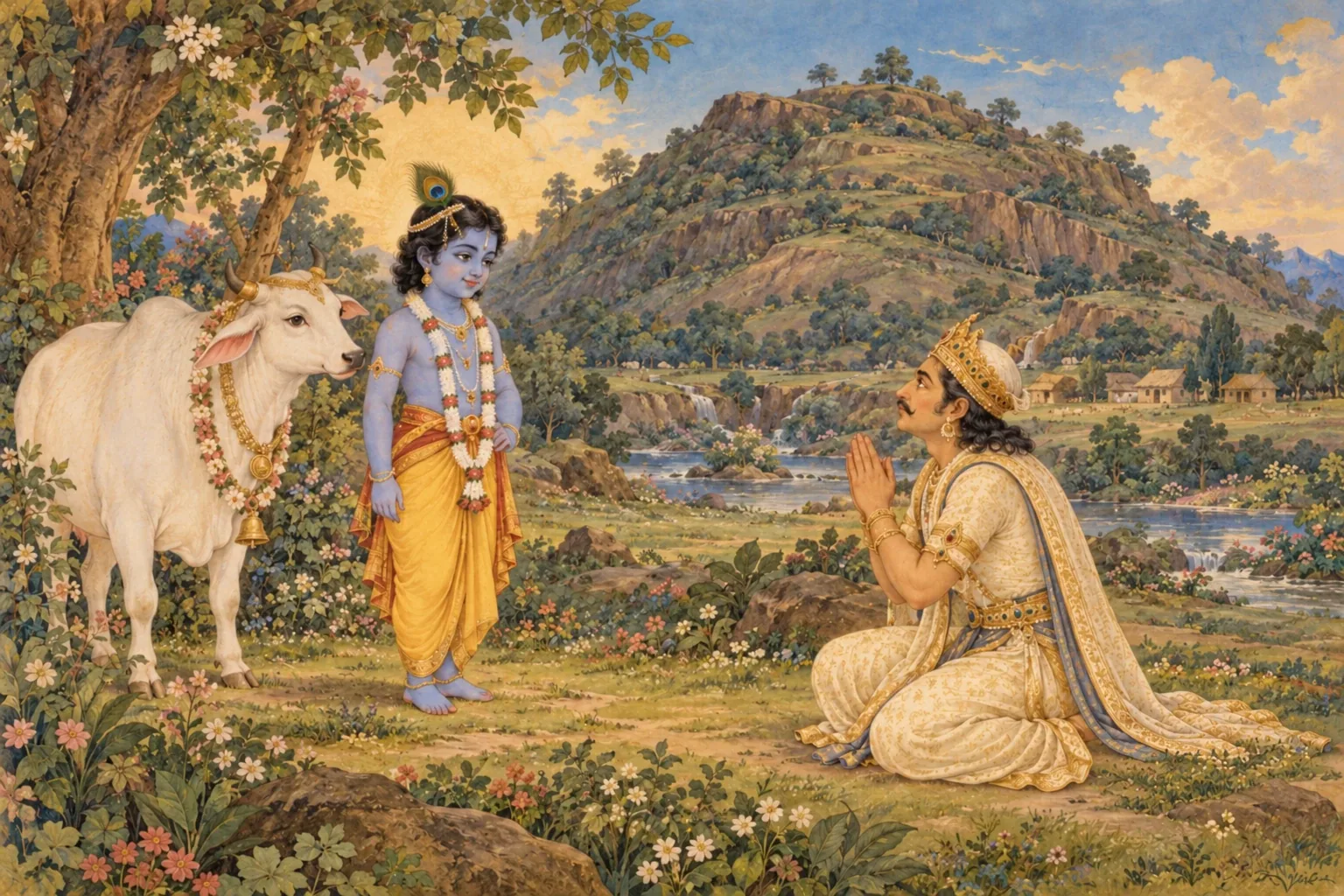
Indra comes before Krishna with Surabhi. Ashamed of his attack, he bows and acknowledges how pride in his authority had blinded him. He asks forgiveness.
Krishna explains the correction as an act of mercy. Indra’s office does not make him independent of the divine source of his power. He may return to his appointed responsibility, but must carry it without arrogance.
The encounter ends the conflict through recognition and a changed understanding of duty. Indra is sent back to serve, rather than encouraged to repeat his display of power.
The name Govinda
Surabhi honours Krishna as the protector upon whom the cows and the wider world depend. She requests a ceremonial bathing.
Surabhi offers her milk; Indra anoints Krishna with heavenly Ganga water brought by Airavata, his elephant. In this celebration Krishna receives the name Govinda. Celestial beings sing and scatter flowers.
The episode closes with peace and renewed abundance. Indra receives permission to return to heaven. The power that frightened Vraja has been recalled to its proper service, and Krishna’s protection has become the centre of the celebration.
EDITORIAL REFLECTION / PAUSE & REFLECT
Power that protects.
Responsibility without pride.
Who benefits from the authority we hold? This story invites a pause before treating respect as something we are owed. What would it mean to measure our influence by the care, safety and trust it creates?
TRADITIONS & INTERPRETATION
Following the Bhagavata’s account
This reader follows the Bhagavata Purana’s Krishna-centred devotional narrative. Simplified spellings and condensed prose keep the sequence readable. The account of Indra’s correction is not a blanket rejection of worship or gratitude. The reflection above is editorial, distinct from the scripture.
The newly commissioned paintings are AI-generated devotional interpretations. Their landscapes and figures illustrate the narrative; they are not historical photographs or exact reconstructions of Vraja.
Read the chapter references and edition notes