
A kingdom without care
King Vena turns authority toward himself. He forbids the rites and gifts by which the people understand their obligations, and he refuses the sages’ repeated counsel. When his conduct will not change, the sages end his rule.
But the absence of a ruler does not by itself restore justice. Theft spreads, dust rises from the roads and the people lose the security by which ordinary life can continue. The realm has learned two dangers at once: power without responsibility, and responsibility left without any power to uphold it.
A ruler brought forth
The sages first draw Vena’s accumulated wrongdoing away through a dark, small figure named Nishada. They then churn Vena’s right arm. From it appears Prithu, radiant and marked for royal responsibility.
A divine bow, armour and arrows accompany his appearance. Rivers, oceans, mountains and the divine assembly bring gifts for his consecration. Prithu’s authority is not described as private possession: the whole realm participates in placing a duty upon him.
Praise must be earned
The bards Suta and Magadha are asked to celebrate the new king. Prithu stops them. His deeds have not yet been seen, he says, so how can they truthfully praise qualities that remain untested?
The sages tell the bards to describe the virtues toward which his reign should grow. They speak of truth, generosity, equal regard, protection and the honouring of worthy conduct. Praise becomes a public standard rather than flattery: a ruler must become answerable to the qualities proclaimed in his name.
The Earth withholds her gifts
The people approach Prithu in distress. Their food and sustaining herbs have disappeared into the Earth. They ask the new king for the means to live.
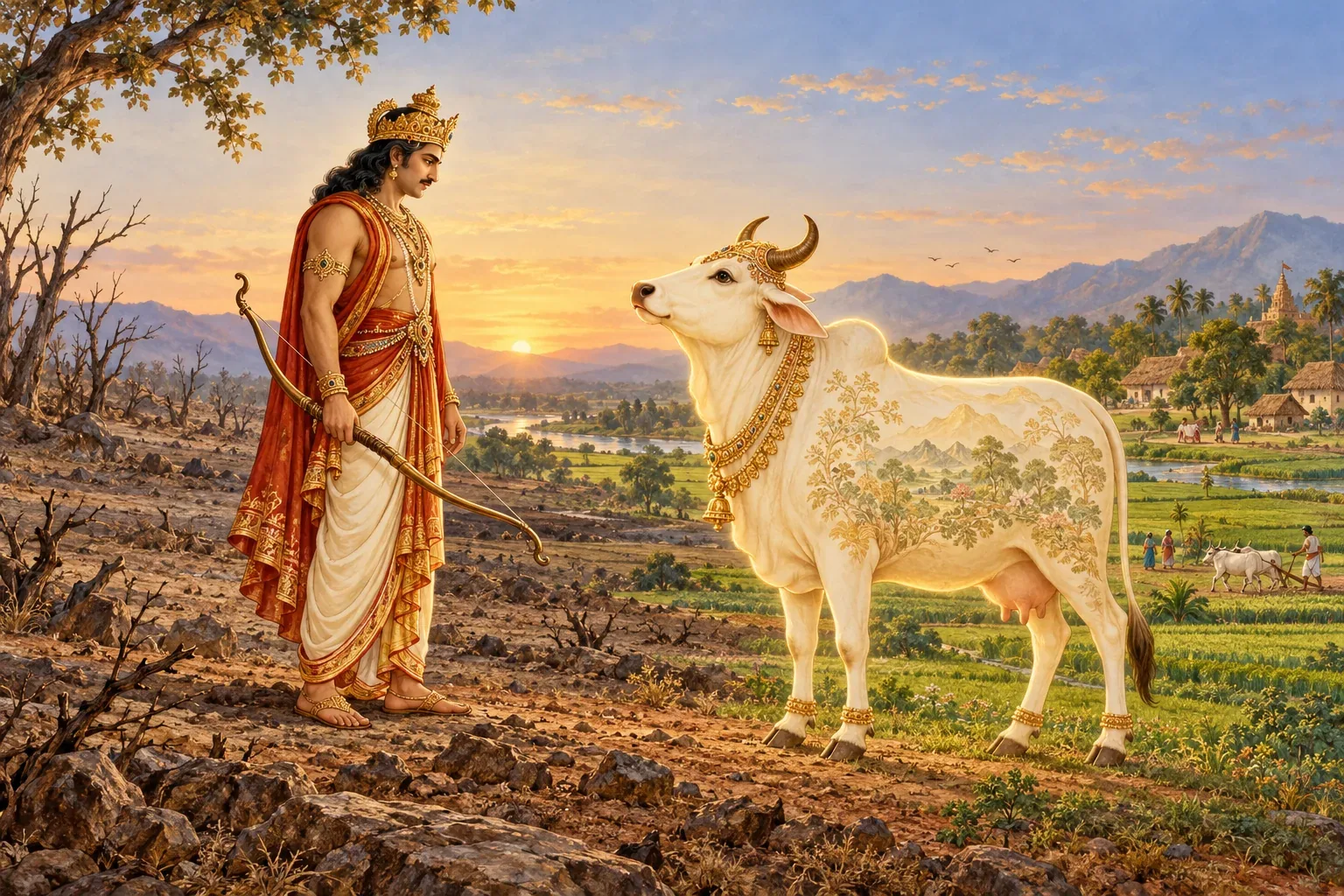
Prithu takes up his bow and pursues the Earth, who assumes the form of a cow and moves through the worlds. The chase makes the crisis visible, but it does not resolve it. When there is nowhere left to flee, Mother Earth turns and speaks.
She asks whether the king, who claims to protect living beings, can protect them by destroying the very ground that bears them. The welfare of the people and the welfare of the Earth cannot finally be separated.
A pursuit becomes a dialogue
Prithu answers from the urgency of a hungry kingdom. A ruler, he argues, cannot ignore harm to many. Yet Mother Earth’s warning changes the direction of his power: force alone would remove the support on which every life depends.
She offers another path. Level the broken ground, choose a calf and a vessel, she says, and I will yield what has been hidden. Her abundance is neither seized without limit nor released without conditions. It returns within a relationship of preparation, restraint and care.
Protection becomes agreement
Prithu lays out the land, breaking and relocating the great stones with the end of his bow. The supplied text presents this as the beginning of ordered villages, fields, herding, agriculture and commerce where settlement had previously been uneven.
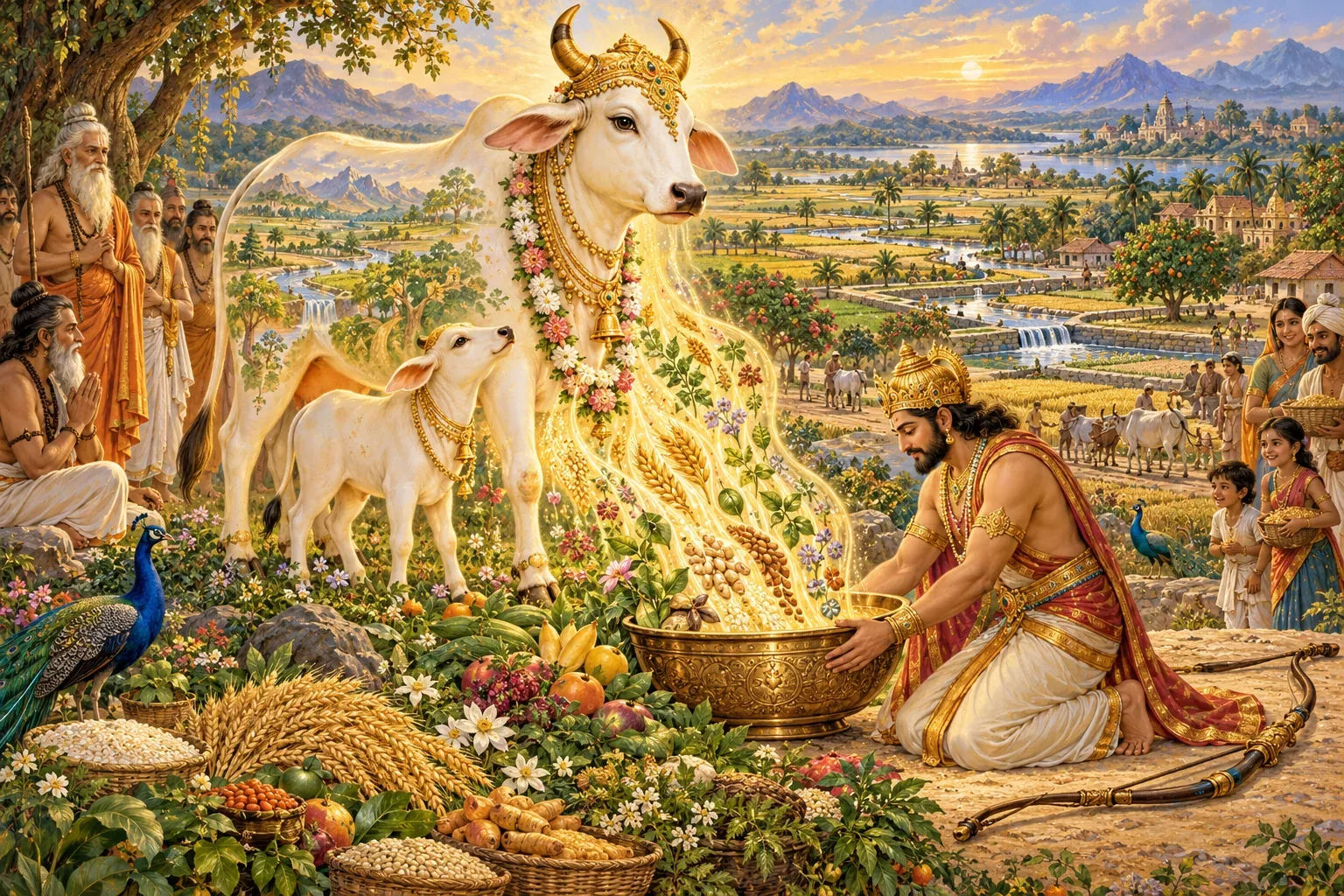
He appoints Swayambhuva Manu as the calf. Using his own hand as the vessel, he draws forth seeds, medicines and the nourishment on which the people depend. The Purana’s cow-and-milking image turns the recovery of food into a sacred exchange between ruler, people and Earth.
The ground of prosperity
Food returns, settlements take shape and the people regain a stable way of life. The narrative says that Prithu accepts the Earth as his daughter. From that bond she receives the name Prithvi.
Prosperity here is not simply wealth appearing at a king’s command. It grows from truthful standards, protection of the vulnerable, prepared land, shared labour and respect for the source of nourishment.
Prithu’s bow remains part of the story, but its most enduring work is not the threatened arrow. It is the ordering of the ground and the acceptance of a duty that power cannot escape.
EDITORIAL REFLECTION / PAUSE & REFLECT
A flourishing realm begins
with what it refuses to exhaust.
What changes when prosperity is understood not as taking more from the Earth, but as protecting the relationships that allow life to renew?
KINGSHIP & STEWARDSHIP
Authority is measured
by the life it makes possible.
In the supplied Vishnu Purana, the Earth literally takes the form of a cow; Prithu pursues her, hears her case, levels the ground and draws forth seeds and herbs with Manu as the calf. The page preserves that sacred narrative sequence.
Reading the episode as an invitation to ecological stewardship is an editorial reflection for contemporary readers. It does not turn the Purana into a modern policy text. The story’s own images nevertheless place a limit on kingship: a ruler cannot secure the people by destroying their support.
Details of how Earth is milked, who serves as calf and what different beings receive vary across Puranic tellings. This reader follows the supplied Vishnu Purana chapter rather than silently combining those lists.
The paintings are contemporary devotional interpretations. Clothing, landscape, settlements and the visual flow of grain are imagined; they are not archaeological reconstructions or literal diagrams of the text.
Read the supplied-edition references