
An insult in the assembly
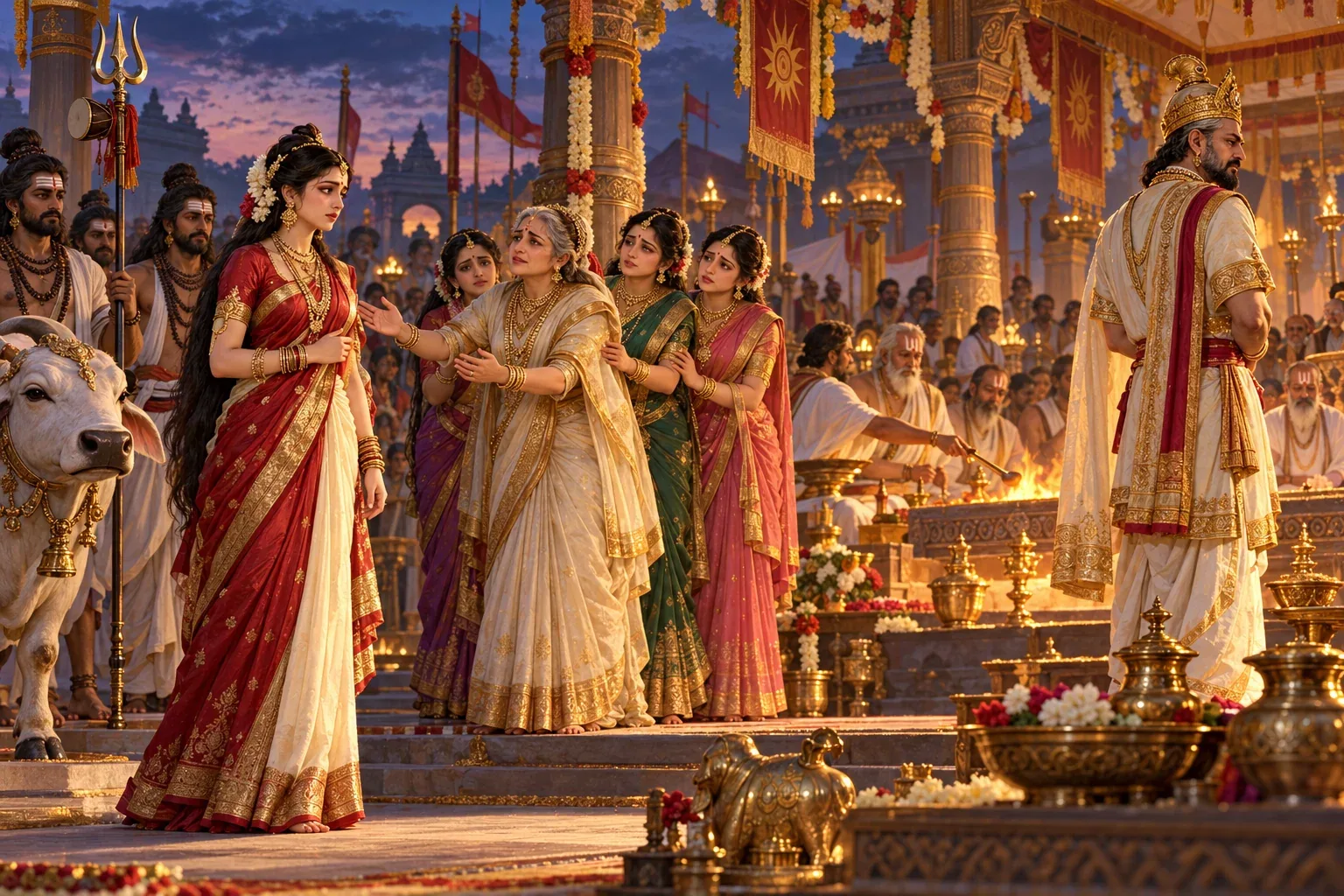
At an earlier gathering of sages and divine leaders, Daksha enters with the authority of a Prajapati. Nearly everyone rises. Brahma remains seated because of his senior place; Shiva remains seated in self-possession.
Daksha reads Shiva’s stillness as a personal humiliation. Before the entire assembly he attacks Shiva’s appearance, habits and fitness as a son-in-law. He then declares that Shiva will receive no share in sacrificial offerings.
Shiva does not answer the abuse. Yet angry curses are exchanged by followers on both sides, and the unresolved hostility leaves the hall with Daksha.
A sacrifice built on exclusion
Time passes. Daksha is elevated among the Prajapatis and arranges a magnificent yajna. Sages, devas, ancestors and their families travel toward the ceremony in splendour.
The invitation reaches neither Shiva nor Sati. The omission is not an accident of distance or protocol. It carries forward Daksha’s hostility and turns a sacred gathering into a public statement about who will not be honoured.
From Kailasa, Sati sees the travellers crossing the sky and learns that they are going to her father’s house. Memory, affection and hope pull her toward the family she has not ceased to love.
Sati wishes to return
Sati asks Shiva to accompany her. A daughter, she says, may visit the home of her parents even without a formal invitation. Her sisters and relatives will be there, and she longs to see her mother and birthplace.
Shiva recognises the ordinary truth in her words, but warns that affection cannot make a hostile house safe. Pride in learning, wealth, beauty or status can turn good qualities into blindness. The words of a relative, he tells her, can wound more deeply than an enemy’s weapons.
He foresees that Daksha will not honour her because she is Shiva’s wife. Torn between the warning and her longing to return, Sati finally leaves with Shaiva attendants.
No welcome, no share
At the yajna, Sati’s mother and sisters receive her with tears and affection. Most of the assembly remains silent from fear of Daksha. Daksha himself neither greets his daughter nor asks after her wellbeing.
Sati sees that the offerings contain no share for Shiva. The absence makes visible what the invitation had already declared: the rite has been shaped to exclude him.
Shiva’s attendants move to defend her, but Sati stops them. She chooses to speak for herself. Before the assembly she names the envy beneath her father’s judgment and praises Shiva as one who finds and enlarges even a little goodness in others.
Sati’s final resolve
Sati declares that she will no longer carry the body received through the father who has dishonoured Shiva. She sits facing north, purifies herself and turns inward through yogic concentration.
The Bhagavata describes an inner fire arising through that discipline. Holding Shiva in her mind, Sati relinquishes her body. The website does not illustrate the moment and does not present it as conduct to imitate; it belongs to the Purana’s sacred narrative of divine figures.
The assembly erupts in grief and astonishment. A daughter’s final protest reveals the full human and cosmic cost of the contempt that the ceremony had tried to normalise.
Virabhadra and the broken yajna
Narada brings the news to Shiva. Grief becomes terrible anger. Shiva tears a lock from his matted hair and casts it down; from it rises Virabhadra, immense and fierce, ready to carry his command.
Virabhadra and Shiva’s followers reach the arena in a storm of dust. They tear down pillars, scatter the priests and extinguish the fire. The Bhagavata gives violent details; this retelling keeps the outcome without dwelling on injury. Daksha is killed and the sacrifice is left unfinished.
The destruction mirrors the exclusion at the rite’s foundation. A ceremony that refused relationship cannot preserve its outer order once its hidden hostility is exposed.
Brahma seeks Shiva’s mercy
The surviving participants go to Brahma. He tells them that a sacrifice cannot bring happiness while its makers insult and exclude a great being. Completion now requires humility rather than another display of ritual power.
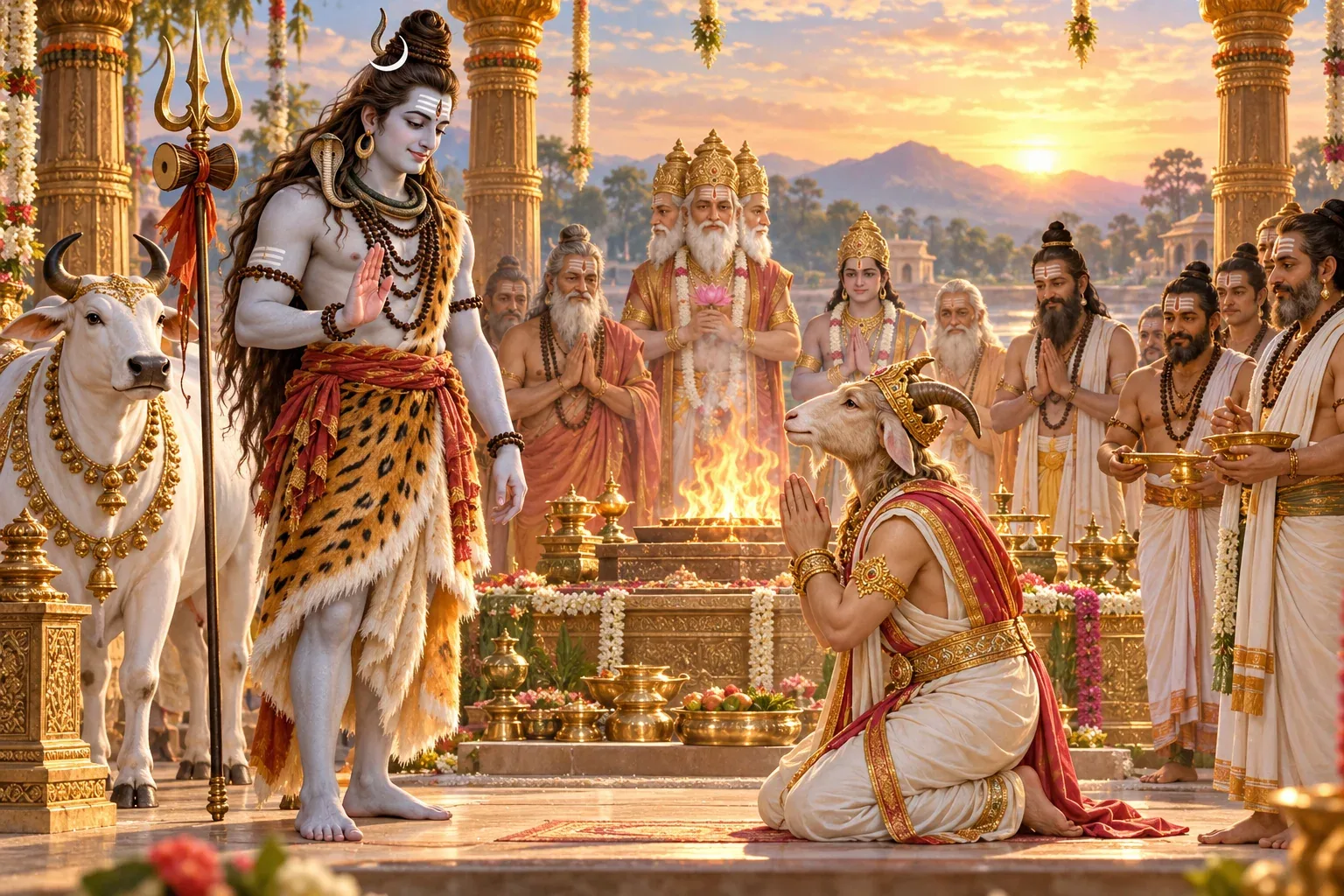
Brahma leads the devas and sages to Kailasa. Beneath a vast banyan tree they find Shiva no longer consumed by anger. He sits among sages, holding rudraksha beads and speaking about ultimate reality.
When Brahma arrives, Shiva rises and bows. The gesture answers Daksha’s earlier accusation more clearly than argument could. Brahma asks him to restore those who were harmed and allow the yajna to be completed.
Daksha restored
Shiva agrees. He does not deny the offences, yet he refuses to make anger the final word. Daksha is restored with the head of the sacrificial goat, and others receive remedies for their injuries.
When Daksha awakens and sees Shiva, envy leaves him. Remembering Sati, he is overcome by grief. He admits that his sharp words arose from ignorance and asks for mercy. Shiva accepts the reconciliation.
The yajna resumes with Shiva’s rightful share restored. The Bhagavata then describes Narayana appearing as the sacrifice reaches completion. The ending does not erase Sati’s loss; it shows pride giving way to recognition, pardon and a reordered sacred community.
EDITORIAL REFLECTION / PAUSE & REFLECT
A rite cannot become sacred
by hiding contempt.
What do our ceremonies, institutions and families communicate through exclusion? This story asks whether outward correctness can carry meaning when respect, relationship and humility have been removed from within.
TRADITIONS & INTERPRETATION
Following the Bhagavata’s sequence
This reader follows Bhagavata Purana 4.2–7, a Vaishnava Puranic account in which Shiva is honoured as the great yogin and Narayana appears when the restored yajna is completed. The Shiva Purana and other traditions arrange some events and theological emphases differently; those versions are not blended into this page.
Sati’s relinquishing of her body is presented non-graphically as a singular event within sacred narrative, not as an example for personal action. Virabhadra’s assault is likewise condensed. The reflection above is editorial, and the paintings are devotional interpretations rather than historical records.
Read the verse groups and edition notes