
A promise amid Taraka’s shadow
Taraka’s power has become a burden upon the devas. A boon protects him from every expected opponent: the one destined to overcome him must be a son of Shiva.
Yet Shiva has lived apart in the stillness of the great yogin. Parvati’s long tapas and their marriage have joined ascetic power with the life of relationship, but the promised child has not appeared. The devas wait between fear and hope.
The story therefore begins before the birth itself. Kartikeya’s arrival will answer a crisis, but the Purana first presents him as the fruit of Shiva and Parvati’s divine union—not merely as a weapon made for war.
The gods come to Kailasa
As Shiva and Parvati remain together on Kailasa, the power of their union shakes the worlds. Brahma, Vishnu and the devas approach the mountain, their prayers mingling with cries for protection from Taraka.
Shiva hears them. He steps forward and asks what must be done. The devas explain their need, and an immeasurable golden radiance issues from him. No ordinary body or place can contain it.
The scene is not presented as an ordinary human birth. It is sacred cosmology: divine energy moves through fire, mountain, river and living care until it can take visible form.
Agni carries the radiance
Agni assumes the form of a dove and takes in Shiva’s radiance. Even the deity of fire cannot bear its intensity for long. Afflicted by its heat, he seeks Shiva’s guidance.
The radiance passes onward. Six wives of the celestial sages approach Agni’s warmth after bathing in the cold season. Arundhati warns them away, but the other six draw near. Through the Purana’s divine agency, each becomes a bearer of a portion of the power.
Their husbands misunderstand what has happened and reject them. The six women, distressed by both the radiance and the accusation, carry it to the summit of Himavat. The story’s future foster mothers first meet the child’s destiny through an ordeal not of their choosing.
From mountain to river
Himavat cannot contain the blazing force. The mountain gives it to Ganga, whose waters receive what fire and stone could not hold.
Ganga bears the radiance through her current and carries it toward a forest of sara reeds. River, mountain and fire each become part of the child’s sacred geography. The Purana later remembers these connections in his many names.
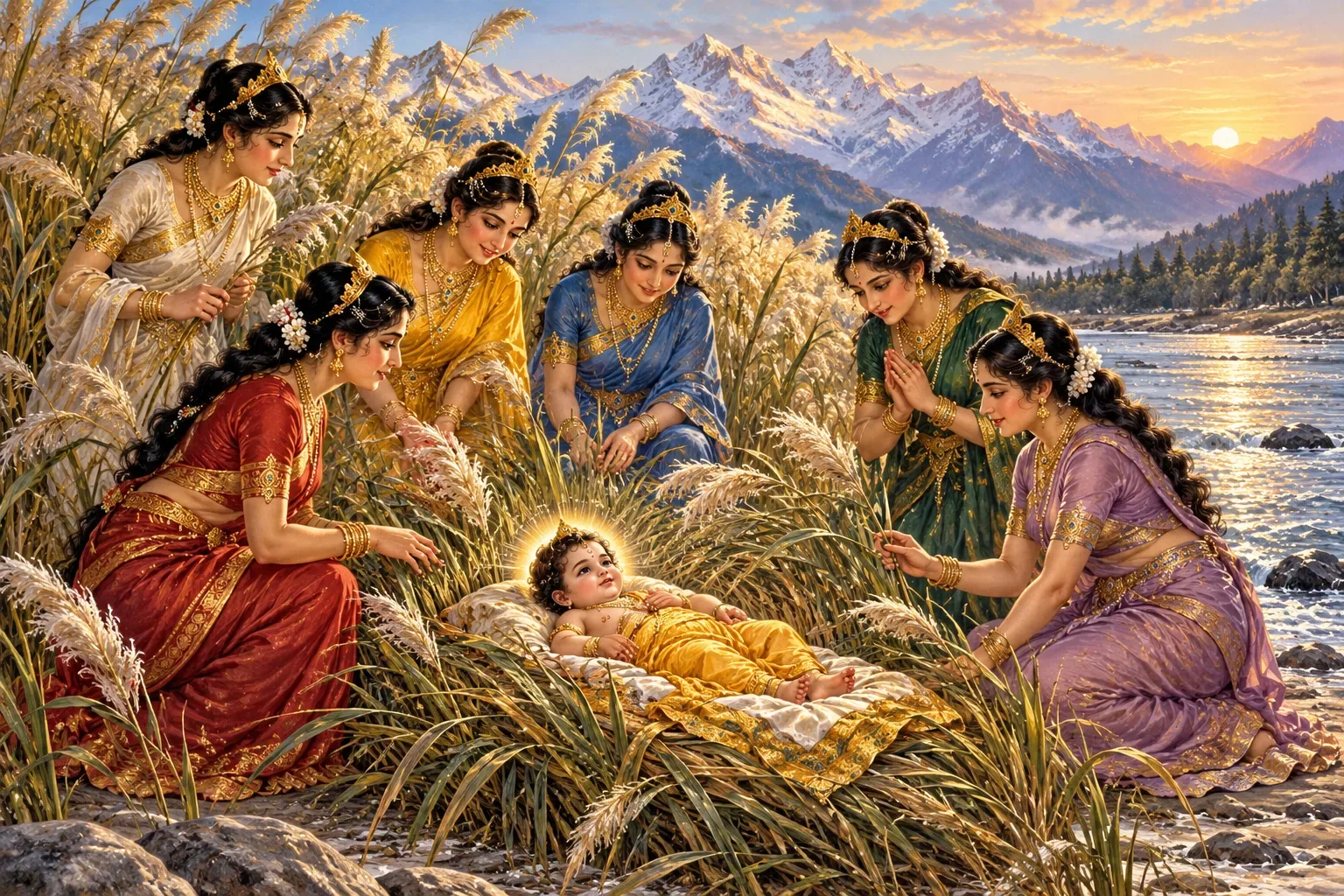
At the riverbank, the radiance settles among the reeds. What has travelled across the elements is now ready to become a child.
Born among the reeds
In the sara forest beside Ganga, the divine radiance takes the form of a beautiful boy. The Shiva Purana places his birth on the sixth lunar day and describes joy spreading through all three worlds.
Celestial drums sound without visible hands. Flowers descend. Shiva and Parvati feel the happiness of the moment even before the child has been brought to Kailasa.
The reeds do not hide an abandoned child. They form a sanctuary where cosmic power becomes vulnerable, visible life—Kumara, the youth; Guha, the hidden one; Gangeya, connected with Ganga; and Sharavana, born among the reeds.
Six mothers, six faces
The six Krittikas come upon the radiant boy. Each longs to feed and care for him. Rather than choose one mother and refuse the others, the child reveals six faces and receives nourishment from all six together.
Because the Krittikas foster him, he becomes Kartikeya. The sixfold form is remembered as Shanmukha, the six-faced one. His identity holds several relationships at once: Shiva’s radiance, Parvati’s son, Ganga’s child and the beloved foster-son of six mothers.
As he grows, the Purana gives him extraordinary knowledge and strength. Vishvamitra performs his rites, Agni gives him the spear, and the child’s early deeds reveal a power greater than his youthful form suggests.
Nandin comes for Kumara
Parvati asks where Shiva’s unfailing radiance has gone. The devas, the elements and the Krittikas recount its passage until the child is found. Shiva sends Nandin and a great company of ganas to invite Kartikeya to Kailasa.
The Krittikas fear that they will lose the son they have raised. Kartikeya answers them with reverence. He does not deny their motherhood; he assures them that the divine source within all beings remains the deeper ground of every bond.
He agrees to return, and the Krittikas accompany him. Homecoming does not erase foster care. The child travels toward Shiva and Parvati with the mothers who protected his first days still beside him.
Homecoming and consecration
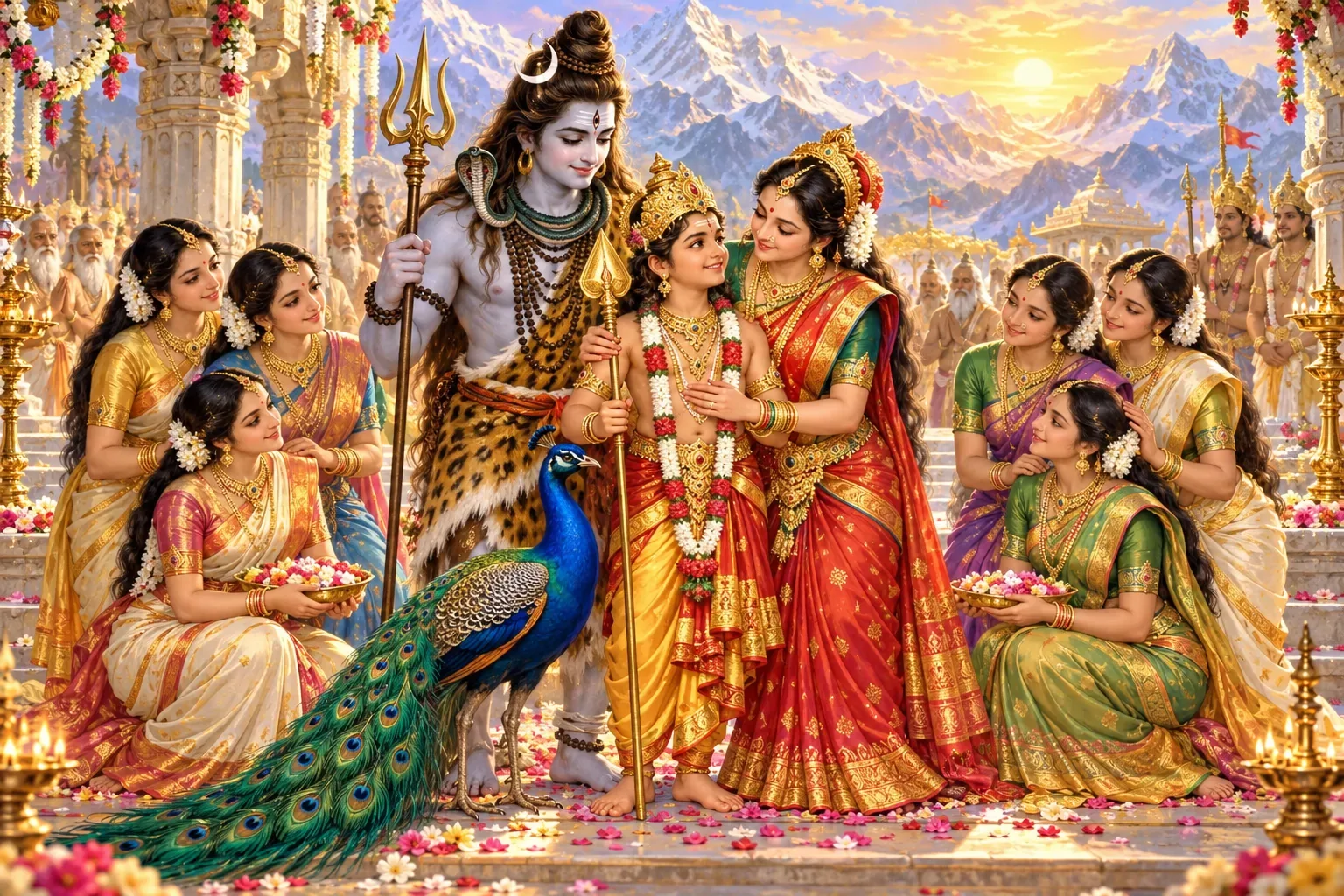
Kailasa becomes a place of welcome. Music, flowers and lamps fill the road. Kartikeya steps down from the chariot and bows; Shiva embraces him, and Parvati receives him with overwhelming joy.
The gods and goddesses bring gifts. Sacred waters are gathered for his consecration. Agni gives the spear associated with his protective power, while Shiva, Vishnu, Brahma and the assembled devas honour the young guardian.
He is entrusted with command because the worlds need courage guided by wisdom. The battle with Taraka belongs to the chapters that follow; this page ends at the threshold of that mission—with a child born through many bearers, welcomed by many forms of love and called to use strength in protection.
EDITORIAL REFLECTION / PAUSE & REFLECT
Belonging can hold
more than one kind of love.
Kartikeya’s story remembers divine parents, foster mothers, fire, mountain, river and reeds without reducing one bond to another. Who helped carry, protect or guide us before we could name what they had given?
TRADITIONS & INTERPRETATION
Following the Shiva Purana’s sequence
This reader follows Kumara Khanda 1–5: the devas’ appeal, Agni’s burden, the six Krittikas, Himavat, Ganga, the reed forest, Kartikeya’s early life, Nandin’s invitation and the consecration at Kailasa. The Skanda Purana, Mahabharata, Ramayana and regional Murugan traditions preserve important alternative arrangements and emphases; they are not blended into this page.
The Purana uses embodied reproductive language for divine radiance. The main story condenses that language without hiding the source note. The homecoming painting uses a single youthful face for visual clarity; the text explicitly preserves Kartikeya’s six-faced Shanmukha form. All three paintings are devotional interpretations, not historical reconstructions.
Read the chapter references and edition notes