
An unfinished duty
Searching for their father Sagara’s missing sacrificial horse, his sons find it near the sage Kapila. They accuse him of taking it and rush toward him. Kapila’s fierce response reduces them to ashes.
Sagara sends his grandson Anshuman to discover what happened. He finds the horse and mourns his kinsmen. Garuda tells him that ordinary water will not suffice for their ancestral rites: the waters of the Ganga must reach their ashes. Anshuman returns with the horse, but the greater task remains.
A quest across generations
Anshuman later becomes king. After entrusting the kingdom to his son Dilipa, he undertakes austerities, but the Ganga does not descend during his life. Dilipa also carries the concern for the ancestors without finding its fulfilment.
His son Bhagiratha inherits the kingdom and the unresolved hope. The narrative’s quest has outlasted those who began it.
The king’s austerities
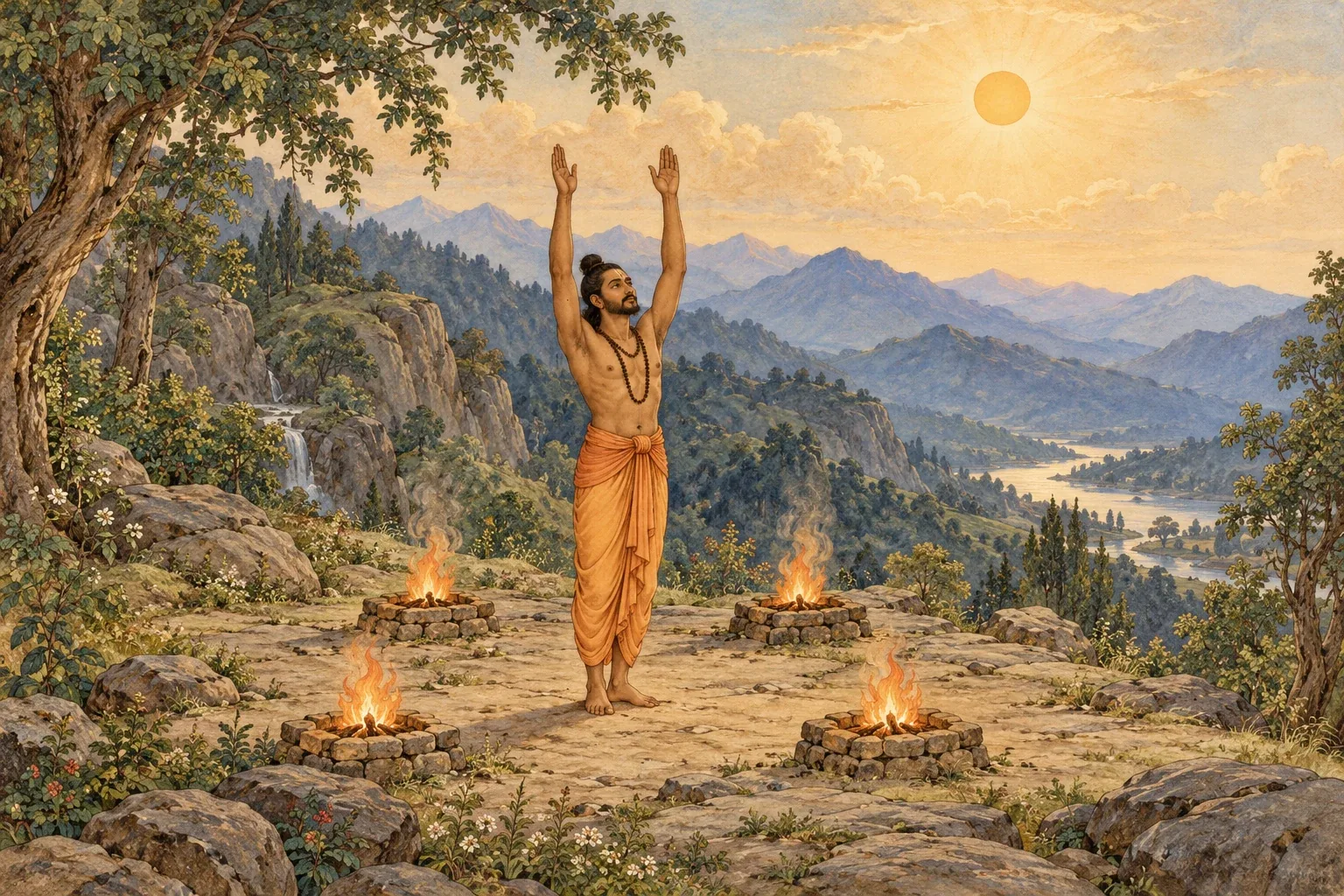
Bhagiratha leaves the kingdom in his ministers’ care and practises sustained austerities at Gokarna. He stands with raised arms amid the five fires, the sun above and four fires around him.
Brahma appears and offers a boon. Bhagiratha asks that the Ganga’s waters reach Sagara’s sons, allowing them to attain heaven. Childless himself, he also asks that his lineage continue.
The one who can receive
Brahma agrees, but the earth cannot withstand the falling river. Only Shiva can bear her force. Bhagiratha turns to him in renewed austerity.
Shiva is pleased and agrees to receive the Ganga upon his head. The promise of descent now has a receiving presence.
A descent held in stillness
The Ganga plunges down, intending to sweep Shiva away. He holds her within his matted locks. She cannot find an outlet.
Bhagiratha again undertakes austerities. Shiva releases her toward Bindu Lake. Seven streams emerge: three flow east, three west, and the seventh follows Bhagiratha.
The river follows
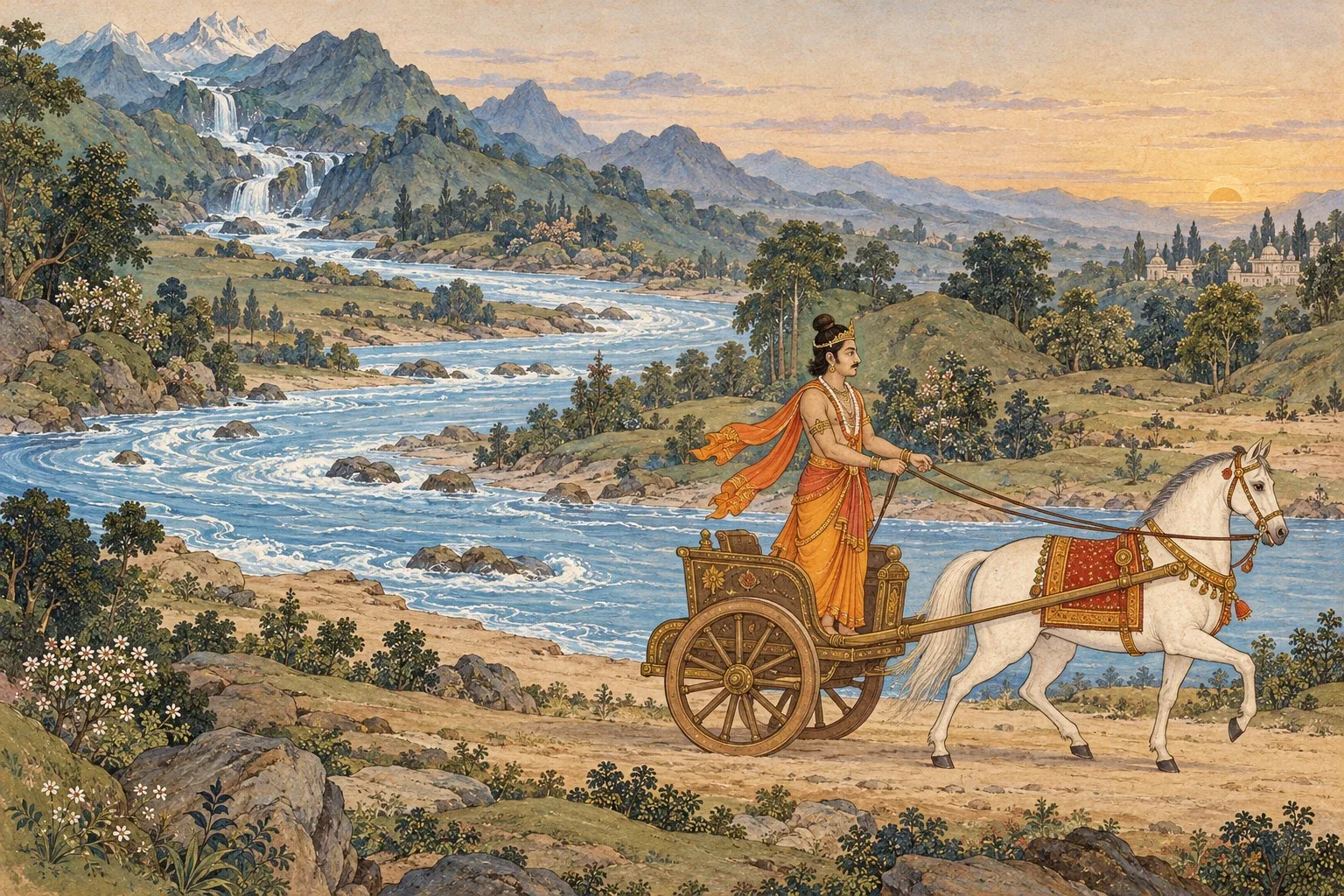
Bhagiratha rides ahead in his chariot; the Ganga follows. Gods, sages and other beings gather to witness her arrival.
The account describes water rushing, winding, rising and slowing across the earth. Those who touch and bathe in it rejoice in its sanctifying power. Bhagiratha continues toward the place of his ancestors.
Jahnu and the river
The river floods the sacrificial grounds of Jahnu. Angered, the sage drinks up her waters.
The gods and sages honour him and ask that the Ganga become his daughter. Pleased, he releases her through his ears. She is therefore called Jahnavi. Her journey behind Bhagiratha resumes.
The vow fulfilled
The Ganga reaches the ocean and proceeds into the netherworld, where Sagara’s sons lie as ashes. Her waters wash over them, and they attain heaven.
Brahma praises Bhagiratha for accomplishing what his predecessors could not. The river will bear the name Bhagirathi, recalling his undertaking. At Brahma’s direction, the king offers water to his ancestors.
With the rites completed, Bhagiratha returns to his capital. Vishvamitra’s telling has brought Rama from an ancestral loss to a vow fulfilled across generations.
EDITORIAL REFLECTION / PAUSE & REFLECT
Effort that endures.
Care that remembers.
Which responsibilities reach us from those who came before? Bhagiratha’s story invites reflection on patient effort, asking for help and carrying a purpose through repeated obstacles. What would it mean to pursue something whose benefit extends beyond our own lifetime?
TRADITIONS & INTERPRETATION
The Ramayana’s account
This reader keeps to Vishvamitra’s telling in the Bala Kanda. It presents the river’s sanctifying power within that devotional narrative. Other textual and regional tellings are not combined here; this is not a scientific account of the river’s geological origins.
The reflection above is editorial. Both illustrations are AI-generated interpretations in imagined landscapes. The five-fire scene evokes the austerities described in sarga 42; the chariot’s design, horse and scenery are artistic choices, not an exact reconstruction of the divine vehicle described in sarga 43.
Read the chapter references and edition notes