
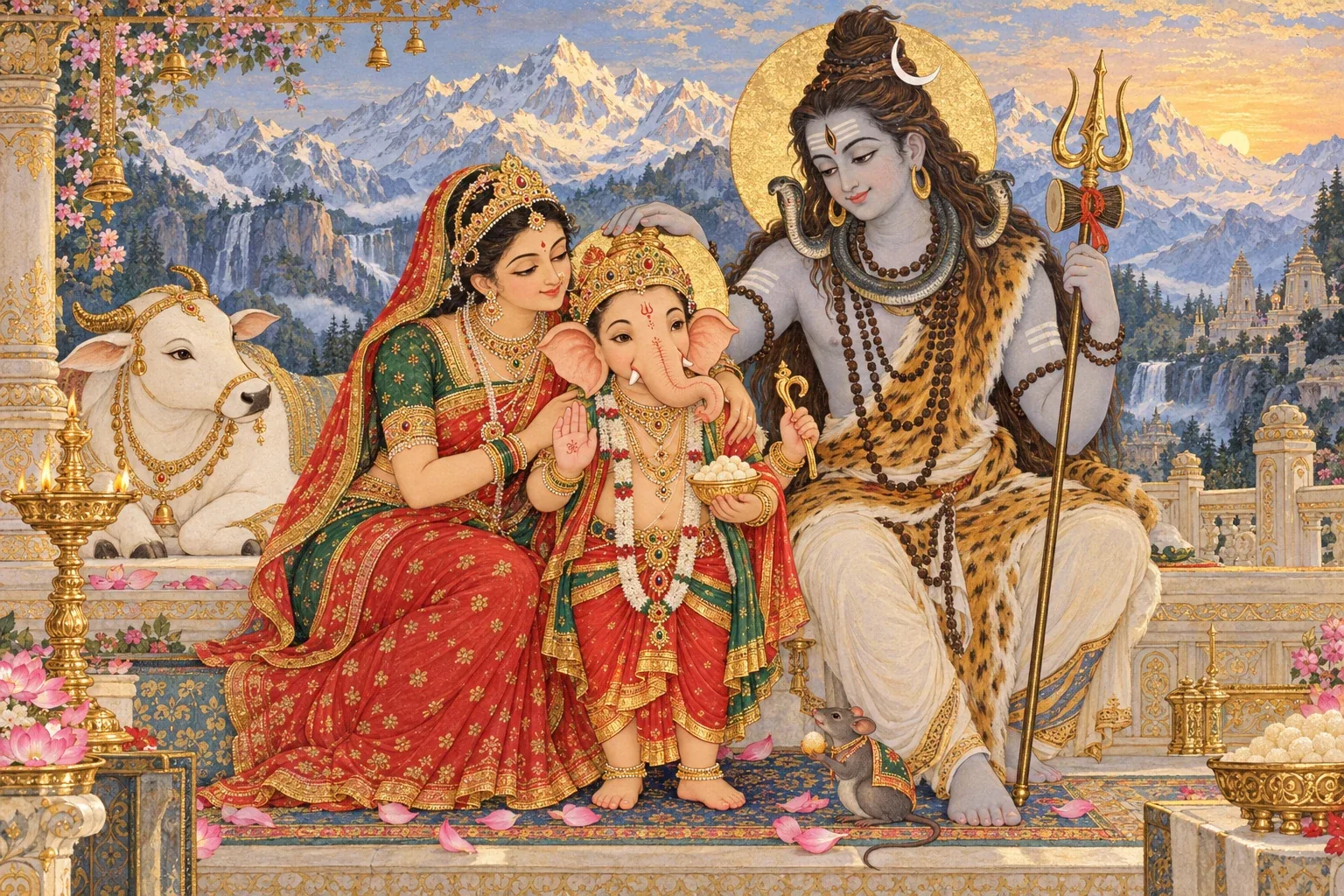
Parvati wishes for her own guardian
On Kailasa, Parvati’s companions Jaya and Vijaya observe that Nandi, Bhringi and the countless ganas serve the household, yet their first allegiance is to Shiva. They suggest that Parvati should have an attendant who answers directly to her.
The thought becomes urgent when Shiva enters while Parvati is bathing, despite Nandi’s place at the door. Parvati is embarrassed. She remembers her companions’ advice and resolves to create someone trustworthy—one who will not move from her command even by a single step.
The story begins with a question of agency inside a shared home. Parvati does not borrow one of Shiva’s attendants. She brings forth a guardian of her own.
A son and a sacred instruction
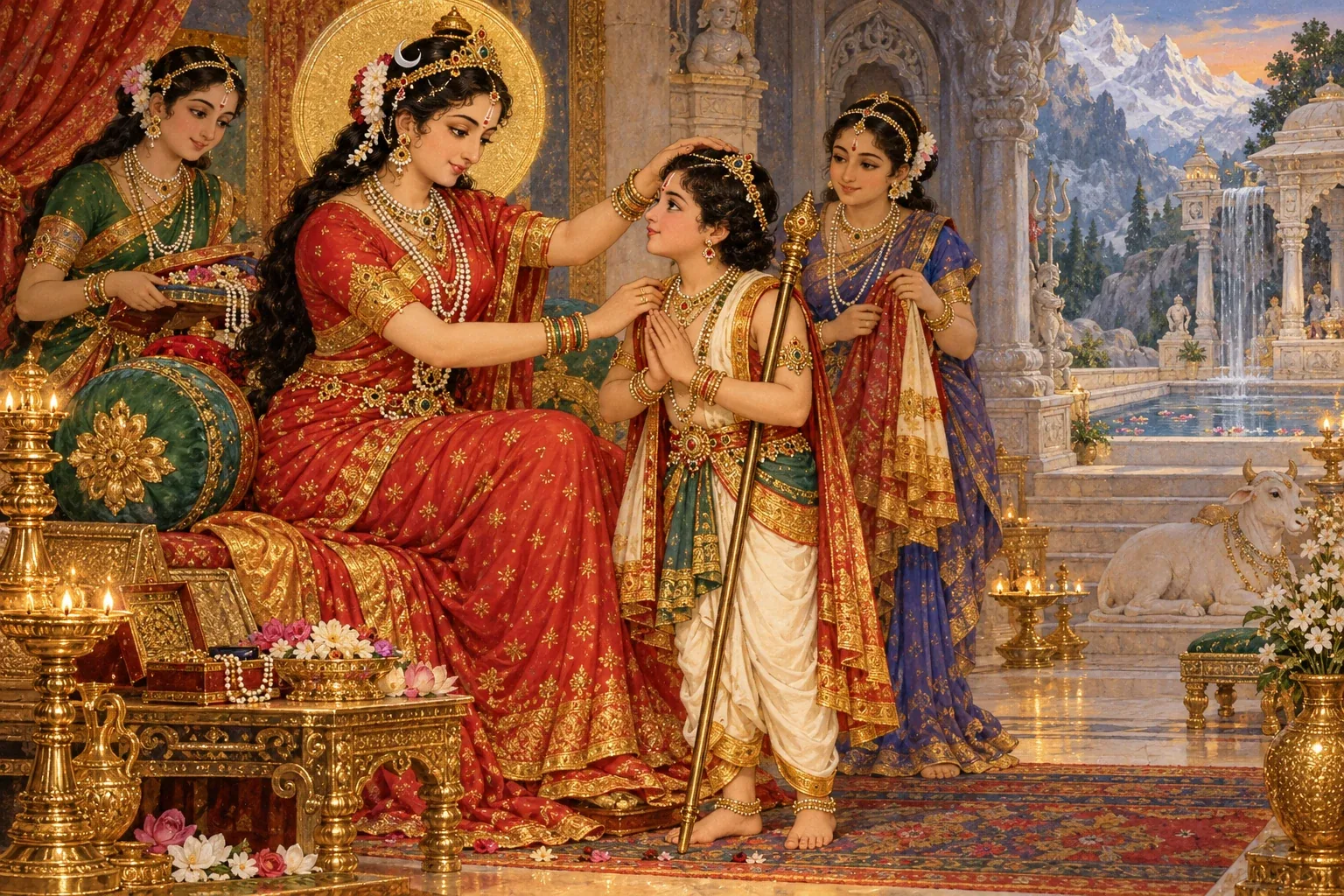
From the substance of her own body, Parvati creates a beautiful, powerful young person, complete in every limb. She dresses him in fine garments, gives him ornaments and blesses him.
Then she tells him the relationship between them: “You are my son.” He bows and asks what task he may perform. Parvati appoints him guardian of her doorway and gives him a strong staff.
Her instruction is exact. No one is to enter without her permission. She embraces and kisses her son, places him at the entrance, and returns to bathe with her companions.
The guardian at the door
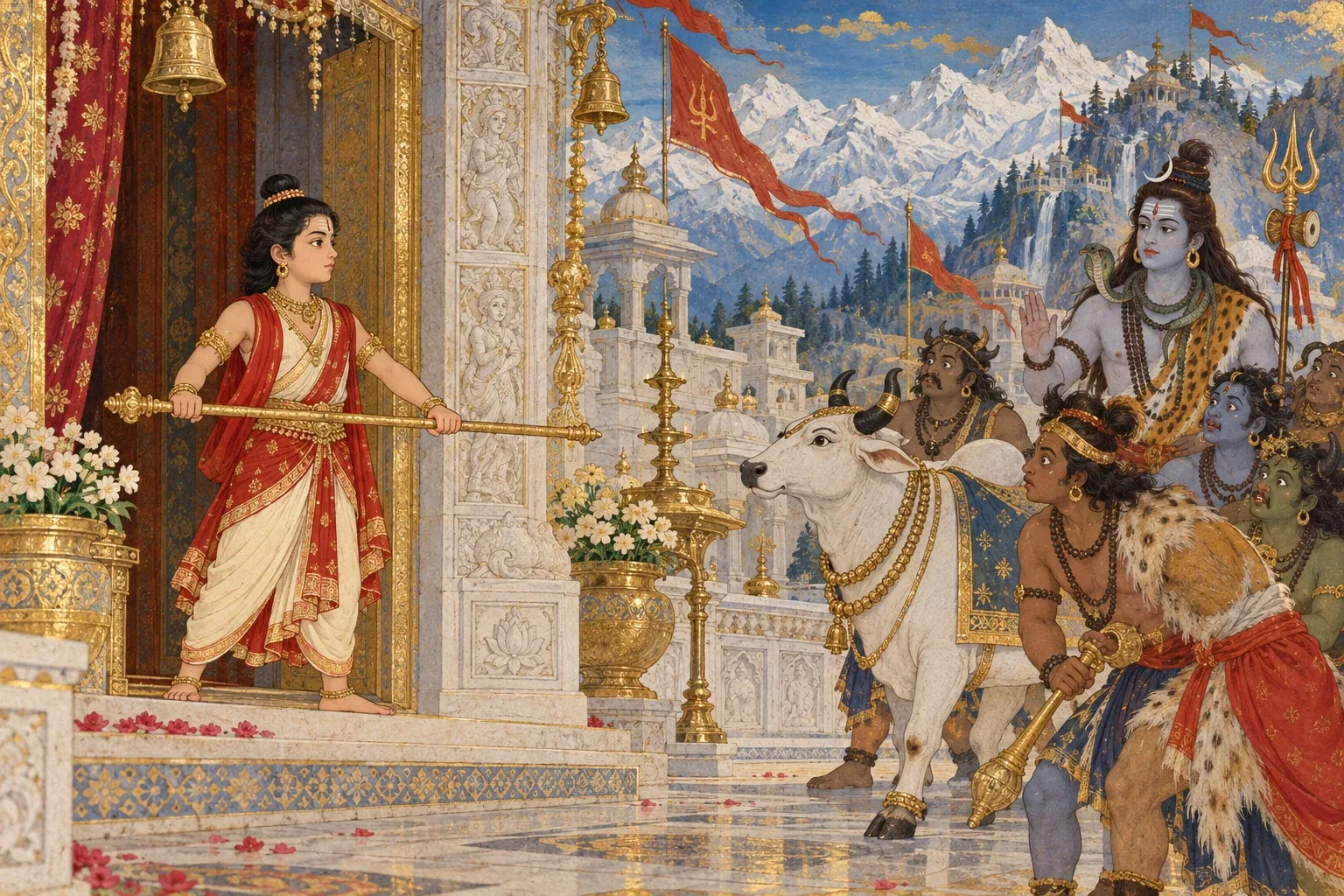
Shiva arrives and moves toward the inner chamber. The young guardian has never met him. Remembering only his mother’s command, he raises his staff and tells the visitor that no one may enter while she bathes.
Shiva identifies himself as Parvati’s husband and lord of the house. The boy still refuses to step aside. From his point of view, the order is not his to revise; only Parvati can release him from it.
Shiva summons his attendants. They ask the unfamiliar guardian to leave, but he answers that he stands where his mother placed him. Both sides understand themselves to be acting loyally, and neither recognises the bond that guides the other.
Loyalties collide
Words turn into a contest. The young guardian drives back Shiva’s ganas. When Parvati hears what is happening, she sends powers to support her son. The struggle grows far beyond the doorway where it began.
Brahma attempts to approach peacefully, but the guardian remains wary. Vishnu and other divine forces enter the conflict. The text emphasises the young defender’s extraordinary courage: though alone, he continues to carry out the task his mother gave him.
No one has yet paused the confrontation long enough to establish who the guardian is. Obedience without recognition has become a crisis for the entire divine household.
The terrible turning
The battle reaches its tragic end. While the guardian is engaged in the struggle, Shiva strikes and severs his head. The armies become still.
The website does not illustrate this moment. The Shiva Purana tells it directly, but the heart of the episode lies in what follows: the cost of the misunderstanding, Parvati’s response, and the obligation to restore the life that has been lost.
Narada carries the news to Parvati. Her newly created son—the one person appointed as her own guardian—has been killed while obeying her instruction.
Parvati’s grief and demand
Parvati’s grief becomes cosmic anger. She brings forth innumerable powers and threatens dissolution. The gods and sages understand that peace cannot return while her loss remains unanswered.
They praise her as Jagadamba, the Mother of the world, the primordial power who creates, sustains and dissolves. Parvati sets clear conditions: her son must live again, receive an honourable place, and be worshipped before the other gods.
Shiva accepts. He tells the gods to go north and bring back the head of the first living being they encounter. They find a one-tusked elephant and return with its head.
Life restored
The gods prepare the child’s body and join the elephant’s head to it. Remembering Shiva and invoking sacred mantras, they sprinkle consecrated water upon him.
At its touch he awakens as if from sleep: elephant-faced, radiant and serene. The crisis begins to lift. The gods show the restored child to Parvati, and her grief gives way to joy.
She gathers him into her arms, dresses and adorns him, touches him with blessing and promises that he will be honoured. The son she created has returned with a form that will be recognised across the worlds.
Ganapati and remover of obstacles
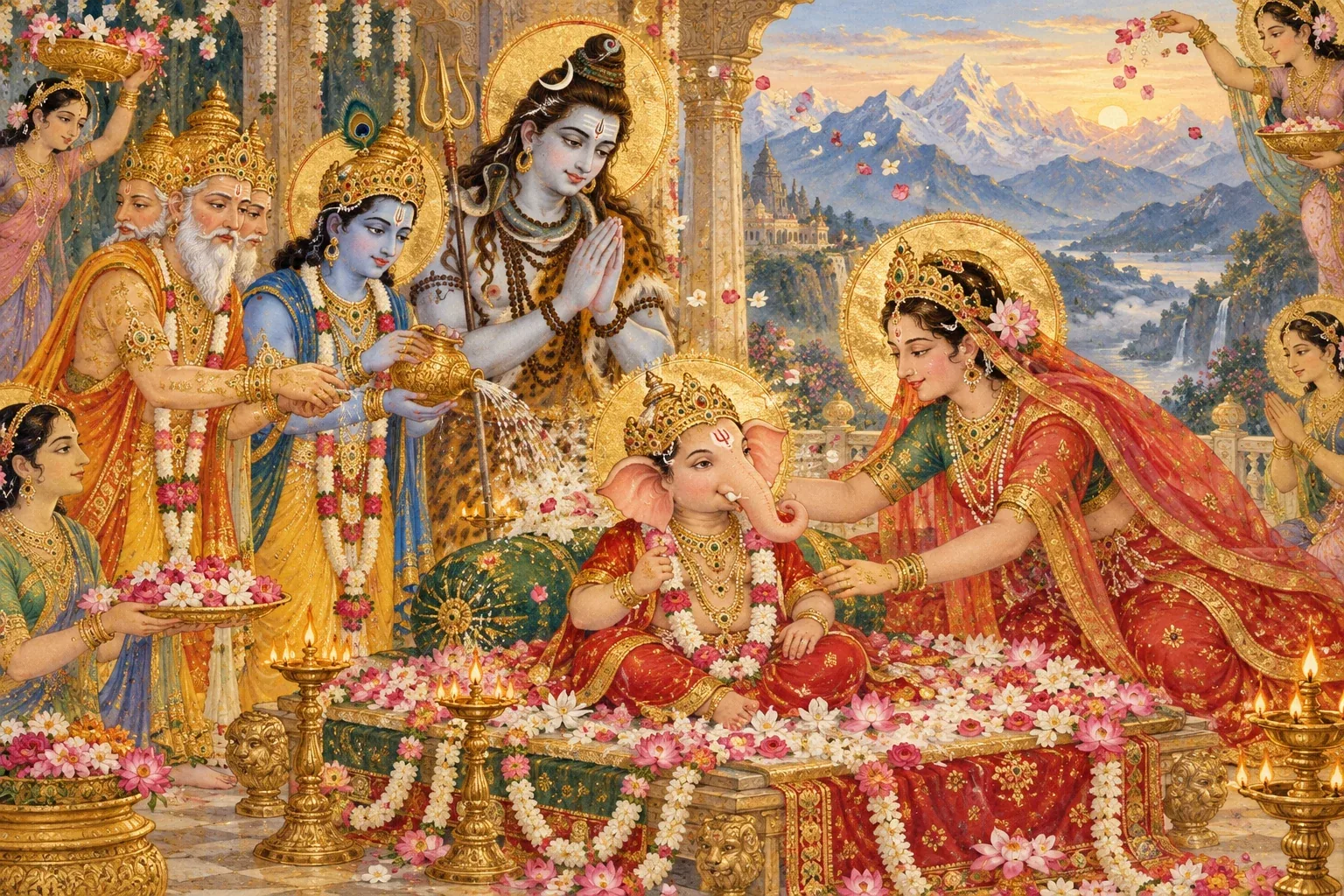
Ganesha is consecrated as leader of the ganas. Parvati declares that he will be worshipped first and that sincere worship will remove obstacles. Shiva receives him as his own son, places a hand upon his head and affirms his place in the family.
Brahma, Vishnu and Shiva honour Ganesha. Shiva names him chief of all his ganas and promises that his name will be foremost in overcoming impediments. The gods, sages and attendants worship him; music, dancing and a shower of flowers mark the reconciliation.
The doorway conflict does not end with one side simply declared victorious. It ends with recognition: Parvati’s son is restored, Shiva accepts him, the ganas receive their leader, and the guardian of one threshold becomes a divine presence invoked at new beginnings.
EDITORIAL REFLECTION / PAUSE & REFLECT
A boundary misunderstood.
A relationship transformed.
The crisis begins because each side sees loyalty but not the other relationship involved. What changes when we ask whose trust, instruction or safety stands behind a boundary?
TRADITIONS & INTERPRETATION
The Shiva Purana’s account
This reader follows the Kumara Khanda account in which Parvati creates a human-headed son from her own bodily substance and appoints him guardian. Shiva does not recognise him; after the conflict, an elephant’s head is joined to the child and sacred water restores him.
Other texts and regional traditions tell Ganesha’s birth differently. Some vary the reason for the elephant head, the identity of the elephant or the divine figures involved. Those versions are not blended into this page.
The supplied edition continues chapter 18 with detailed vrata instructions. This story retains the narrative establishment of Ganesha as first-worshipped and remover of obstacles, while referring readers to the source notes for the broader ritual context. All four reader paintings and the separate card artwork are AI-generated interpretations, not historical images.
Read the chapter references and supplied-edition notes