
A cherished child
The sage Mrikandu and his wife long for a child. Their prayers are answered, and Markandeya is born into their forest household. From an early age he is remembered as gentle, observant and drawn toward Shiva.
The joy of his parents is deep, yet it carries a shadow. Their son’s life, they learn, will be brief. The supplied Skanda Purana preserves one version in which a visiting seer sees the child’s qualities and announces that death is close. Other tellings place the knowledge earlier, around the boon through which the child is received.
The traditions differ in arrangement, but they agree on the heart of the dilemma: a luminous young life seems to have been given very little time.
The measure of a life
As the appointed time approaches, grief becomes harder for Markandeya’s parents to hide. He asks what troubles them. At last they tell him that his years are nearly complete.
Markandeya does not pretend that death is unreal. Nor does he spend his remaining time in resentment. He turns toward the presence he trusts most completely.
A life may be counted by years, but its depth is not measured by duration alone. The young devotee chooses to let the knowledge of death clarify his attention rather than scatter it.
Markandeya’s choice
Markandeya goes to a shrine of Shiva and settles before the linga. He offers water, leaves and flowers, then gathers his mind in remembrance. The story’s force does not depend on an elaborate ceremony; it rests on the directness of his refuge.
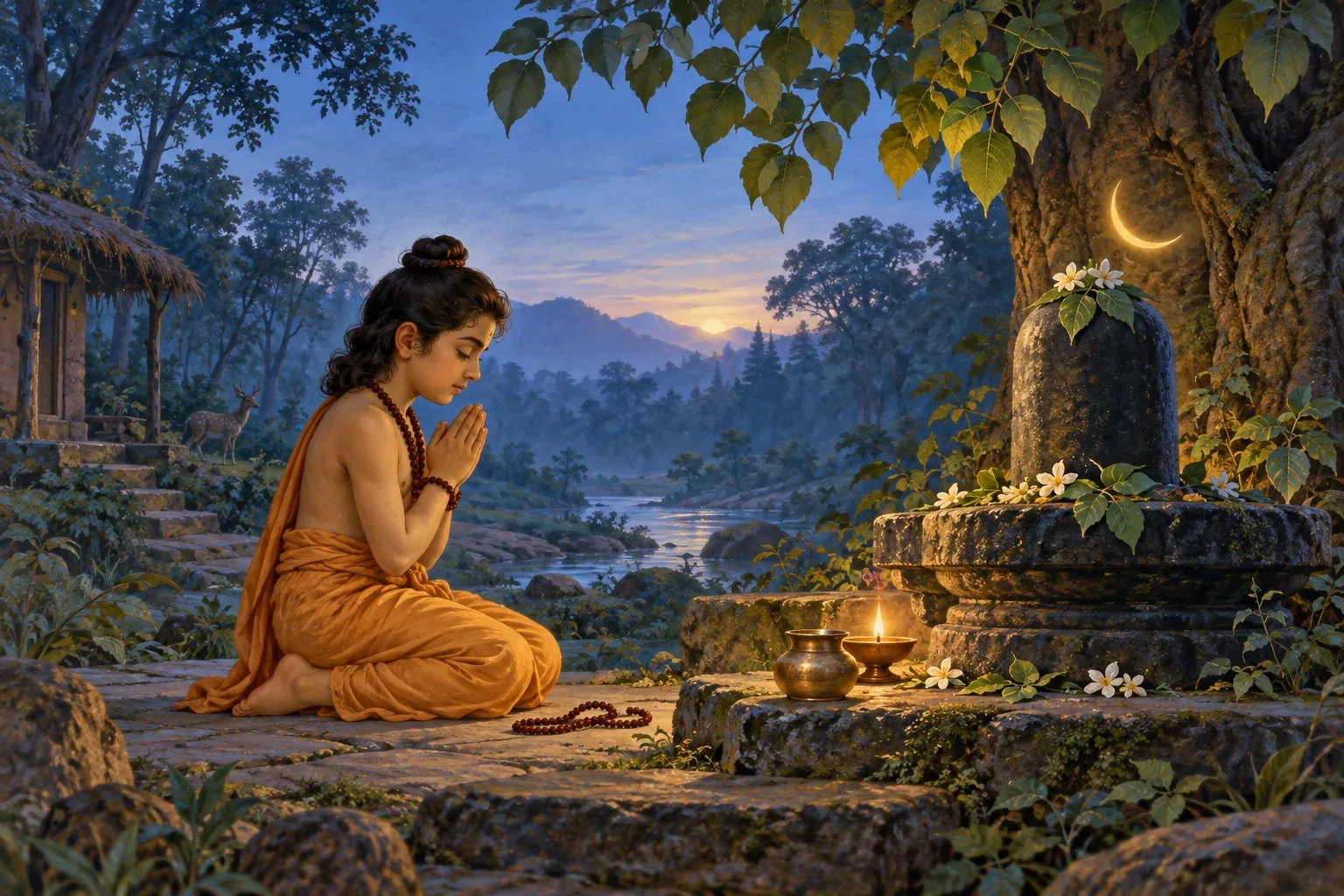
He does not ask for another person’s loss in exchange for his safety. He does not arm himself against the order of the world. He remains with Shiva, repeating the name of the Lord and refusing to let fear become the centre of his final hour.
The appointed hour
Yama’s messengers come, but the radiance of Markandeya’s worship prevents them from drawing near. They return to their lord, and Yama himself approaches.
Yama is not portrayed here as a demon. He is Dharmaraja, guardian of an order in which embodied lives begin and end. The conflict is therefore not between a good child and an evil god. It is a meeting between appointed law and a devotion that has placed itself wholly in the Divine.
Yama calls Markandeya to come. The young devotee does not answer with defiance. He draws closer to the linga.
Refuge at the linga
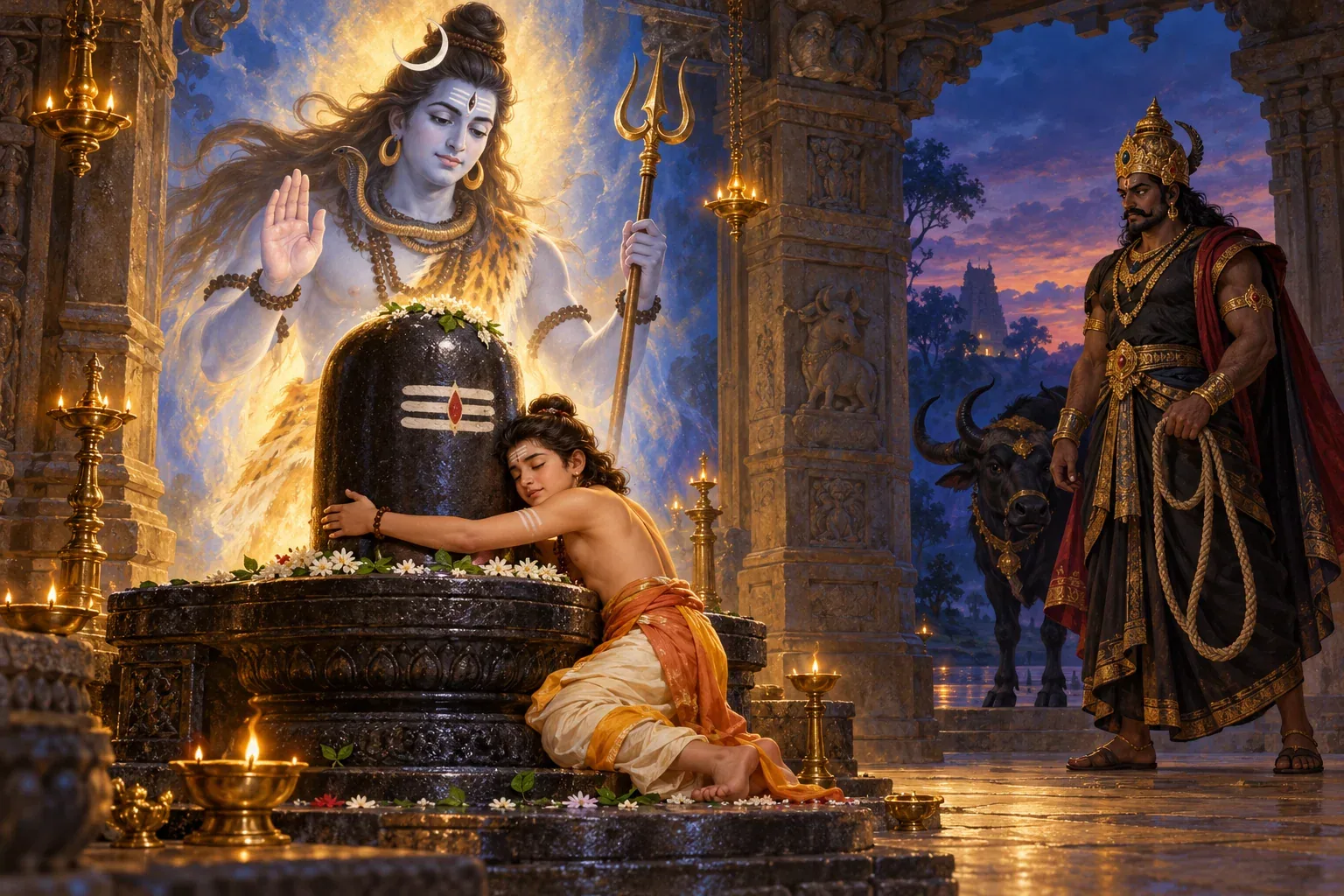
Markandeya wraps his arms around the linga. Yama casts his noose. In the familiar telling, the loop falls around the devotee and the sacred emblem together.
That moment changes the scene. The noose intended for one life has touched the sign of Shiva’s presence. The stone is no longer perceived as silent. The shrine opens into revelation.
Markandeya does not conquer death through physical strength. His act is surrender: he refuses to imagine himself as separate from the refuge he has chosen.
Shiva appears
Shiva manifests from the linga as Kalantaka—the one who brings Kala, time and death, to a halt. He stands between the young devotee and the noose.
Temple images and later retellings render the encounter in different ways: Shiva may restrain Yama, strike him down or press him beneath a raised foot. This reader keeps the scene non-graphic. Its centre is protection, not spectacle.
Yama’s power is checked. Markandeya remains at the feet of Shiva, still holding the linga, while the appointed boundary of his life is overturned by grace.
Order restored
A world without death cannot remain ordered. In related Shaiva accounts, the devotee himself asks that Kala be restored, and Shiva revives him. The famous Markandeya tradition likewise does not end with the permanent destruction of Yama’s office.
Yama acknowledges the power of Shiva and the protection given to the devotee. Markandeya receives long life—remembered in devotional tradition as perpetual youth or freedom from the ordinary limit that had been announced.
The result is not that death becomes wicked or meaningless. Its authority is placed within a reality greater than fear.
What was conquered?
The title “conquest of death” can suggest that the story is only about escaping an event. Its deeper movement is already visible before Shiva appears: Markandeya refuses to spend his remaining life in the possession of fear.
Time still moves. Bodies remain mortal. Yama returns to his necessary place. What changes is the devotee’s relation to mortality. Refuge transforms the final hour from isolation into presence.
Markandeya becomes one of the great long-lived sages of Puranic memory. His story continues not because he denied death, but because he sought what death could not separate him from.
EDITORIAL REFLECTION / PAUSE & REFLECT
When time feels short,
what deserves your whole attention?
Markandeya cannot control the news he receives, but he can choose where he places his mind and trust. What helps you meet uncertainty without letting fear decide the meaning of the moment?
TRADITIONS & INTERPRETATION
One beloved story.
Several textual pathways.
This reader presents the familiar Kalasamhara tradition in which Markandeya embraces the linga and Shiva intervenes when Yama casts the noose. The supplied Skanda Purana’s Prabhasa Khanda gives Markandeya a short predicted life but resolves it through blessings from the Seven Sages and Brahma. The supplied Shiva Mahapurana later names him a deathless devotee through Shiva’s grace.
A separate supplied Skanda Purana chapter tells of King Sveta, a Shiva devotee whom Yama cannot seize; Shiva burns Kala, then restores him at the devotee’s request. That chapter supplies the site’s parallel theological context, but Sveta is not silently renamed Markandeya.
The names Kalantaka and Kalasamhara describe Shiva as the one who checks or overcomes Kala. Temple iconography varies. The artwork is a respectful devotional interpretation, not a claim that one image reproduces every textual detail.
Read the supplied-edition references