
A promise at Panchavati
On the way to Panchavati, Rama and Lakshmana encounter a vulture of extraordinary size. The brothers approach carefully, but the bird speaks gently: he is Jatayu, an old friend of their father, Dasharatha.
Jatayu offers practical help. When the brothers must leave the dwelling, he will remain near Sita and guard her. Rama has heard his father speak of this friendship. He embraces Jatayu, accepts the offer and entrusts Sita to his care.
The promise is made without ceremony or expectation of reward. It joins an old friendship to a new responsibility.
A cry across the forest
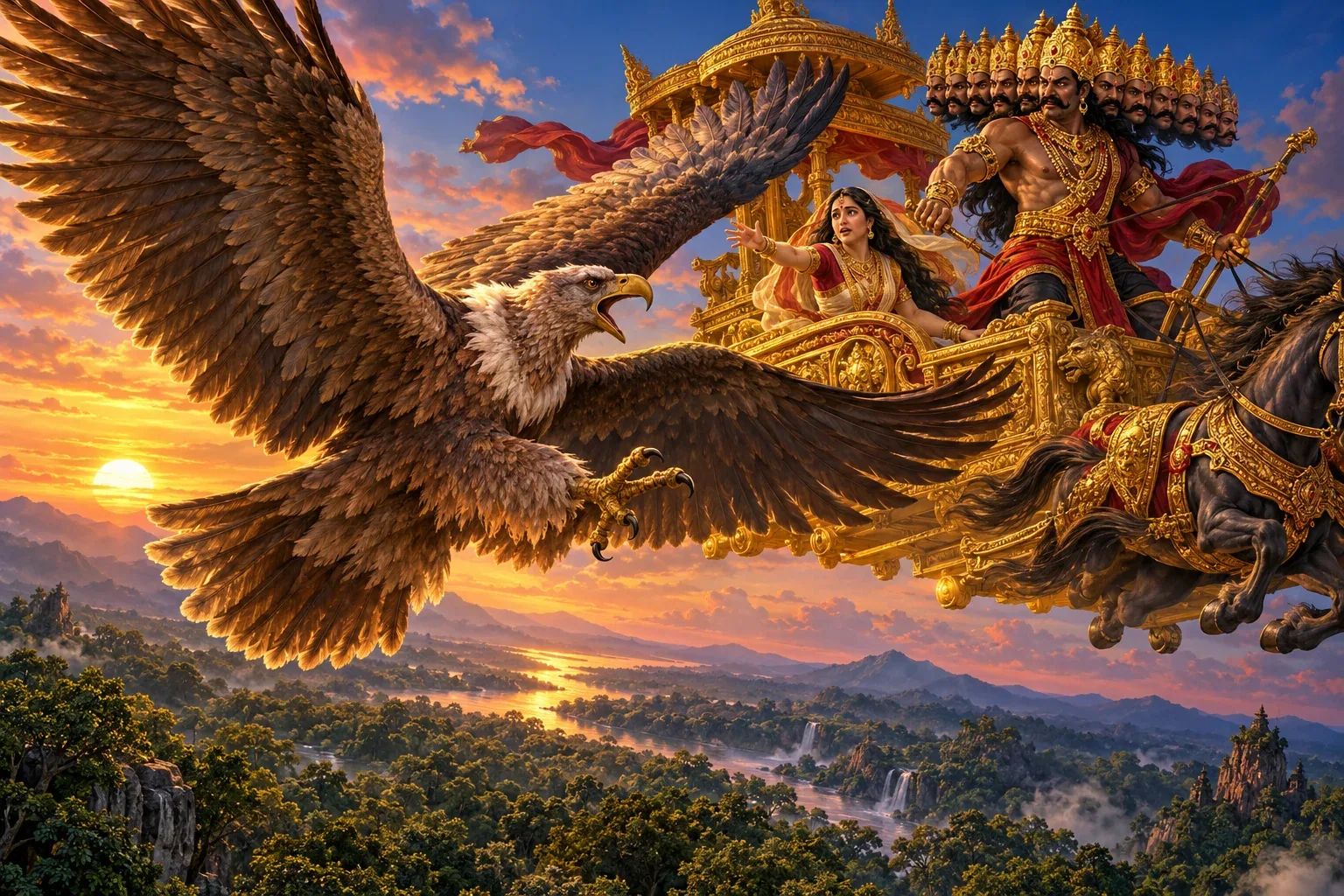
Later, while Rama and Lakshmana are away, Ravana seizes Sita and carries her from the forest in his chariot. Sita calls to the trees, rivers, animals and birds, asking every witness to tell Rama what has happened.
She sees Jatayu and appeals to him. Her first request is not that the aged bird defeat Ravana alone, but that he carry news to Rama and Lakshmana. Jatayu hears her voice and wakes.
What reaches him is both a cry for help and the promise he once made. He looks toward the chariot and chooses to intervene.
An elder stands in the way
Jatayu addresses Ravana before attacking. He names the act for what it is: taking another’s wife by force is unworthy of a ruler. He urges Ravana to release Sita and warns that Rama will answer this wrong.
He does not hide the inequality between them. Jatayu is old; Ravana is armed, armoured and powerful. Yet the vulture king refuses to let that difference decide whether he should act.
His courage is not confidence in an easy victory. It is the refusal to make safety the price of doing what protection demands.
The chariot is brought down
Ravana answers with arrows. Jatayu endures them and keeps his attention on Sita. With beak, talons and wings, he breaks Ravana’s bow, tears away the chariot’s ornaments and canopy, brings down its draught animals and driver, and forces Ravana to the ground.
Again the aged defender rises to block the escape. The struggle has already spent much of his strength, but he continues. At last Ravana uses his sword against Jatayu’s wings, and the great bird falls.
The reader keeps the violence restrained; the epic’s emphasis is unmistakable. Jatayu spends every remaining resource to delay the abduction and resist it.
A witness remains
Sita goes to Jatayu’s side and mourns the protector who has fallen for her. Ravana seizes her again and continues southward through the sky.
Jatayu cannot resume the pursuit, yet his work is not finished. Around him remain the broken chariot, bow and arrows—signs of the resistance Ravana met. More importantly, Jatayu himself has seen the abductor and the direction of his flight.
His body has been overcome, but his testimony can still serve the search. He holds to life long enough to give it.
Rama finds Jatayu
Rama and Lakshmana range through Janasthana looking for Sita. Grief and anger cloud Rama’s first sight of the great bird on the ground. For a moment he fears that this creature has harmed her, and he raises his bow.
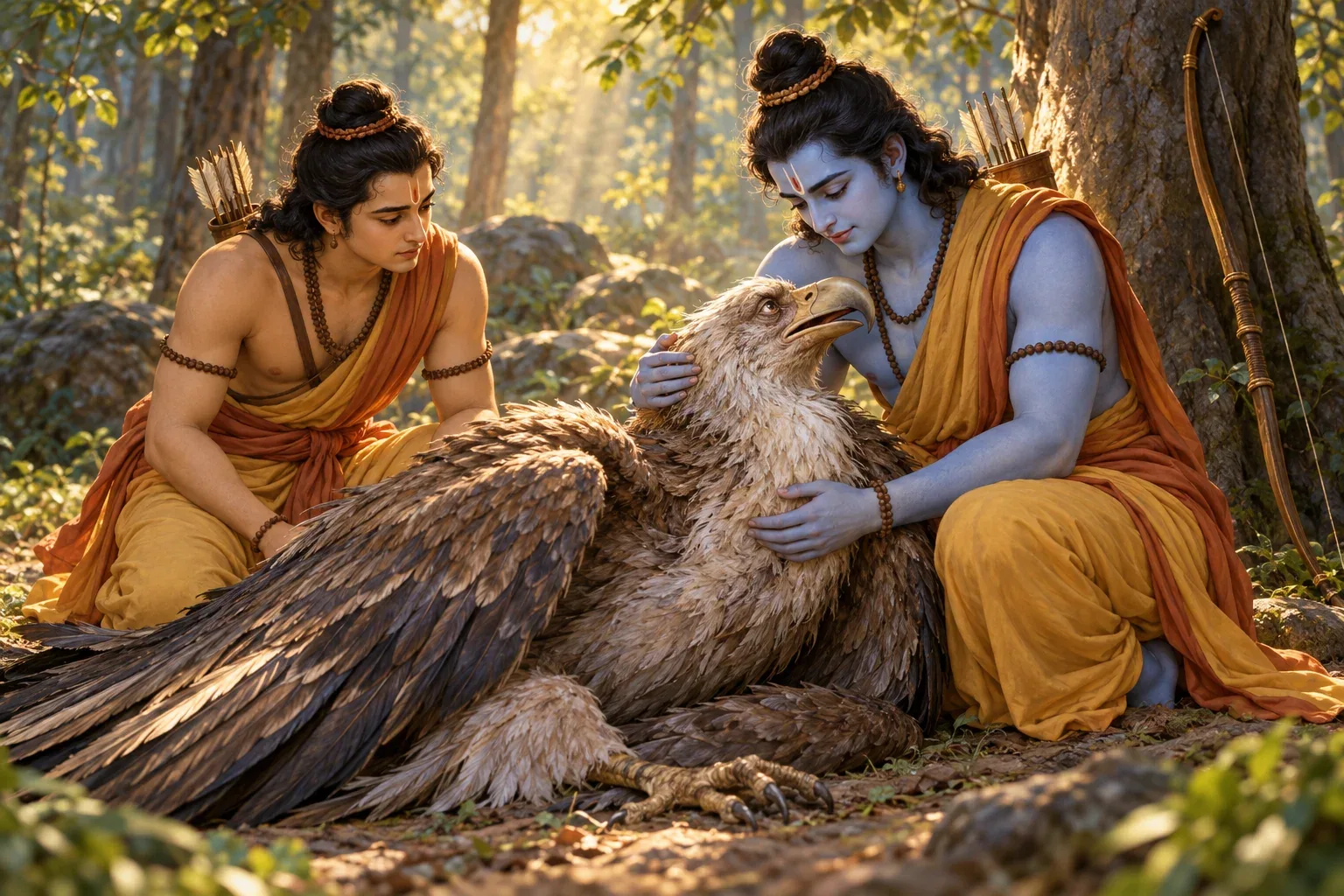
Jatayu speaks before the arrow is released. The voice transforms the scene: the suspected enemy is Dasharatha’s friend, and the apparent signs of violence are the remains of a defense mounted on Sita’s behalf.
Rama lowers his bow and embraces him. The search has found not Sita, but a loyal witness who has paid dearly to preserve the path toward her.
The final message
Jatayu tells Rama that Ravana took Sita. He points out the broken bow, arrows and fragments of the chariot, recounts the struggle and explains that Ravana flew toward the south.
He identifies the abductor as the son of Vishravas and assures Rama that the deed will bring Ravana ruin. These words turn anguish into direction: the enemy has a name, a lineage and a path.
Jatayu’s last service is therefore not only resistance. He safeguards knowledge. When his strength can no longer carry him into the sky, his truthful account carries the search forward.
Honoured as family
After speaking, Jatayu dies. Rama mourns him with the affection due to a father. He tells Lakshmana that the grief of seeing this revered bird is profound: Jatayu gave his life while trying to free Sita.
Rama and Lakshmana gather wood, prepare the funeral fire and perform the rites themselves. They make offerings and pour water in Jatayu’s honour. The epic does not allow his sacrifice to disappear as a passing incident in the search.
Jatayu could not prevent the abduction, but courage is not measured here only by the result of combat. He fulfilled friendship, protected another at mortal risk, preserved the truth and was received as family.
EDITORIAL REFLECTION / PAUSE & REFLECT
When success is uncertain,
what does courage require?
Jatayu knows that age and strength are against him. He still interrupts wrongdoing, protects another person and preserves the truth for those who will continue the work. Where might courage mean doing the part that is yours, even when you cannot control the final outcome?
TRADITIONS & INTERPRETATION
Sacrifice, witness
and dharma.
This reader follows the selected sequence in the supplied Griffith translation of the Valmiki Ramayana: Jatayu’s promise at Panchavati, the confrontation and combat, the final testimony, and Rama’s funeral rites.
Long speeches, genealogical material and graphic combat details are condensed. The reflection on courage and outcome is editorial. Ravana’s multi-headed appearance, Rama’s blue complexion and the airborne chariot in the paintings follow devotional artistic conventions rather than claiming historical documentation.
Sita is not treated as a passive object within the episode: she calls witnesses, appeals to Jatayu, mourns him and continues to resist Ravana in speech. Jatayu’s intervention answers her appeal and his own promise.
Read the canto references and edition notes