Prayer, music, storytelling and shared celebration bring sacred narratives into community life. Explore 31 festivals and observances through their meanings, stories and traditions. Open any entry to read its fuller context.
EXPLORE THE SACRED CALENDAR
Festivals, journeys and observances.
Find a celebration, then explore its meaning, observances and textual setting in the same entry. Lunar dates and practices vary between traditions.
31 calendar entries
Festival
Maha Shivaratri
A night of devotion to Shiva, marked by worship and vigils in many communities. Its sacred associations include protection, transformation and divine grace.
Read more+
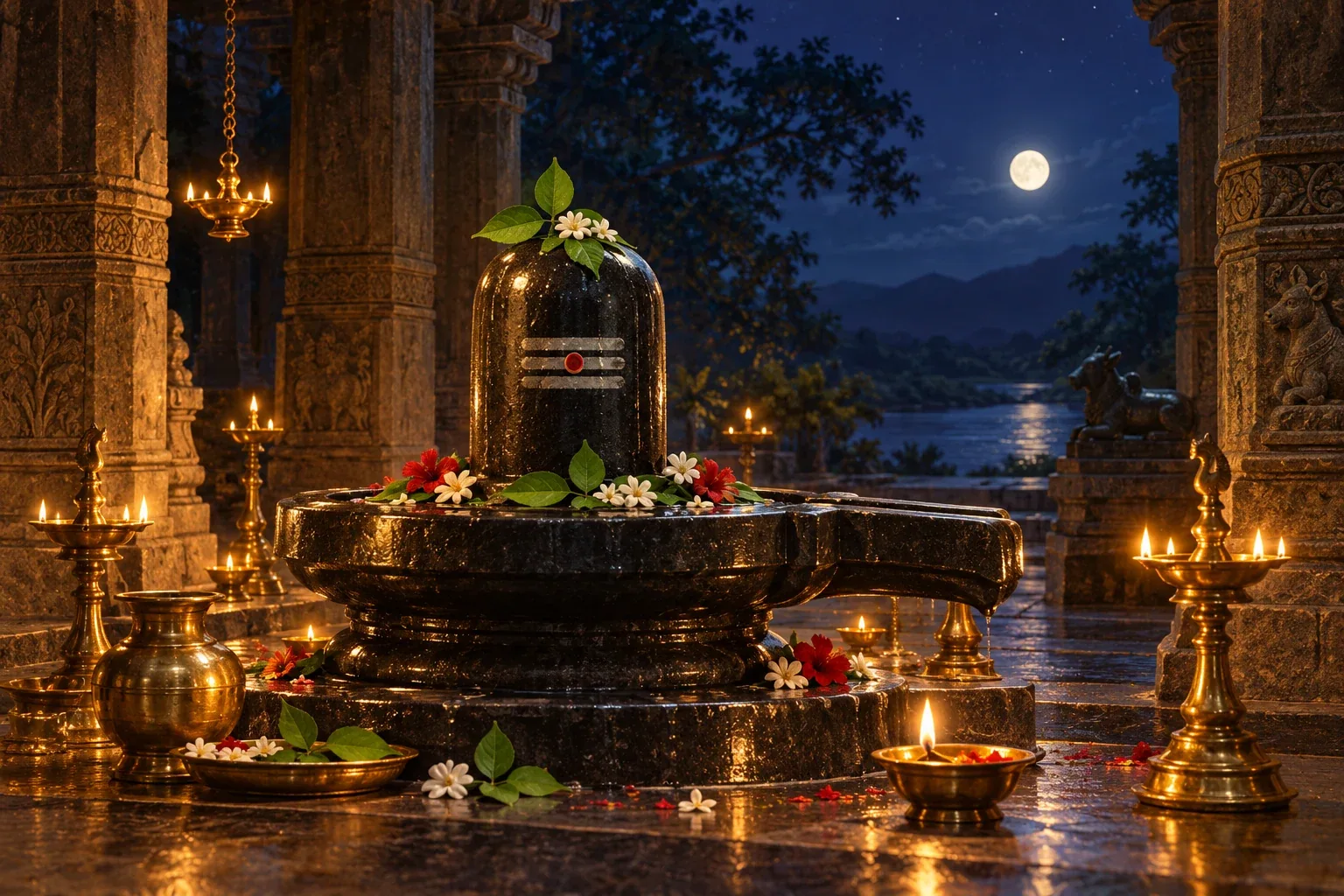
A quiet night of devotion · AI-generated devotional illustration; an imagined shrine.
Maha Shivaratri honours Shiva through worship, prayer and, in many communities, a night vigil. Temple observances may include abhisheka, the ceremonial bathing of the Shiva linga.
More than one sacred association
Devotional explanations connect the festival with Shiva and Parvati’s union, Shiva’s cosmic dance, and his protection of the worlds from Halahala. These are different associations, rather than one continuous episode.
From stillness to movement
Forms of celebration differ by place. At Chidambaram, Natyanjali offers worship through dance; other Shiva centres draw pilgrims for temple worship and prayer. A quiet vigil and a dance offering can express devotion in different ways.
A question to carry: How does the Halahala story connect strength with compassion? This is an editorial invitation to reflection.
In the Skanda Purana’s Kedara-khanda, a forester named Canda spends a night awake in a bilva tree. Leaves and water fall onto a Shiva linga below, becoming an offering he has not consciously intended. Later, when a dog eats the food brought for him, his response changes from anger toward acceptance. The account connects Shivaratri with transformation and Shiva’s grace.
This is one textual telling, distinct from the festival’s other sacred associations.
Nine nights of devotion to the Goddess, with distinct regional expressions including garba, Durga Puja and golu.
Read more+
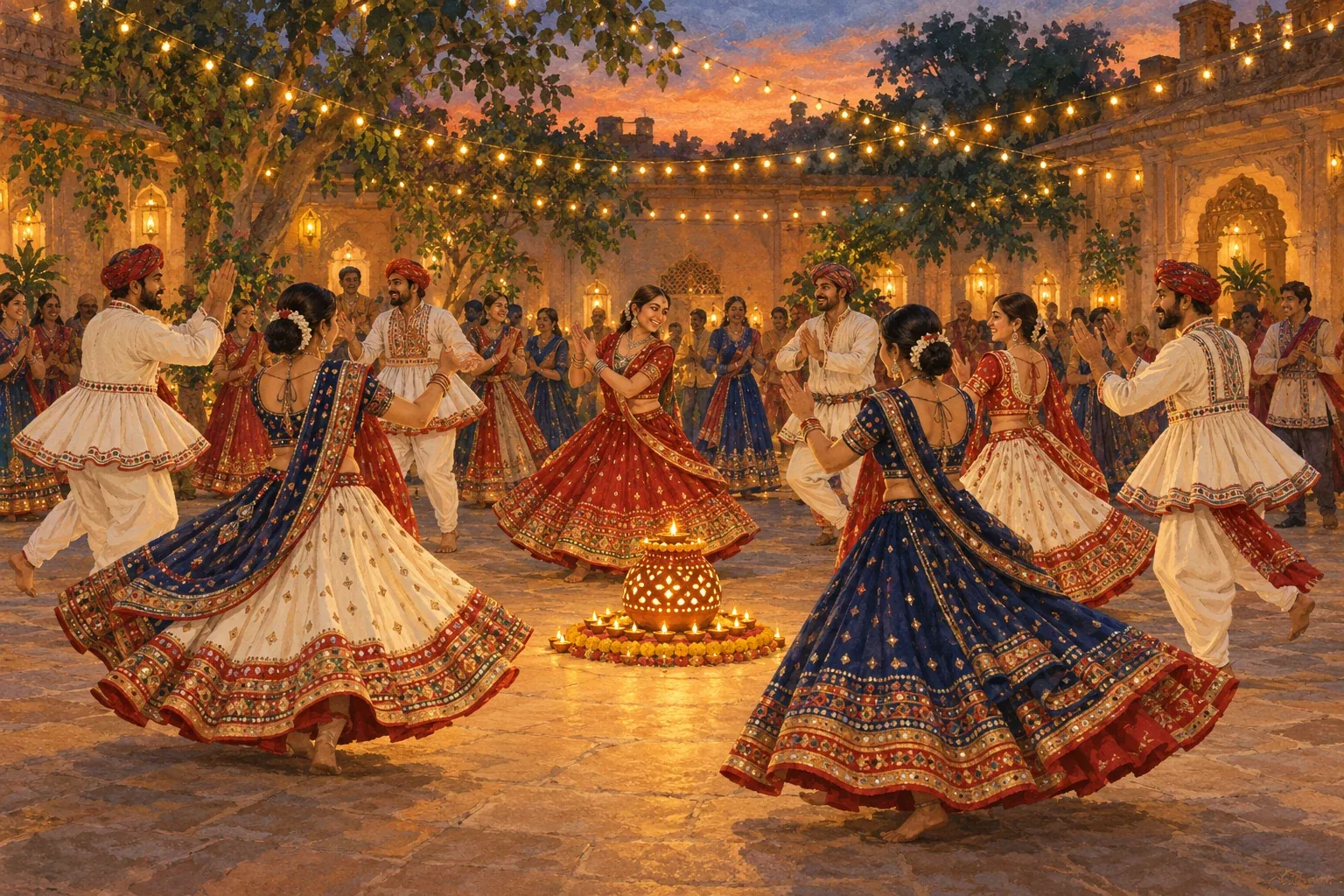
Garba during Navaratri · AI-generated cultural illustration.
Navaratri means “nine nights.” Devotion to the Goddess finds expression through worship, stories, music and community gatherings. Different regions give the celebration distinct forms.
A tradition with many local voices
Gujarat
Garba brings people together in circular dance and devotional celebration.
West Bengal
Durga Puja centres on the Goddess through elaborate images, worship and public celebration.
Tamil Nadu
Golu displays arrange dolls and figurines as part of the festival’s storytelling and devotional world.
These examples introduce a wider diversity; they do not describe every household or community. The Devi and Mahishasura narrative offers one doorway into the festival’s theme of divine protection.
A question to carry: What can a story, a dance and a carefully arranged display each help us remember?
A celebration of Hanuman’s birth and devotion. Regional calendars and temple traditions give the observance different dates and forms.
Read more+
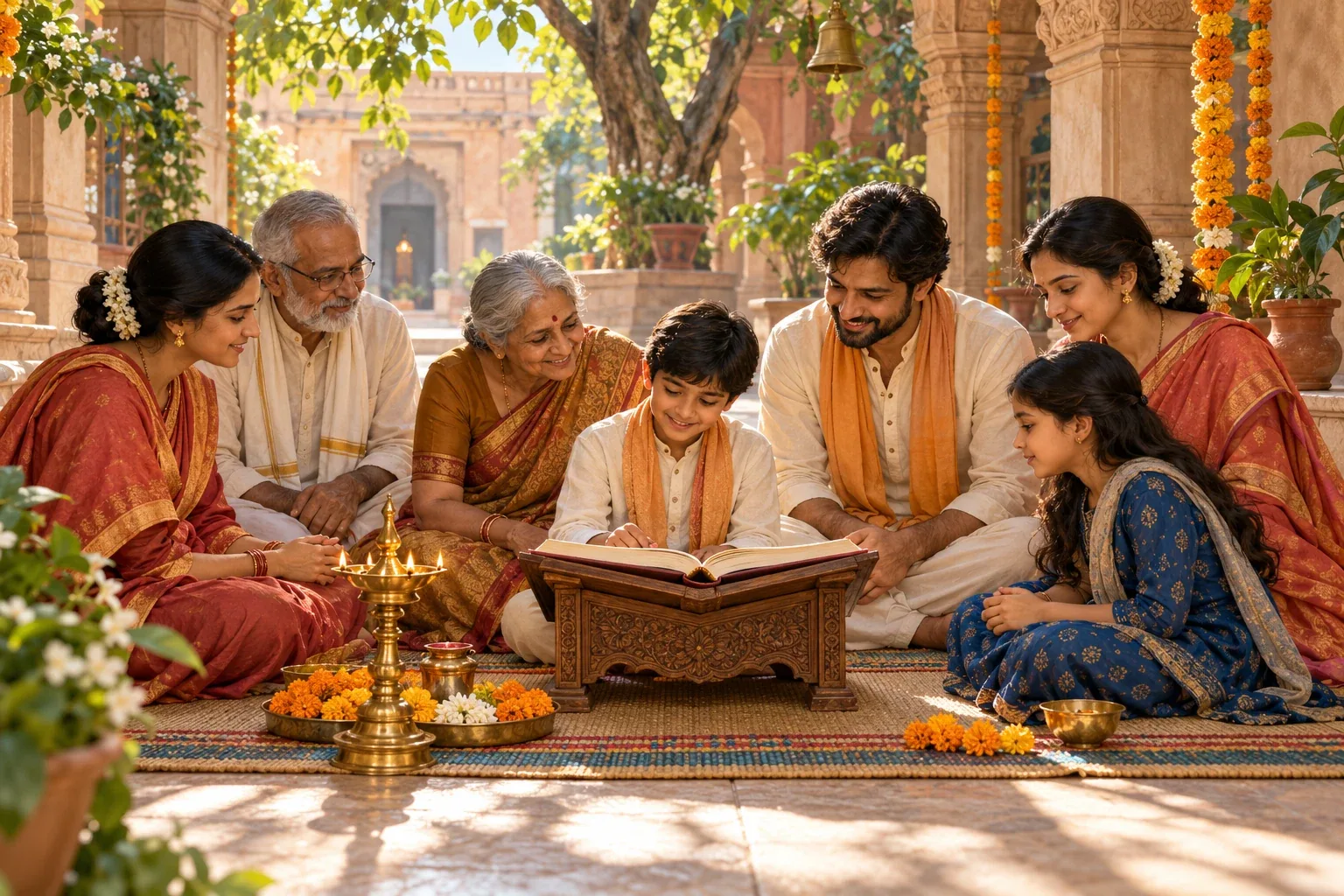
Reading in community · AI-generated cultural illustration; an imagined gathering.
Hanuman Jayanti celebrates Hanuman’s birth and honours his devotion. The Sundara Kanda, which tells of his search for Sita, also has a place in festival observances: Tirumala Tirupati Devasthanams has organised its recitation as part of Hanuman Jayanti festivities.
Honouring a shared figure in different ways
Festival timing follows different regional calendars and temple traditions. Sri Venkateswara Temple’s account distinguishes Tamil Nadu and Kerala observances from those in Andhra Pradesh and Telangana. Local temple practice offers the appropriate context for a community’s celebration.
In Hanuman’s ocean crossing, courage works alongside courtesy and good judgment. His mission gives his strength a purpose: finding Sita in service of Rama.
A question to carry: When does careful thinking help courage become useful?
In the Karttika account, the festival of lights includes evening worship of Lakshmi, offerings and the lighting of lamps. The chapter places this celebration within a multi-day festival sequence.
Read more+
Lakshmi and the night of lamps
The Karttika account describes a decorated place of worship for Lakshmi, with flowers, fresh shoots and food offerings. A hymn in the same passage associates her radiance with the Sun, Moon, fire and the flame of a lamp. Light is therefore part of the chapter’s devotional language as well as its festive setting.
A celebration beyond the home
The description extends illumination to temples, courtyards, houses, riverbanks and other shared places. Streets are decorated with cloth and flowers, and the following verses include feeding hungry people. The account brings worship, public celebration and generosity together within the wider festival-of-lights sequence.
This part of the festival-of-lights sequence emphasizes an early bath and acts of remembrance connected with Yama. The account treats it as a distinct observance within the wider celebration.
Read more+
The fourteenth-day observance
This part of the Skanda Purana moves from early bathing to offerings of water and lamps associated with Yama. It describes the bathing observance in the company of close relatives, giving the occasion a family setting as well as a ritual one.
Its place in the festival sequence
The chapter treats the fourteenth day, the new-moon celebration and the opening of Karttika as related but distinct moments. Naraka Chaturdashi’s emphasis on bathing, remembrance and lamp offerings should therefore remain visible when reading it beside the Lakshmi worship described for Deepavali.
The first bright day of Karttika is associated here with Bali and the gift granted by Vishnu as Vamana. Worship, gifts, songs and storytelling give the occasion a festive character.
Read more+
The remembrance of Bali
The chapter connects this day with Bali’s gift of the earth and his own head to Vishnu as Vamana. In its account, the pleased Lord grants a festival to Bali. Later verses describe an annual day and night on earth belonging to the king of the Danavas.
Worship and shared celebration
The text presents an adorned image of Bali and describes worship in the company of family and other people. Flowers and food offerings accompany the celebration; dances and story recitals enliven the night. The opening of Karttika becomes a time when a sacred narrative is remembered through gathering, giving and celebration.
The chapter describes worship of Govardhana alongside honouring cows. It offers a textual doorway into a celebration associated with Krishna and the protection of the pastoral community.
Read more+
The hill and the pastoral world
The chapter honours Govardhana alongside cows and bulls. It describes cows being adorned and bulls being relieved of burdens, while the accompanying invocation addresses Govardhana as a protector of the herds. Animals and the landscape have a direct place in the occasion’s devotional focus.
The Krishna connection
The supplied edition’s note identifies the hill near Mathura and recalls Krishna sheltering the cows, calves and people of Vraja beneath it during Indra’s rain. This gives readers a connection to the Govardhana story, while the festival verses themselves concentrate on worship and the pastoral community.
The account remembers Yama being welcomed by his sister Yamuna. A brother visiting and sharing food in his sister’s home, with gifts and affection, gives the observance its family focus.
In this account: The second bright day of Karttika.
Read more+
Yama at Yamuna’s home
The story centres on Yamuna welcoming and feeding her brother Yama in her own house. The second bright day of Karttika is remembered through that meeting. The chapter gives a sacred narrative to an occasion whose visible expression is hospitality between a sister and brother.
Food, affection and gifts
The observance is described through a brother eating food offered by his sister and honouring her with gifts of garments. The text also includes listening to the occasion’s story. A meal, a visit and the retelling of a family relationship become connected expressions of remembrance.
This observance honours a cow together with her calf. The supplied account places it among the rites leading into the festival-of-lights season.
Read more+
Honouring the cow and calf
The passage describes a cow and her calf together beneath the shade of a banyan tree. Sandal-paste and flower garlands accompany their worship. Its focus is the pair, rather than the cow alone, within a sacred calendar that gives pastoral life a prominent place.
Lamps at the beginning of the season
The account then turns to an evening offering of light, or nirajana, and the lighting of many lamps. These details place the observance within the wider approach to the festival-of-lights period. The cow-and-calf worship and the evening lamps provide its distinctive introductory themes.
The text describes an annual wedding celebration joining Tulasi with Hari. Evening worship, offerings and the language of a marriage ceremony shape its devotional atmosphere.
In this account: A Karttika celebration in this passage.
Read more+
A sacred wedding
The chapter describes the marriage of Tulasi and Hari as a celebration repeated each year. The image of Vishnu is brought near Tulasi with music and sacred recitation. The language of welcome, offerings and marriage shapes the gathering, and the text particularly emphasizes celebration in the evening.
The atmosphere of the ceremony
Cloth, auspicious sounds and the offering of food appear within the account’s wedding setting. Tulasi is spoken of with the care given to a daughter who has been nurtured. The night continues with marriage festivities, making the occasion a devotional celebration expressed through the familiar language of a family wedding.
The bright ninth day of Karttika is marked here by gifts of kusmanda gourds and a festival for Krishna. It illustrates how seasonal produce and charitable giving enter the sacred calendar.
Read more+
A seasonal gift
The short passage singles out the bright ninth day of Karttika and the charitable gift of a kusmanda gourd. It also names a festival for Krishna on that day. Seasonal produce enters the account through an act of giving rather than through a long description of a public procession.
The scope of this entry
These verses form the opening of a chapter that then turns to Tulasi’s marriage. Keeping the gourd gift and Krishna festival together preserves the emphasis of this particular Navami passage. Its focus here is devotion and charity within Karttika’s sequence of observances.
A five-day observance near the end of Karttika remembers Bhishma and honours Vishnu. The account presents it as a concentrated period of worship and restraint from Ekadashi to the full moon.
Read more+
The story remembered
The chapter recalls Bhishma teaching about duty, liberation and charitable gifts while lying on the bed of arrows, with the Pandavas and Krishna listening. It also remembers Arjuna bringing Ganga’s water when Bhishma asked for a drink. That act of relief becomes part of the explanation for offerings made in Bhishma’s memory.
Five days of devotion
The vrata extends from Karttika’s bright Ekadashi to the full moon. The account combines remembrance of Bhishma with worship of Vishnu, restraint and concluding acts of giving. Its five-day span offers a concentrated observance within the broader month of Karttika.
This observance celebrates Vishnu’s awakening at the close of the four-month devotional season. Songs, lamps, readings and a night vigil are among the expressions of worship described in the chapter.
In this account: The bright eleventh of Karttika.
Read more+
The awakening of Hari
Prabodhini, also called Haribodhini in the supplied edition, marks Vishnu’s awakening and the close of the four-month devotional season. The chapter describes the Lord being awakened with a conch, drums, flutes, other instruments, songs and dance. The return from sacred sleep is given a joyful, audible expression.
The night vigil
The vigil includes readings from the Puranas, lamps, flowers, food offerings and charitable gifts. The chapter also names truthfulness and restraint among its qualities. Devotional attention is expressed through storytelling, music and conduct, as well as through the act of remaining awake in worship.
A Varanasi account joins devotion to Vishnu and Shiva through the story of a thousand lotus offerings. Its observance brings the two forms of worship into one sacred occasion.
In this account: The bright fourteenth of Karttika.
Read more+
Vishnu’s lotus offering
The Varanasi narrative describes Vishnu worshipping Shiva with a thousand lotuses, one for each divine name. Shiva tests his devotion by making one lotus disappear. Determined to complete the offering, the lotus-eyed Vishnu offers one of his own eyes in its place, and Shiva is pleased by his devotion.
A shared sacred occasion
The chapter gives this Karttika Chaturdashi its name through Vishnu’s arrival from Vaikuntha and his worship of Vishveshvara. Its observance then joins worship of Vishnu with worship of Shiva. The story presents devotion between the two deities as central to this particular sacred day.
The full moon brings a formal conclusion to the Karttika vow in this account. Worship, gifts and sharing food mark the completion of the month’s devotional effort.
Read more+
Bringing the vow to completion
In this account, the full moon completes the month’s Karttika vrata through its udyapana, the formal concluding observance. The closing acts include worship, offerings and gifts according to the devotee’s means. The emphasis falls on completing a period of sustained devotion with care and gratitude.
A conclusion shared with others
The chapter describes honouring the teacher and other participants, asking forgiveness, and finally taking food with friends and the teacher. These social acts accompany the conclusion of the vow. The full-moon gathering gives the month-long observance a communal ending as well as a devotional one.
The Vaishakha account honours Akshaya Tritiya through worship of Vishnu, sacred storytelling and charitable giving. A Purushottama passage adds a temple celebration with cooling, fragrant sandal-paste, music and offerings.
In this account: The bright third day of Vaishakha.
Read more+
Devotion and generosity in Vaishakha
The Vaishakha account places Akshaya Tritiya on the bright third lunar day and associates it with worship of Madhusudana, a name of Vishnu. Holy bathing, listening to sacred narrative and charitable giving are its introductory themes. The chapter treats the day as a meaningful occasion for acts of devotion and generosity.
A temple celebration with sandal-paste
The separate Purushottama account gives the day a seasonal temple setting. The Lord is honoured with cooling, fragrant sandal-paste, accompanied by worship, music and offerings. Read together, the two passages show both a sacred day of giving and a particular temple celebration, with each account retaining its own emphasis.
The Purushottama account describes Hari’s ceremonial bathing with fragrant water on the Jyestha full moon. It places the bathing festival within the worship of the wooden deities of Purushottama.
Read more+
A festival of ceremonial care
The bathing scene belongs to the Purushottama temple account, where devotion is expressed through attention to the deity’s embodied presence. Hari is bathed with fragrant water on the Jyestha full moon. The same passage names Balabhadra and Subhadra, keeping the observance within this particular sacred setting.
The setting described in the text
The chapter gives careful attention to the place prepared for the bathing: an open, shaded setting surrounded by trees, with a canopy and cooling air from the sea. These details help a reader picture the festival’s atmosphere. Water, fragrance, shade and the gathered worshippers all form part of the account’s expression of reverence.
The chariot procession takes the Lord toward the Gundicha pavilion amid music, flowers and celebration. The text associates this journey with Jagannath, Balabhadra and Subhadra.
In this account: The second bright day of Ashadha.
Read more+
A sacred journey through the community
The movement toward the Gundicha pavilion brings worship into the processional route. The chapter describes a cleaned and level path, sandal-scented water, seasonal flowers, banners and many kinds of musical performance. Preparation of the route is part of the celebration itself, giving the journey a carefully arranged public setting.
Jagannath, Balabhadra and Subhadra
This account concerns the deities of Purushottama and the journey associated with the Gundicha pavilion. Songs, drums, flowers and devotional cries accompany the procession. The name Rama in this portion of the supplied translation refers to Balabhadra. Keeping that identification clear helps the reader follow the text without confusing this festival with a different narrative.
This passage names Nirjala Ekadashi within the Jyestha observances and presents it as a demanding vrata. It sits within the chapter’s wider rhythm of worship at Purushottama.
Read more+
Its place in the Jyestha observances
The named Ekadashi appears near the conclusion of the chapter’s Jyestha-panchaka discussion. That larger context includes worship and acts of giving. The passage singles out the Ekadashi falling within the period and gives its demanding observance particular devotional importance.
Understanding the chapter’s praise
The text expresses this importance through comparisons with the merit of many other Ekadashi observances. Such comparisons belong to the chapter’s religious language of praise. For a reader, they show how a single sacred day can become a concentrated focus of commitment within a wider calendar of devotion.
The Lord’s retiring to sleep marks the beginning of a four-month rainy-season sacred period. The supplied account places the observance on the bright eleventh of Ashadha.
Read more+
The beginning of the sacred sleeping season
The Purushottama account presents the bright eleventh of Ashadha as the Lord’s retiring to sleep. This opens a four-month period that ends with the bright Ekadashi of Karttika. The festival therefore gives the rainy-season calendar a devotional beginning and a clearly described relationship to the awakening observance later in the year.
An intimate form of temple devotion
The chapter describes a pavilion and a carefully prepared bed, with soft cloth, a pillow, fragrance and decoration. These images express care through the familiar gesture of making a place for rest. The supplied note identifies the observance as Shayani Ekadashi and places it among Jagannath’s temple festivals.
The four months extend between the bright Ekadashis of Ashadha and Karttika in this account. Worship and devotional observances are emphasized throughout the season.
Read more+
A season rather than one festival day
Chaturmasya provides the longer span within which several individual observances sit. In this account it begins with the bright Ekadashi of Ashadha and continues to the corresponding Ekadashi of Karttika. The opening sleep festival and the eventual awakening give the season its devotional rhythm.
The importance of remaining in devotion
The Purushottama chapter repeatedly emphasizes staying in the sacred place, seeing the Lord and continuing worship through the rainy months. Its focus is sustained attention across time. Reading the season in this way helps distinguish its continuing devotional character from the particular ceremonies that mark its beginning or later stages.
This observance imagines Vishnu turning onto his other side during the sacred sleeping season. Prayer, offerings and devotional service mark this point within Chaturmasya.
In this account: The bright eleventh of Bhadrapada.
Read more+
A turning within Chaturmasya
The festival belongs to the same sacred sleeping season that begins in Ashadha. Here, on the bright eleventh of Bhadrapada, the account turns to Vishnu’s change of resting position. Approaching the bedchamber, bowing and offering worship give this moment its intimate devotional character.
Rest and the care of the cosmos
The accompanying prayer connects the Lord’s waking, dreaming and sleeping with the movement and protection of the universe. This gives the small gesture of turning in sleep a much wider theological meaning within the chapter. The passage names the observance Parsva Paryayana; the directory retains its place within that particular temple account.
The text describes clothing the deities against the cold with a procession of consecrated garments. It also includes giving blankets and other protection from cold to people in need.
In this account: The bright sixth of Margashirsha.
Read more+
Preparing for winter
The covering festival treats the arrival of colder weather as an occasion for care of the deities. Consecrated cloths are brought from the pavilion in a procession with flags, flowers, singing, instrumental music and dance. The account then describes covering the deities while leaving their faces visible.
Care that extends beyond the shrine
The chapter also includes gifts of blankets and other protection against cold to people in need. Temple service and charitable giving appear together in the description. This makes the observance a useful example of how a seasonal festival can join ceremonial beauty with practical attention to the conditions of other people’s lives.
A winter bathing festival combines ceremonial ablution with worship, music and offerings. The account places it on the Pausha full moon associated with the Pushya constellation.
Read more+
A full-moon festival in winter
The account locates the festival in Pausha when the full moon coincides with the Pushya constellation. Its preparations extend across several days, so the bathing is the culmination of a sequence of worship. Night-time songs, dance and other services form part of the setting described before the morning rites.
The image, the mirror and the water
One distinctive detail is the worship of Purushottama reflected in a mirror before the ceremonial bathing. The description then turns to an unbroken flow of water and further offerings. These elements show the ceremony’s visual and sensory richness, while keeping the explanation within the particular Purushottama passage being read.
The Sun’s entry into Capricorn is marked with worship in the Purushottama festival cycle. Newly prepared rice offerings, lights, music and a procession connect the turning of sacred time with temple devotion.
Read more+
A turning point in sacred time
The Purushottama account connects the Sun’s entry into Capricorn with Uttarayana, the northern transit, and with temple worship. Its festival scene includes the shrine’s deities, a movable image, a palanquin and a procession accompanied by lights and music. The turning of the year is thus given a visible devotional expression.
Fresh grain as an offering
Newly prepared rice has a prominent place in the description. The chapter presents the grain with ingredients including curds, ghee, sugar, coconut and ginger, and joins the offering to a prayer for the nourishment and protection of the world. These details belong to this temple-cycle account rather than a description of every regional Sankranti celebration.
Govinda is honoured on a decorated swing with worship, music and showers of flowers. Later verses describe scented coloured powders, while the supplied editorial note associates the celebration with Krishna’s Holi play.
Read more+
Govinda on the swing
The passage describes a decorated pavilion and a seat for Govinda, followed by worship and the movement of the deity toward the place of the swing. Musical instruments, conch-shells, lamps, flags and showers of flowers give the celebration its lively setting. A fire observance is described before the main swing festival.
Colour within a particular temple account
Later verses include scented coloured powders, and the supplied editorial note associates the scene with Krishna’s Holi play. The text offers one way to explore the relationship between spring, joyful worship and the festival’s visual abundance. Its specific sequence should remain visible alongside the wider variety of celebrations associated with the Holi season.
The account names a spring festival centred on the fragrant damanaka plant and its offering in worship. The passage presents it as one of the temple’s seasonal yatras.
Read more+
A fragrant plant at the centre of spring worship
The chapter calls this spring celebration Damanabhanjika and places the fragrant damanaka plant at its centre. The account speaks of bringing the plant with its root during the bright fortnight of Chaitra. The plant is treated as an offering with a sacred narrative attached to it, giving seasonal growth a place in temple devotion.
A festival carried through the night
The continuation describes the offering in the Lord’s presence, followed by singing and dancing through the remaining night and worship again after sunrise. Fragrance, movement and the passage from night into morning give the celebration its distinctive atmosphere within the sequence of Purushottama yatras.
The Linga Purana describes recurring worship of Shiva on Ashtami and Chaturdashi, the eighth and fourteenth lunar days. Its account joins devotion with ethical disciplines such as nonviolence, truthfulness and forgiveness.
Read more+
A recurring lunar rhythm
The Linga Purana presents these observances as part of a year-long pattern of worship. The eighth and fourteenth lunar days recur in both fortnights, giving devotion a regular place within the month. The chapter is concerned with a continuing vrata rather than a single annual celebration.
The ethical character of the vow
Its concluding verses place nonviolence, truthfulness, non-stealing, forgiveness and mercy alongside the observance’s ritual disciplines. The passage therefore joins the repeated act of worship to the devotee’s conduct over time. The description here keeps that connection visible while leaving the chapter’s detailed ascetic regimen within its original textual setting.
The Uma-Maheshvara vrata honours Uma and Shiva together. The Linga Purana places it within a year-long rhythm of lunar observances, with worship and concluding acts of giving.
Read more+
Honouring Uma and Shiva together
The chapter opens by presenting a holy rite of Uma-Maheshvara and describes worship of an image of the two together. Its year-long framework includes full-moon and new-moon occasions as well as the eighth and fourteenth lunar days. Repetition across the lunar calendar is central to the observance’s form.
Worship, completion and giving
The passage brings the continuing vow toward a conclusion through gifts, feeding and a procession to Rudra’s temple. These elements give the observance both a devotional centre and an act of completion shared with others. Its form brings repeated acts of worship into a longer commitment, with a marked conclusion at the end of the year.
In the Brahmanda Purana’s account of Pururavas, the new moon becomes a recurring occasion for remembrance of the ancestors. The passage describes monthly shraddha, linking the lunar rhythm with duties toward the Pitrs.
Read more+
Pururavas and the new moon
The Brahmanda Purana gives this observance a narrative setting through Pururavas. On the new moon he pays respects to the Sun and Moon, and the passage describes his intention to perform monthly shraddha for the Pitrs, the ancestors. The lunar cycle provides the recurring moment for this act of remembrance.
The Moon and the ancestors
The chapter connects the Moon’s changing form with its account of ancestral beings. Within this sacred narrative, nourishment from the Moon is associated with the Pitrs, and Pururavas waits on their behalf before performing shraddha. The new moon becomes part of a recurring relationship between the worshipper and the ancestors, revisited through the monthly rhythm.
The Ayodhya account links Rama’s birthplace with a Navami vow, holy bathing and charitable giving. This entry retains that particular textual setting.
Read more+
A passage within Ayodhya’s sacred geography
The Ayodhya-mahatmya describes a sequence of sacred places and identifies a place of Rama’s birth within that account. In this setting, the ninth lunar day becomes an occasion for a holy vow. The passage joins remembrance of the birthplace with holy bathing, worship and charitable gifts.
The occasion named in the account
The passage names Navami without specifying a month or a bright or dark fortnight. Its emphasis falls on the relationship between a sacred place, a lunar occasion and acts of devotion and giving. The account offers a way to understand how remembrance of Rama is connected with pilgrimage and generosity.