
Rishis appear as teachers, counsellors, ancestors and witnesses. These profiles follow particular passages in the Bhagavata Purana, the Ramayana and the Skanda Purana. The links identify direct story appearances, wider narrative settings and related cosmological reading.
Narada Guidance shaped by listening
Narada enters Dhruva’s story when hurt has become determination. He hears what the child has endured, comes to him and first counsels a steadier response to honour and insult. Dhruva explains that the wound is still too sharp for this advice to settle in his heart. Narada then guides his resolve toward devotion to Vasudeva.
The encounter makes teaching a dialogue. Narada identifies Madhuvana beside the Yamuna and gives Dhruva a way of worship and contemplation. He later reassures the child’s anxious father, Uttanapada. The sage’s care reaches both the seeker in the forest and the family left behind.
In the passage, Dhruva describes Narada travelling with a vina for the welfare of the world. His movement between people and places offers a way into the sage’s recurring role as a guide across narratives.
Bhagavata Purana 4.8: Narada’s encounter with Dhruva →Vashishtha Counsel within the royal household
Vashishtha, also written Vasishtha, appears in the Ramayana as one of Dasharatha’s priests and trusted counsellors. His work joins sacred learning to the responsibilities of the royal household. When Rama is to become heir, he helps prepare the consecration and guides Rama and Sita through its preparatory observance.
The coming exile changes that expected future. During the departure, Vashishtha sees Sita wearing bark garments and protests to Kaikeyi. The full account gives him a voice of counsel within the grieving court, alongside the choices of the central characters.
Reading him beside Rama’s story draws attention to those who advise, prepare and question around a moment of crisis. The profile supplies context from the fuller departure account around the events retold in the site’s shorter exile reader.
Griffith’s Ramayana: the court, consecration and departure →Atri Contemplation and hospitality
In the Bhagavata Purana, Atri’s account joins tapas with the continuation of a family line. With Anasuya, he goes to Rksha mountain, seeking the Lord of the universe and a son like him. Brahma, Vishnu and Shiva appear, giving the episode its central question: why have three arrived when his contemplation was directed toward one?
The three respond to his intention and promise sons through their own aspects. This chapter names Soma, Dattatreya and Durvasa, associating them respectively with Brahma, Vishnu and Shiva. These relationships belong to this particular telling.
The Ramayana offers another setting. Later in the forest journey, Atri welcomes Rama, Sita and Lakshmana to his retreat. He introduces Anasuya, whose conversation with Sita and gifts give the visit its own centre of hospitality and counsel. That encounter comes after Chitrakuta, beyond the endpoint of the site’s condensed exile story.
Atri in Bhagavata 4.1 and the Ramayana’s forest journey →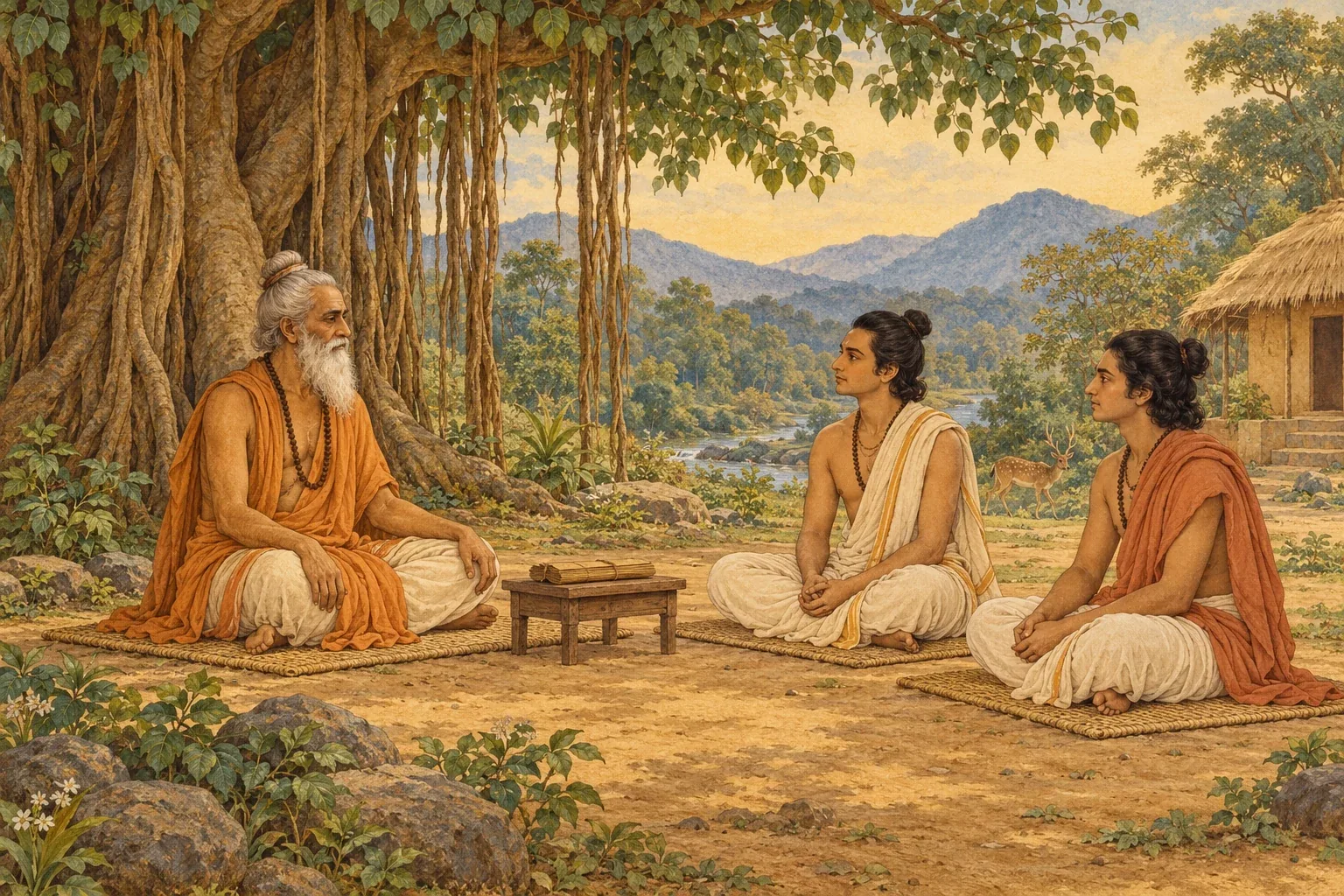
Bhrigu Lineage and a difficult ritual encounter
Bhrigu appears in the Bhagavata as a figure of lineage and ritual authority. The family account names Khyati as his wife and traces descendants through Dhata and Vidhata. One branch leads through Dhata and Mrikanda to Markandeya, giving two of these profiles a directly stated family connection.
His role in the Daksha sacrifice also includes conflict. When angry words and curses divide the assembly, Bhrigu answers with a countercurse. Later, in his prayer to the Lord, he acknowledges the power of delusion to obscure knowledge of the self and asks for grace.
The passages bring together family descent, ritual authority and the need for deeper understanding. Their particular setting gives Bhrigu an individual character within the larger world of the rishis.
Bhagavata 4.1, 4.2 and 4.7: family, conflict and prayer →Markandeya A witness to worlds within worlds
Markandeya opens a doorway from a sage’s life into the scale of the cosmos. In the Skanda Purana’s Purushottama account, he survives into the waters of dissolution and searches for shelter. He encounters a banyan tree and a divine child, then enters the child’s mouth and beholds fourteen worlds, beings, rivers, mountains and cities within the cosmic egg.
When he returns, wonder becomes a question about the divine power he has witnessed. The narration is rooted in Purushottama’s sacred geography. Its conclusion also turns toward worship of Maheshvara and the sage’s conquest of Death.
Read beside the cosmology guides, this particular telling gives worlds and dissolution a narrative form. The Lokas guide follows the Bhagavata’s enumeration; Markandeya’s vision here follows the Skanda account. Their distinct textual settings remain part of the reading.
Skanda Purana, Purushottama-ksetra-mahatmya 3 →Follow the connections
Recurring names help a reader move between narratives. The relationship may be a teacher’s direct appearance, an episode elsewhere in a larger work, a family line or a shared cosmological subject.
| Rishi | A path to follow |
|---|---|
| Narada | Dhruva, Shiva and Parvati, and Lalita and Bhandasura: the existing readers feature Narada. |
| Vashishtha | Rama’s exile: read the shorter episode with his counsel in the fuller departure account. |
| Atri | Rama’s exile: the starting journey leads onward to Atri and Anasuya’s later welcome. |
| Bhrigu | Markandeya: follow the family connection through Dhata and Mrikanda in the Bhagavata. |
| Markandeya | The Fourteen Lokas and creation and renewal: compare related cosmological subjects across their named texts. |
A further shared setting appears in Bhagavata 3.12.21–24: Atri, Bhrigu, Vashishtha and Narada are named among Brahma’s sons in that creation account. This offers a contextual path to the creation guide alongside their individual narratives.
References and notes on the connections →