
Trikuta and the lotus lake
Within the Ocean of Milk rises Trikuta, a vast mountain whose three principal peaks shine like gold, silver and iron. Waterfalls sound across its slopes, and its valleys hold flowering trees, birds and animals.
In Varuna’s garden, Ritumata, a great lake opens among lotuses and water lilies. Swans and other water birds move across its clear surface. The Bhagavata lingers over this abundance before danger enters the scene.
The setting belongs to sacred cosmology rather than modern geography. It is a world of beauty, vitality and hidden consequence.
The king of the herd
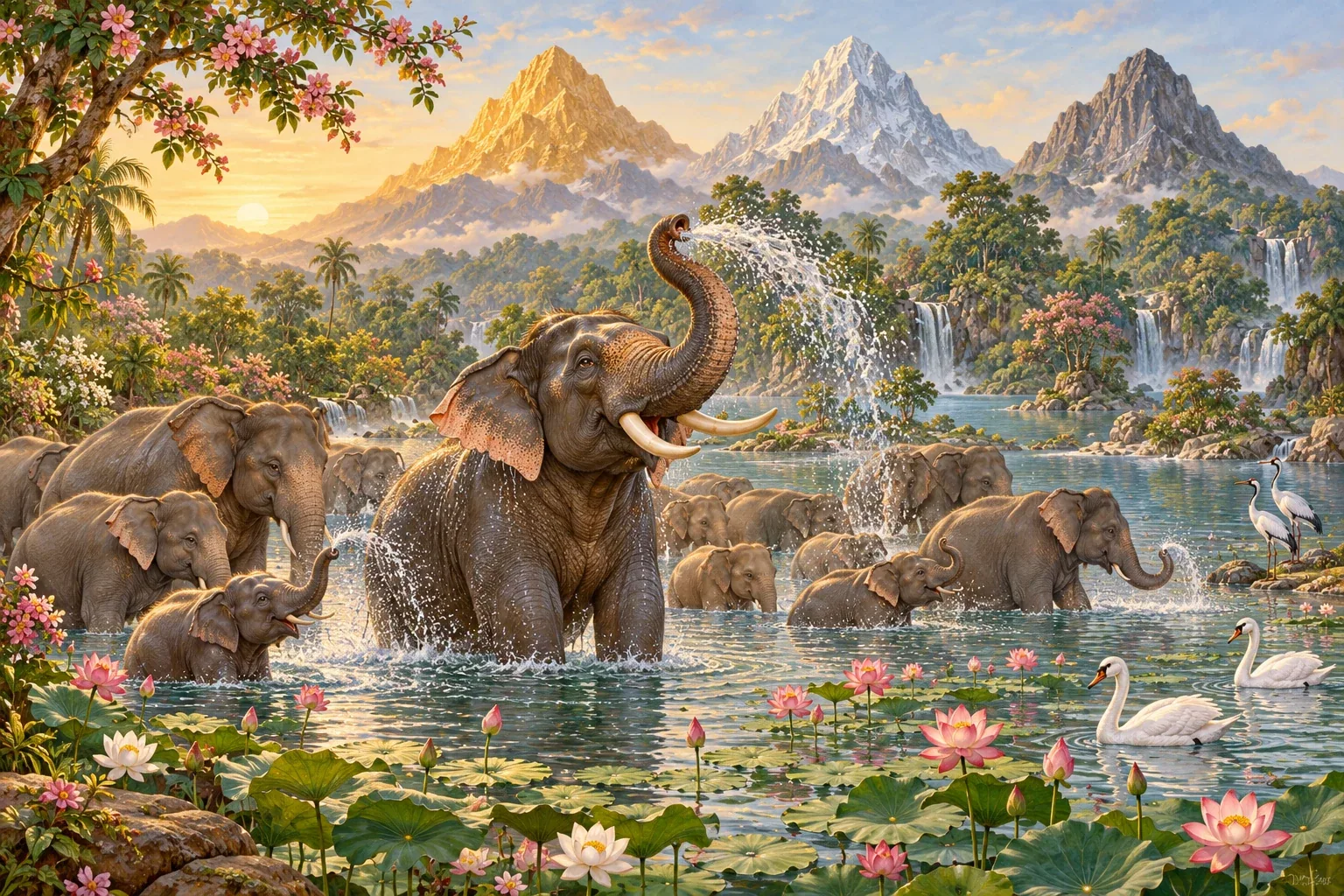
Gajendra moves through the forest at the head of his herd. Great animals withdraw before him, while the elephants who depend on him follow closely. He is powerful, confident and accustomed to protecting those around him.
Heat and thirst lead the herd toward the lake. Gajendra enters first, drinks the cool lotus-scented water and bathes. He draws water with his trunk and sprays the elephants and calves around him.
For a moment, strength appears complete: the king can find water, lead his family and turn the lake into a place of joy.
The crocodile’s grip
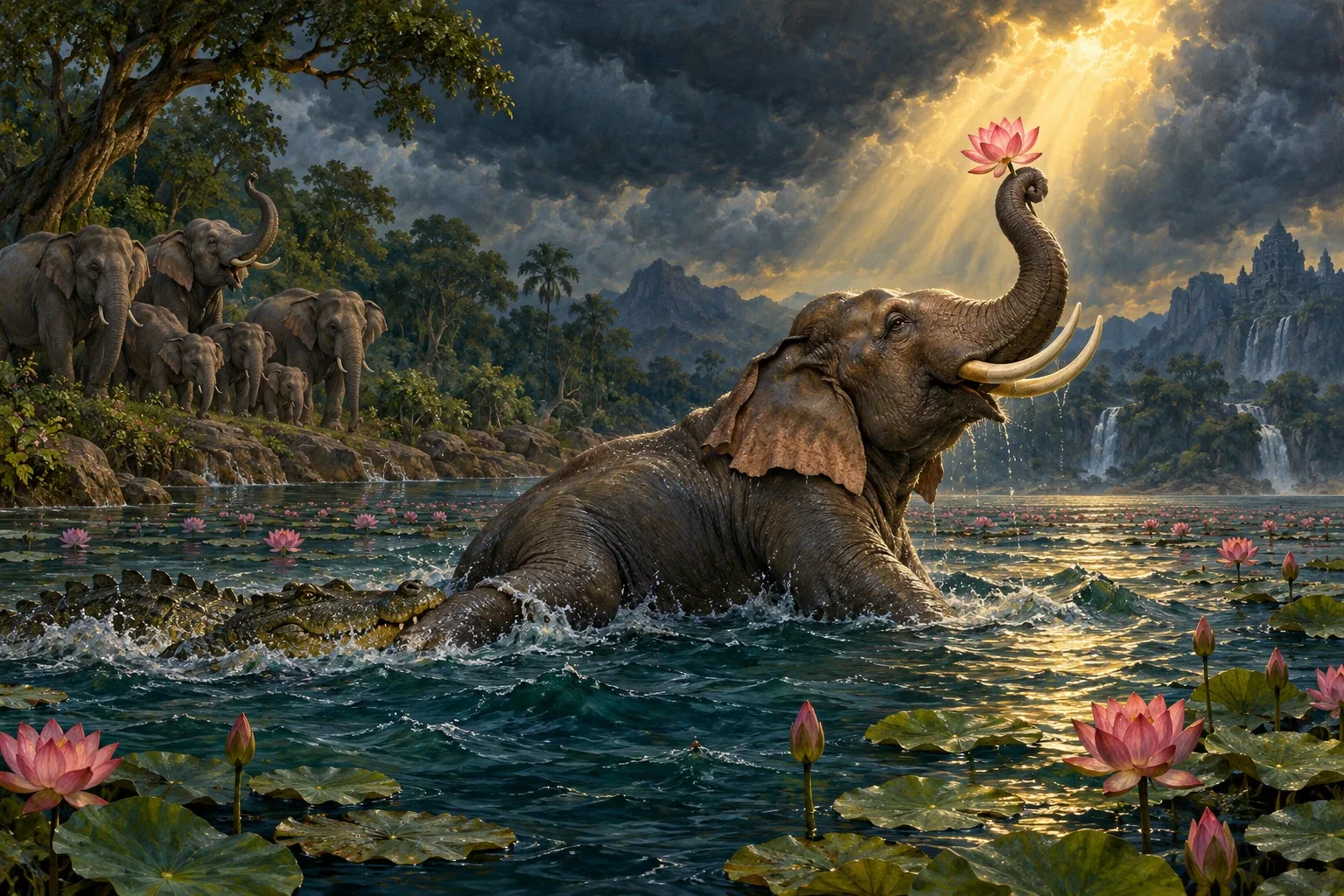
A powerful crocodile suddenly closes upon Gajendra’s leg. The elephant pulls toward the shore; the crocodile pulls toward deeper water.
The herd gathers in distress. Other elephants try to help by drawing Gajendra backward, but they cannot loosen the grip beneath the surface. The one who had led and protected them now faces a danger their combined strength cannot overcome.
The story does not make the lake itself evil. It reveals a reversal: water restores the crocodile’s strength while slowly taking strength from the elephant.
A struggle measured in ages
The Bhagavata describes the contest as lasting a thousand years. Its sacred timescale turns one desperate moment into an image of endurance: neither creature releases the other.
Because the crocodile belongs to the water, its power increases. Gajendra, held away from firm ground, grows weaker in body, senses and mind. The advantage of size and authority disappears.
Even the devas watch in astonishment. Yet observation is not rescue, and Gajendra’s herd remains helpless on the bank.
Where strength reaches its limit
Gajendra understands that his relatives cannot save him, and that he cannot free himself by force. The real turning of the story begins before Vishnu appears: the elephant king sees the limit of every power on which he had relied.
This recognition is not passivity. Gajendra gathers what remains of his attention and seeks a refuge beyond the lake, the herd and his own failing body.
A devotion formed before this elephant life begins to awaken. What strength could not recover, memory now carries toward prayer.
The prayer returns
Gajendra remembers a prayer learned in his earlier birth as King Indradyumna. He fixes his mind and addresses the Supreme Person: the source, witness and shelter of all beings, present beyond creation’s changes.
His prayer is larger than a plea to escape pain. He asks for freedom from the ignorance that binds the living being to bodily identity. The threatened elephant invokes the One who can give both protection and liberation.
With his trunk, Gajendra raises a lotus. His body remains trapped, but the offering gives visible form to surrender.
Vishnu comes on Garuda
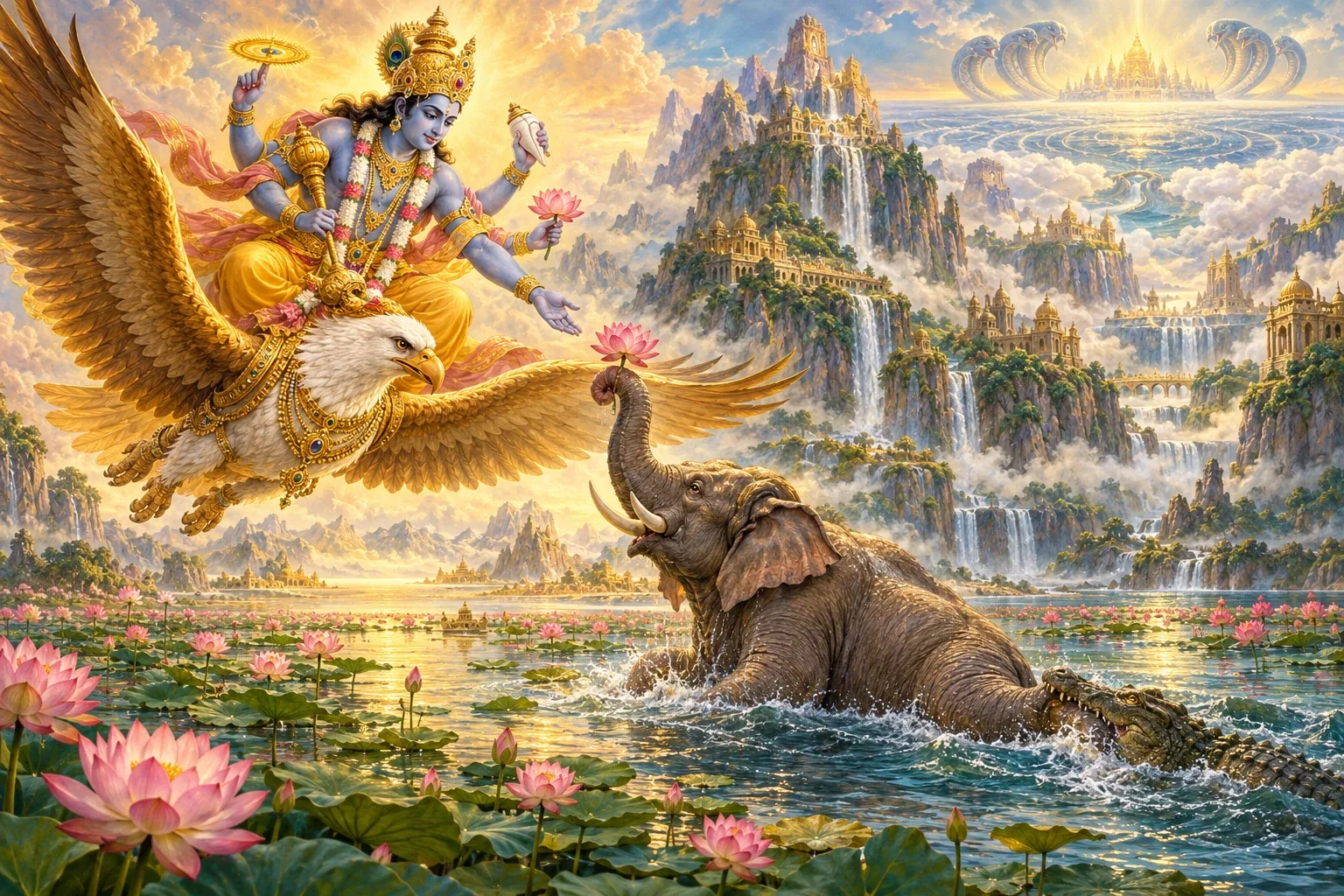
The prayer is addressed not to one limited divine office but to the Supreme Lord. Vishnu arrives personally upon Garuda, carrying conch, discus, mace and lotus.
Gajendra sees the Lord and lifts the lotus as high as his failing strength allows. Vishnu descends, draws both elephant and crocodile from the water, and uses the Sudarshana discus to end the crocodile’s hold.
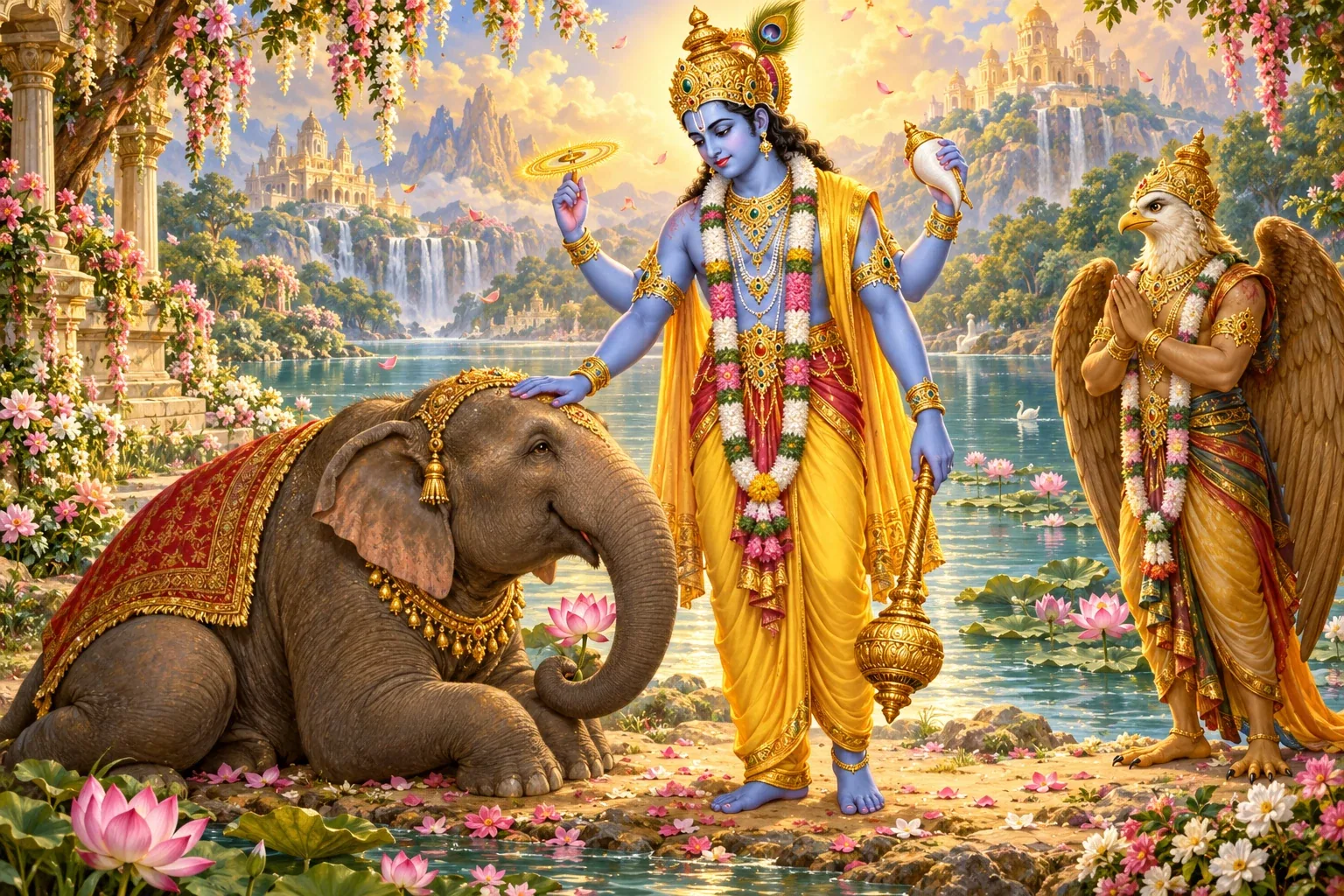
The rescue is swift where the struggle had been immeasurably long. Gajendra is touched by the Lord whose shelter he sought.
Two lives released
The crocodile’s death releases the Gandharva Huhu, who had lived in that form because of a sage’s curse. He honours the Lord and returns to his own realm.
Gajendra’s former life is also revealed. As King Indradyumna, he had withdrawn to worship Vishnu. When the sage Agastya arrived and received no welcome from the silent, absorbed king, the sage cursed him to an elephant birth. Devotion nevertheless remained as a hidden inheritance.
Freed from ignorance and bondage by the Lord’s touch, Gajendra receives a liberated form and accompanies Vishnu. The story’s title points beyond survival: moksha is not merely release from the crocodile, but release from the deeper captivity the struggle has come to represent.
EDITORIAL REFLECTION / PAUSE & REFLECT
The last reserve
was remembrance.
Gajendra does not discover devotion because the crisis makes him eloquent. He discovers that an older devotion is still present when every familiar strength has failed. What remains in us when control is gone?
TRADITIONS & INTERPRETATION
Rescue and liberation
in one sacred account.
This reader follows the Bhagavata Purana’s Vaishnava account in Skandha 8. The narrative identifies Vishnu as Narayana, the Supreme Lord who personally answers Gajendra’s surrender. It also gives previous-life accounts for both Gajendra and the crocodile.
The thousand-year struggle belongs to the Purana’s sacred narrative scale. It has not been converted into ordinary historical time. Likewise, Trikuta and the Ocean of Milk are presented within the text’s cosmology, not assigned a modern terrestrial location.
Only the narrative arc and central themes of Gajendra’s prayer are paraphrased here. The full theological prayer, concluding blessings and ritual recitation statements remain in the source. The four reader paintings and separate card artwork are AI-generated interpretations.
Read the chapter references and supplied-edition notes