
The leap and the tests
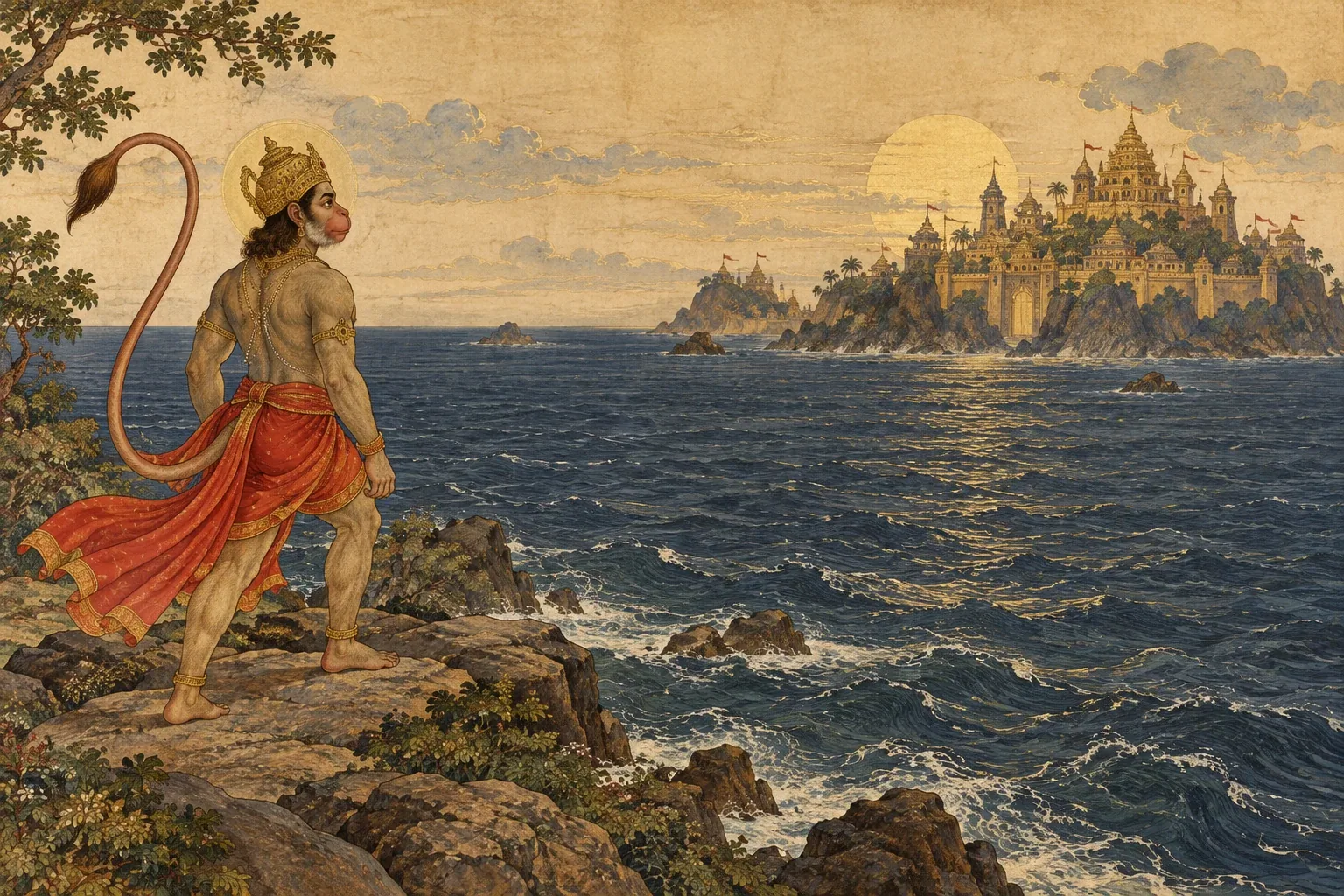
Hanuman prepares for a task unlike any ordinary journey. He offers salutations, gathers his strength and leaps across the sea toward Lanka. Below him are waves; ahead lies the city where he must find Sita.
Mainaka, a mountain rising from the ocean, offers hospitality. Hanuman honours the welcome but continues his urgent mission. Then Surasa, the mother of serpents, blocks his path at the gods’ request, testing his strength and resourcefulness. As her mouth widens, he grows larger—then suddenly becomes tiny, enters and leaves her mouth, fulfilling her demand without being swallowed. She blesses his purpose.
Another danger, Simhika, catches his shadow and draws him toward her. He overcomes her and resumes the crossing. The changing encounters demand different responses: courtesy, ingenuity and force. At last he reaches the shore and sees Lanka.
A city searched in silence
For the search, Hanuman takes a small form. The strength that carried him over the ocean must now serve a different need: entering a guarded city without revealing his purpose.
He examines Lanka’s buildings and Ravana’s residence, but Sita remains unseen. The city’s splendour cannot answer the question that brought him there. Unable to find her, he considers what a return without news would mean for Rama and everyone depending on the search.
He does not abandon the task. An Ashoka grove remains to be examined. Hanuman turns toward it, renewing his search beyond the places he has already explored.
Sita in the Ashoka grove
In the grove, Hanuman sees a woman worn by grief and guarded by rakshasis. Her condition is painful, yet her bearing and the signs he recognises lead him to Sita. He silently honours Rama and Lakshmana, conceals himself in the leaves of a shimshupa tree and waits.
Captivity has not won Sita’s consent. The narrative describes her refusal of Ravana and the threats surrounding her. Hanuman has found the person he sought, but discovery alone is not enough: he must approach her in a way that earns her trust.
A name, a story, a ring
From his hiding place, Hanuman speaks of Rama: his family, his exile, Sita’s abduction and the alliance with Sugriva. Hearing the familiar story, Sita looks toward the tree. The words bring hope, but an unfamiliar visitor in Ravana’s city must still be questioned.
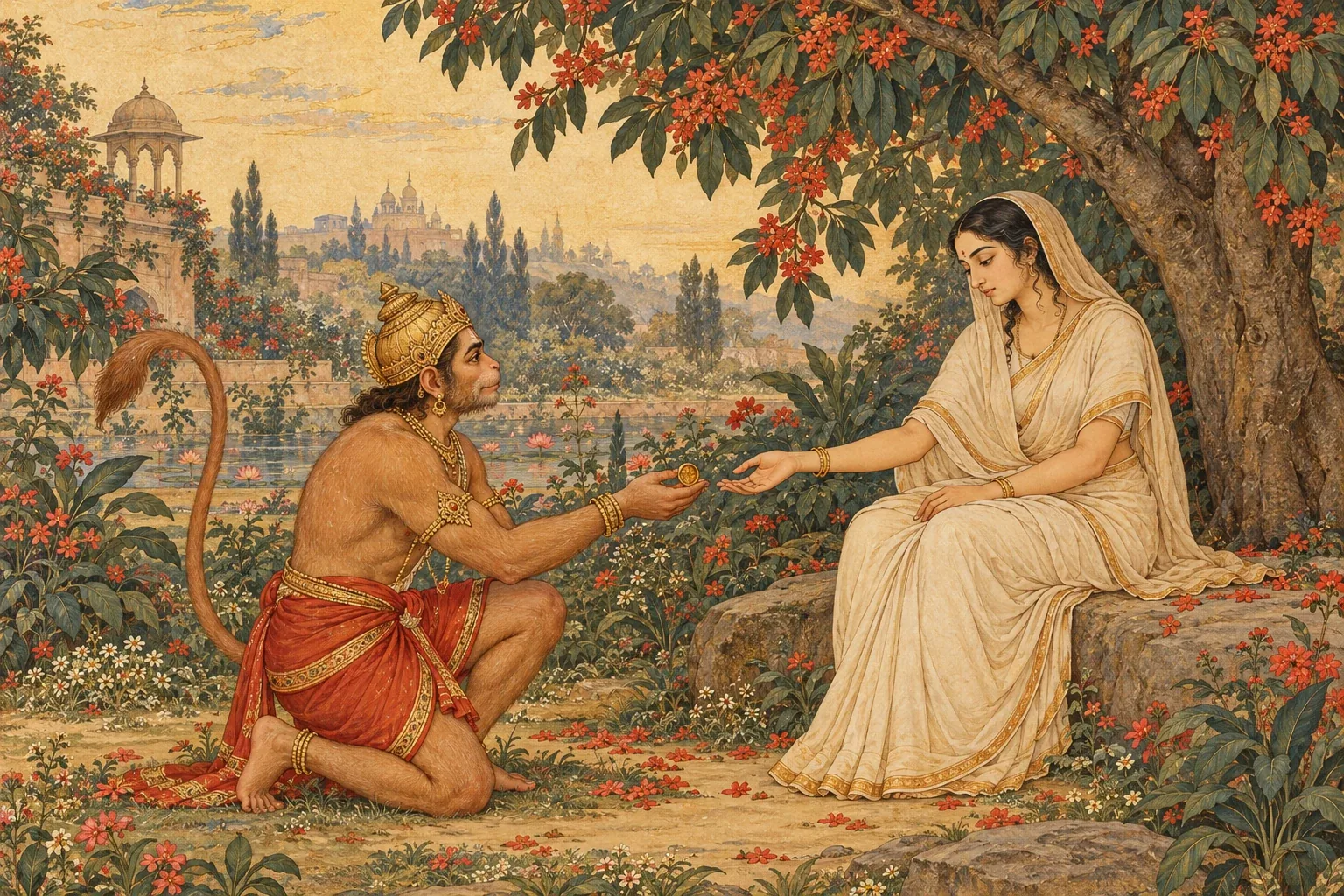
Hanuman identifies himself as Rama’s messenger. He presents a ring marked with Rama’s name, a sign connecting this extraordinary meeting to the husband Sita remembers. Recognition changes the encounter: the stranger becomes a trusted bearer of news.
He tells her of Rama’s devotion and sorrow. Relief and grief remain together. Rama is searching, yet the separation continues; Sita needs the message to travel back as urgently as it came.
The message entrusted to him
Hanuman offers to carry Sita across the ocean himself. When she doubts how his small form could bear her, he reveals his greater size and strength. Yet Sita’s answer considers more than his ability: the speed of the journey, the possibility of pursuit and the danger of fighting while protecting her.
She asks that Rama come and overcome Ravana. Her decision shapes Hanuman’s mission. He will return as a messenger, carrying her appeal rather than taking her away against her wishes.
Sita entrusts him with a token for Rama, the chudamani jewel, and a message urging swift action. Hanuman’s task now includes a precious responsibility: convey her words and her condition faithfully.
Before Ravana
Hanuman does not leave Lanka quietly. The narrative turns from his private meeting with Sita to confrontation: he damages the grove and battles the forces sent against him. The detailed encounters are condensed here.
Indrajit finally binds him with the Brahmastra. Hanuman respects the weapon’s divine authority and recognises an opportunity in capture: he may speak directly to Ravana. Even when other bonds replace the weapon’s restraint, he allows himself to be brought before the ruler.
He declares his mission and calls for Sita’s return. Ravana responds with anger. Vibhishana intervenes against the killing of an envoy, and Ravana orders a different punishment: Hanuman’s tail is to be set alight and he is to be paraded through the city.
Fire and a moment of doubt
When Sita hears of the punishment, she prays to the Fire-god for Hanuman’s protection. The burning tail does not cause him the pain he expects. He escapes and carries the fire through Lanka, sparing Vibhishana’s house.
Afterward, his triumph gives way to alarm. What if the blaze has harmed Sita? He reproaches the anger that might have endangered the very person he came to find. The account does not leave his destructive power without this searching moment of responsibility.
Reassured that Sita is safe, he sees her again before departing. He renews the promise that Rama will come with his allies. Then he prepares for the return crossing.
Hope carried home
Hanuman climbs Mount Arishta and leaps back across the sea. His companions welcome him and hear the account of the journey. Together they return to Rama, Lakshmana and Sugriva.
Before giving his report, Hanuman bows toward the direction where Sita remains. He tells Rama that he has found her, explains her captivity and devotion, and presents the chudamani. The jewel brings the distant meeting close: it is both recognition and the tangible trust of the person who entrusted it to him.
The search has achieved its purpose. Sita is still in Lanka; the larger struggle remains ahead. But uncertainty has become knowledge, and Rama now receives the message on which the next journey depends.
EDITORIAL REFLECTION / PAUSE & REFLECT
Courage that listens.
Strength that serves.
Hanuman’s journey invites us to notice more than the leap. He changes his approach, earns trust, listens to Sita’s decision and returns with her words. Where might thoughtful listening make our own acts of help more faithful to the person we hope to serve?
TRADITIONS & INTERPRETATION
Following Valmiki’s narrative
This reader follows the Valmiki Ramayana’s Sundara Kanda. Names use simplified spellings, and extended descriptions, conversations and battles are condensed. It does not combine this account with other Ramayana tellings. The reflection above is an editorial invitation, distinct from the primary narrative.
The artwork is an AI-generated devotional interpretation. It illustrates the story, rather than documenting historical locations or events.
Read the chapter references and edition notes