
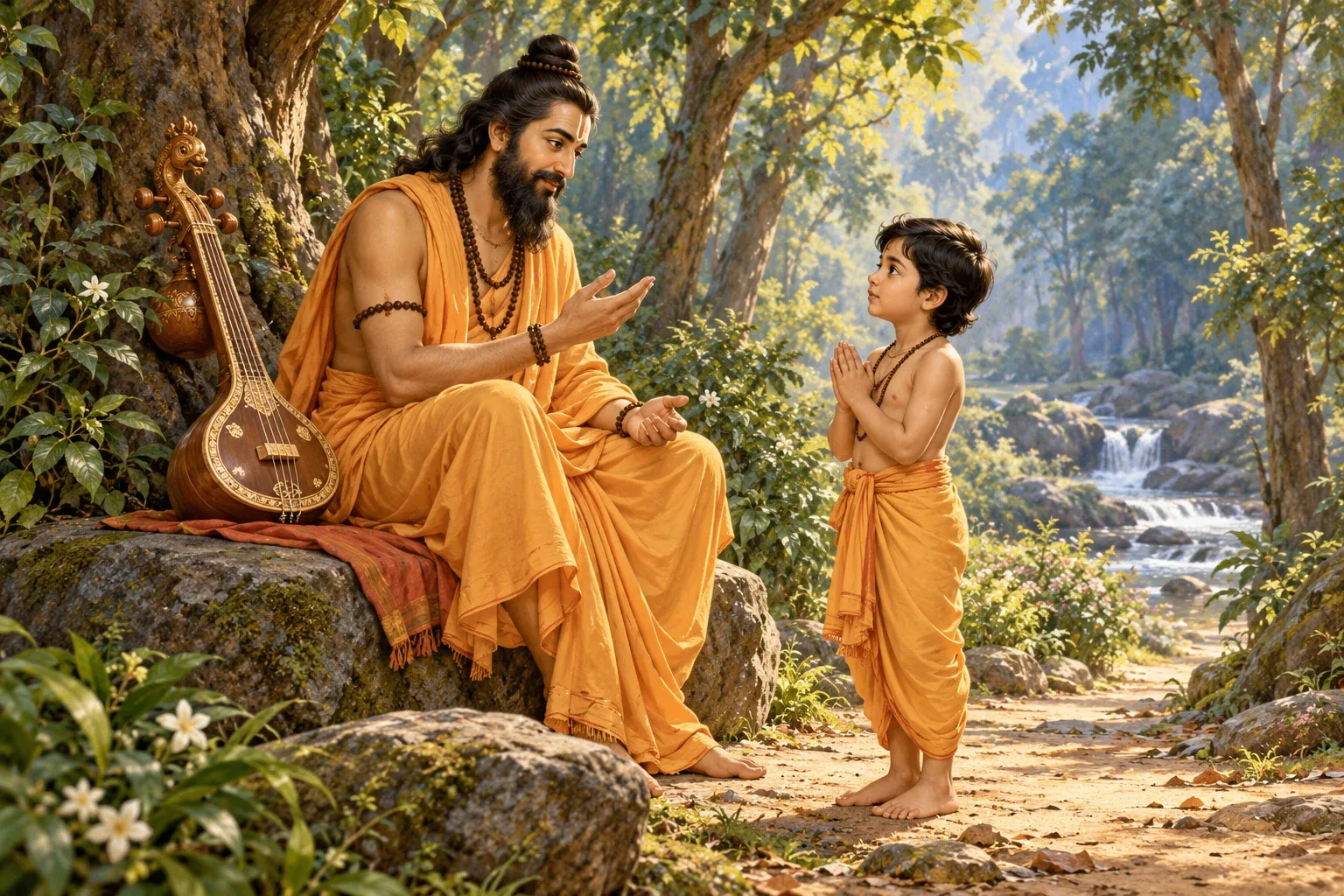
A place on his father’s lap
King Uttanapada has two queens, Suniti and Suruchi. Suniti’s son is Dhruva; Suruchi’s son is Uttama. The king favours Suruchi. One day, while Uttama sits on his father’s lap, Dhruva also tries to climb up. His father does not welcome him.
Suruchi speaks sharply to the child in the king’s presence. She tells him that being the king’s son is not enough: he has not been born from her. If he wants the royal seat, she says, he must worship the Supreme Lord and obtain birth through her. Uttanapada remains silent.
Dhruva goes to Suniti in tears. She takes him into her lap and learns what has happened. Her own sorrow is deep, yet she asks him not to wish harm upon others. She directs him toward the Lord whose care, she believes, can relieve his suffering.
A resolve that will not rest
His mother’s words give Dhruva a direction. He leaves his father’s city, carrying an ambition shaped by the hurt he has received: he wants a place higher than any his ancestors have held.
Narada learns of the child’s resolve and comes to him. The sage first counsels patience and a steadier response to honour and dishonour. But Dhruva admits that the wound is still too sharp for that advice to settle in his heart. He asks Narada to show him a way toward his goal.
Narada responds with compassion. He affirms Suniti’s guidance toward Vasudeva and sends Dhruva to Madhuvana beside the Yamuna. There he is to worship, recollect the Lord and gather his attention into devotion.
Narada gives the journey its form
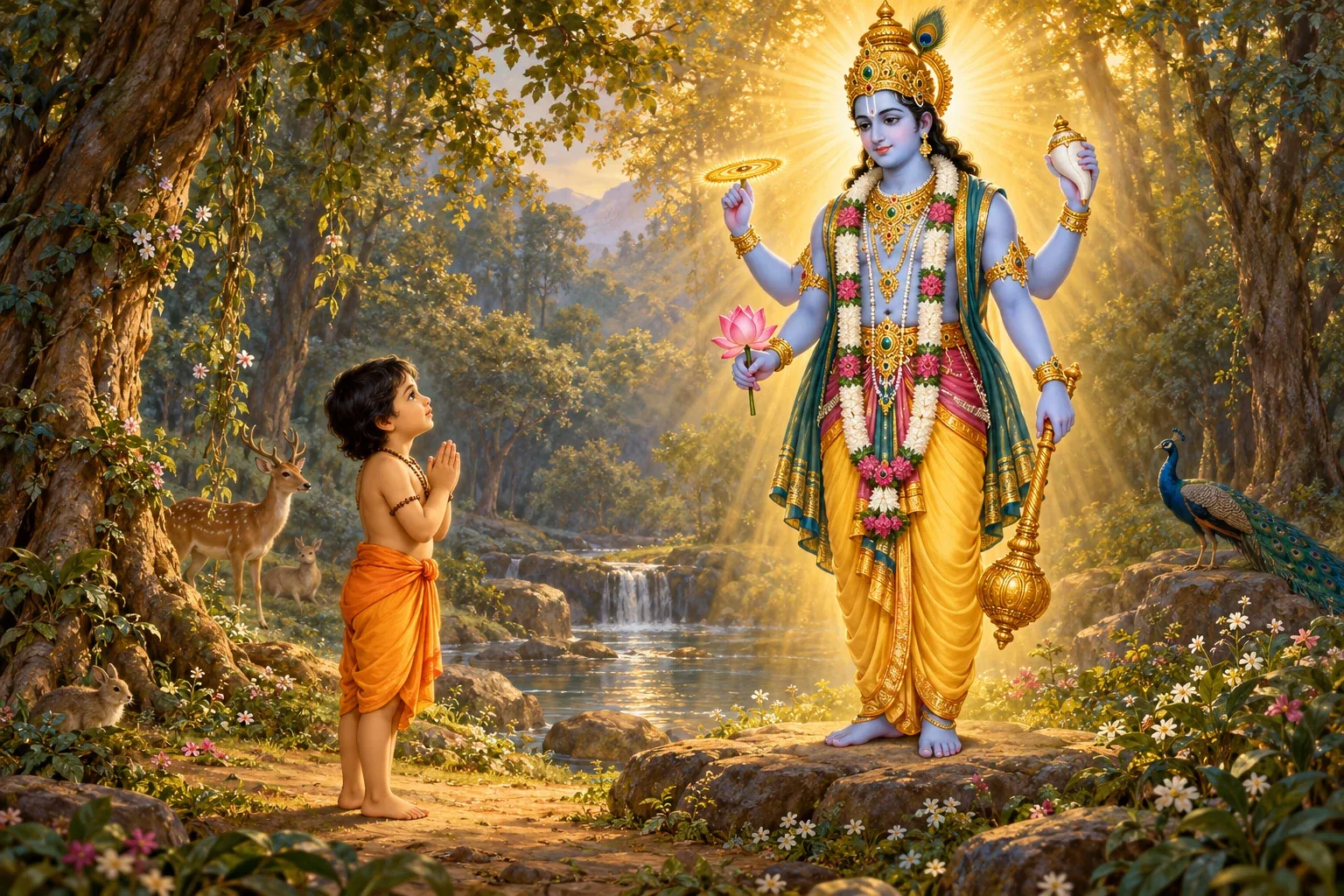
Narada describes a gracious divine form for Dhruva’s contemplation: dark as a rain cloud, clothed in yellow silk, adorned with a forest garland, and bearing the conch, discus, mace and lotus in four hands. The Lord’s expression is peaceful and welcoming.
The sage teaches Dhruva a mantra and the worship described in the text. Simple offerings from the forest—water, flowers, roots and fruits—can become part of his devotion. Narada joins inward attention with worship through mind, speech and action.
Dhruva honours his teacher and goes to Madhuvana. Narada then visits Uttanapada. The king is troubled by his treatment of his small son and fears for him in the forest. Narada reassures him that the child is under divine protection.
The forest becomes a place of attention
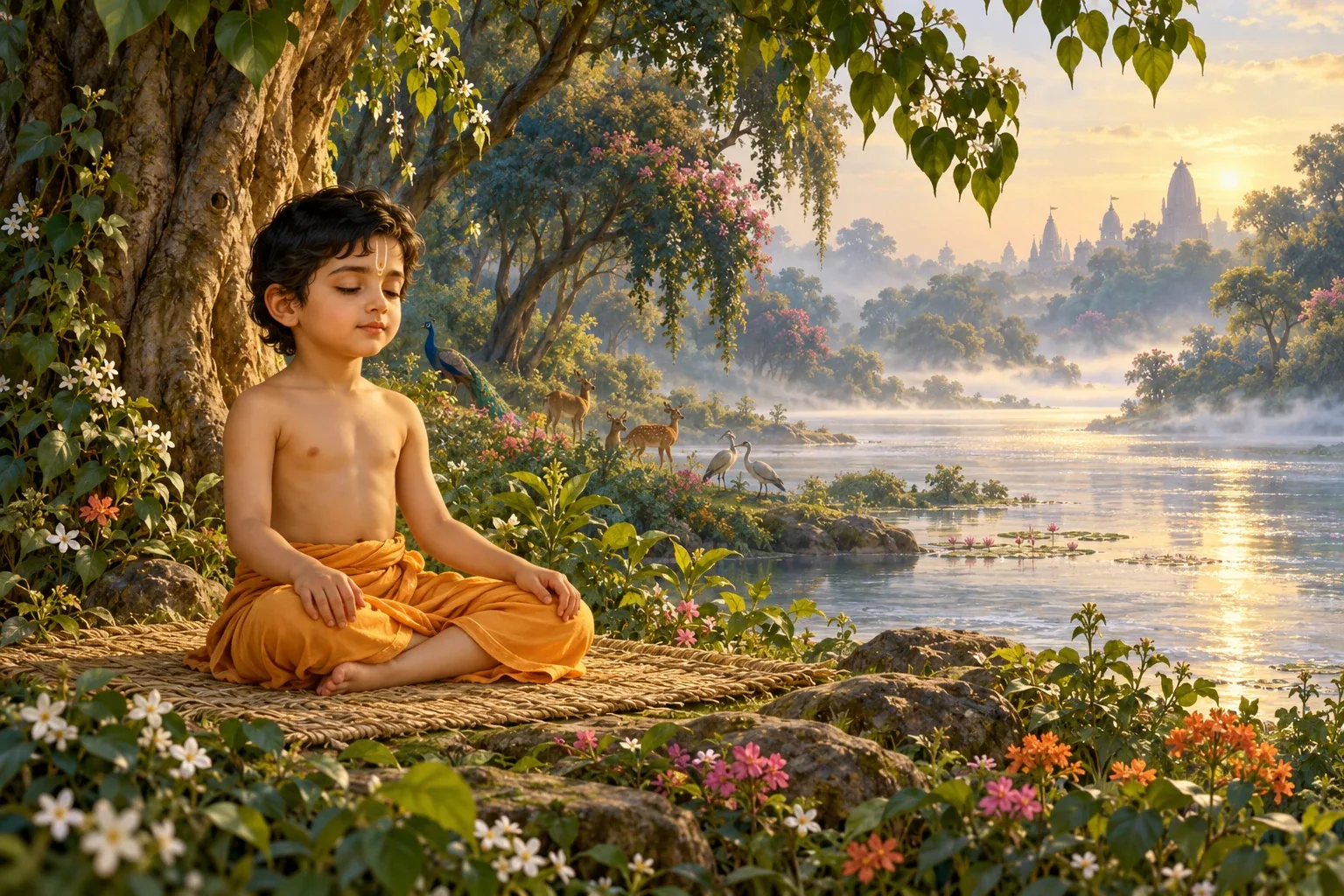
At Madhuvana, Dhruva follows Narada’s instruction. The narrative describes his tapas becoming increasingly intense over successive months. His attention turns away from surrounding distractions toward the form of Hari within his heart.
The account moves beyond an ordinary forest scene into cosmic scale. Dhruva’s absorption in the Lord affects the worlds themselves. The devas become distressed and seek refuge in Hari.
The Lord tells them not to fear. He will go to the child and bring this extraordinary austerity to its conclusion. The story turns from the seeker’s effort toward the divine response.
The presence before him
Hari comes to Madhuvana on Garuda. Within Dhruva’s meditation, the radiant form suddenly disappears. Startled, he opens his eyes—and sees that same form standing before him.
He bows to the ground. The child who left home seeking recognition now stands overwhelmed before the one he has contemplated. He wants to offer praise, but does not know how to speak it.
The Lord touches his cheek with the conch. Dhruva receives the power to express his devotion and begins his prayer. He praises the divine presence that awakens speech, gives life to the senses and sustains the world. The retelling condenses the extended prayer rather than presenting it as a translation.
An answer, and a changed understanding
The Lord knows the intention Dhruva has carried. He grants him the enduring, radiant station described in the text as Dhruvaloka, around which the heavenly lights revolve. He also foretells a period of righteous rule before Dhruva reaches the divine abode.
Yet receiving his wish does not leave Dhruva simply triumphant. After the Lord departs, he reflects on what he asked for. He has reached the giver of liberation while still carrying a desire for worldly distinction.
His regret is part of the account itself. The encounter has shown him a worth beyond the honour he originally sought. The story preserves both the granting of his desire and his recognition that the desire was smaller than the gift of divine presence.
A welcome home
News of Dhruva’s return reaches Uttanapada. The king comes out to meet him with his family and companions. Father and son embrace; Dhruva honours his father and both mothers.
Suruchi lifts the child who bows before her and blesses him through tears. Uttama and Dhruva meet with affection. Suniti embraces the son whose absence has caused her so much sorrow.
The city welcomes him with celebration. This childhood episode closes in reunion, following the account through the homecoming in chapter nine. The later events of Dhruva’s reign belong to the following chapters and are outside this reader.
EDITORIAL REFLECTION / PAUSE & REFLECT
What we seek.
What we come to value.
Dhruva begins with a longing for recognition and later questions the reward he sought. What can change when we examine the wish beneath our determination? This question is an editorial reflection on the episode.
TEXT & INTERPRETATION
One account, read within its setting
This page stays with the supplied Gita Press Sanskrit–Hindi Bhagavata Purana, first volume, chapters 4.8–9. It does not combine the episode with other Puranic tellings. The cosmic language, divine encounter and Dhruvaloka belong to this text’s devotional narrative; the illustrations are artistic interpretations.
The retelling follows a childhood episode rather than Dhruva’s entire life. The detailed discipline and long prayer are condensed. The closing reflection is editorial, separate from the primary account.
Read the edition and chapter references