
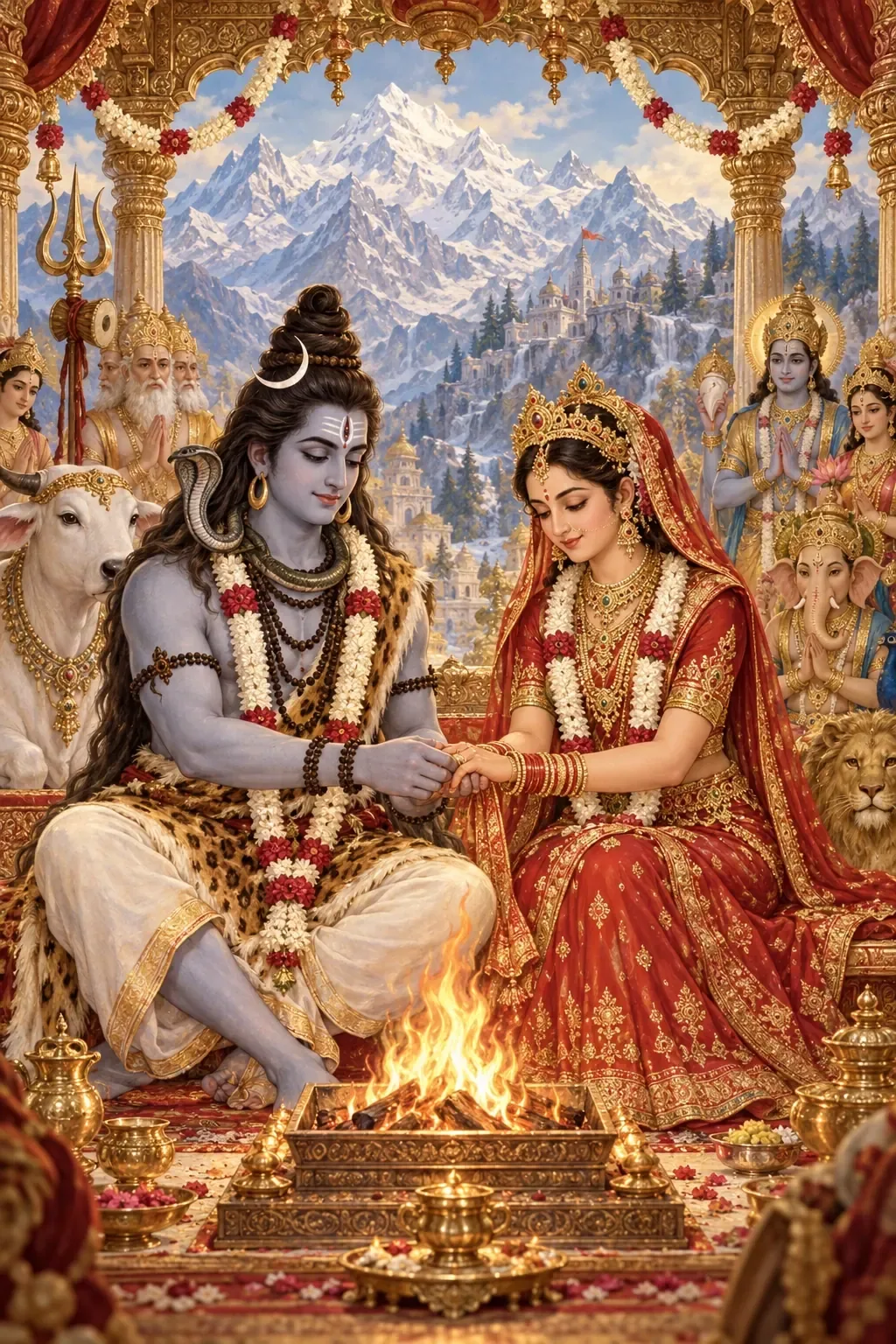
The daughter of the mountains
In the Himalayan kingdom of Himavat and Mena, the Goddess takes birth as Parvati. The Shiva Purana identifies her with Sati, who had relinquished her earlier body after Shiva was insulted. Her new life carries forward that sacred bond.
When Narada visits the family, he speaks of an extraordinary future. Parvati’s husband will be a yogin whose appearance and ways stand outside the expectations of a royal household. What seems troubling to her parents points, in the sage’s explanation, to Shiva.
The story begins with a contrast: the warmth of a mountain home and the stillness of the ascetic. Parvati’s journey will bring those worlds together.
A plan that turns to ashes
The devas face a crisis. Taraka’s boon makes him vulnerable only to a son born of Shiva and Parvati. They hope that their union will bring deliverance, but Shiva remains absorbed in meditation.
Kama, the god of love, tries to stir desire in Shiva. His intervention fails. Shiva sees him with his bow and arrow, and the fire of the third eye reduces him to ashes. The devas’ attempt to hasten the union has brought grief instead.
Parvati returns home shaken by what she has witnessed. Separation from Shiva weighs upon her. It is here that Narada comes to guide her toward a different path: sustained spiritual discipline.
Parvati chooses her path
Narada teaches Parvati the five-syllabled mantra of Shiva and directs her toward tapas. She asks her parents’ permission to leave for the forest. Himavat considers her wish; Mena, fearing the hardships ahead, first urges her to stay at home. At last her mother gives permission.
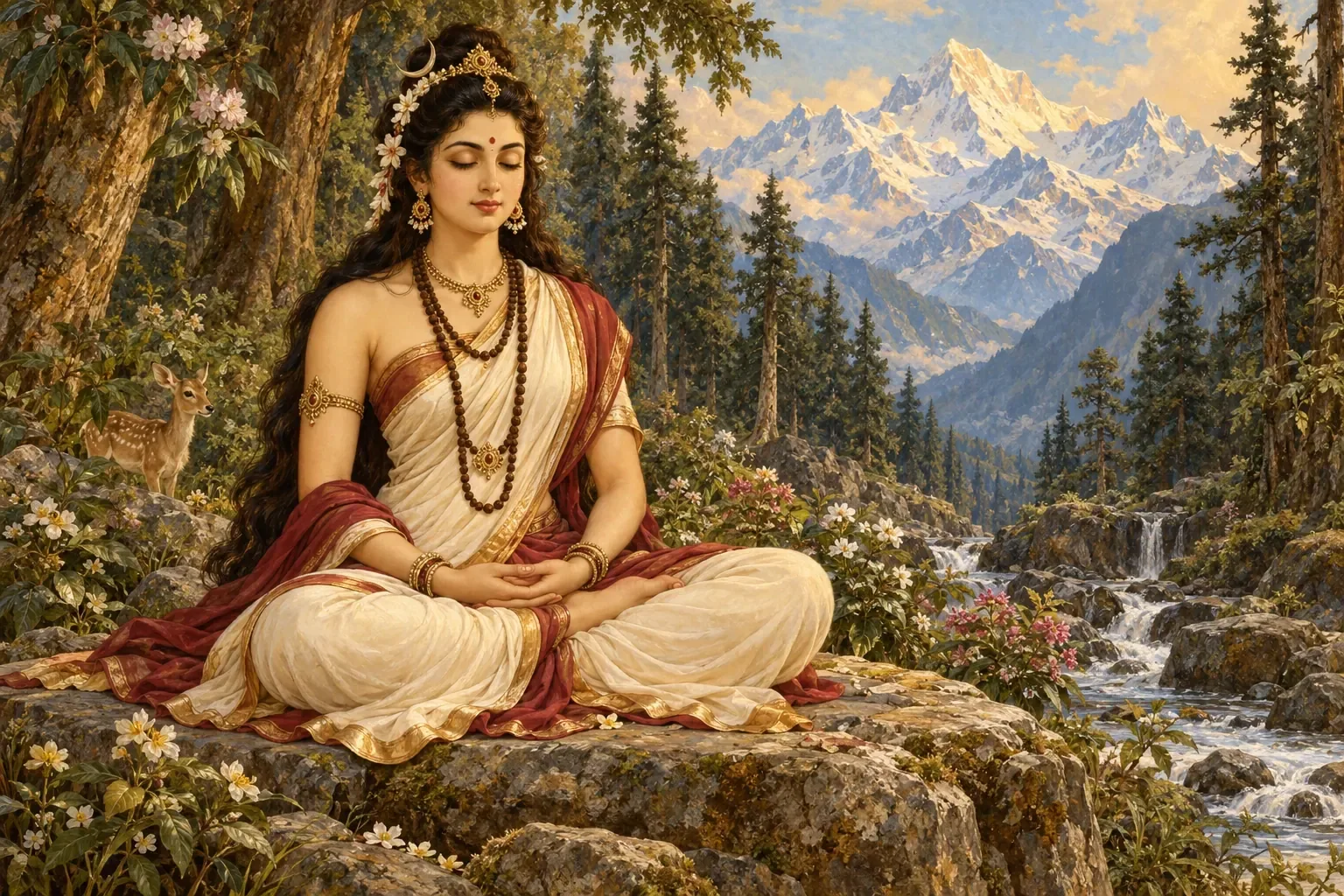
Parvati sets aside royal ornaments and takes up the life of an ascetic. Her companions Jaya and Vijaya remain beside her. The text describes her bearing the changing seasons with extraordinary steadiness, her mind fixed on Shiva.
Her discipline includes acts of care. She waters the trees she has planted and offers hospitality. The narrative later names her Aparna, recalling her renunciation even of leaves for food. These are the immense austerities of a goddess in sacred narrative.
A resolve that will not bend
Moved by the devas’ appeals, Shiva agrees to the union. He then sends the seven celestial sages to test Parvati’s resolve. Their words are deliberately discouraging: why choose a wandering ascetic, with ashes, serpents and strange attendants, when another divine bridegroom appears more suitable?
Parvati does not accept their judgment. She respects the guidance she received from Narada and explains that Shiva’s outward appearance does not exhaust his reality. In her understanding, the great yogin is the supreme Brahman, beyond ordinary measures of status and wealth.
Her answer is firm. She has chosen Shiva, and the sages cannot turn her from that choice. The test reveals both her devotion and her ability to speak for herself.
The visitor in disguise
Shiva now comes to the forest himself, disguised as an aged ascetic with matted hair, a staff and an umbrella. Parvati receives the visitor with reverence. He asks about her family and the purpose of her tapas.
When her devotion to Shiva becomes clear, the visitor begins to criticise the very deity she seeks. He contrasts her royal upbringing with Shiva’s unusual dress and way of life. Parvati responds by defending Shiva’s divine nature. She will not remain to hear him disparaged.
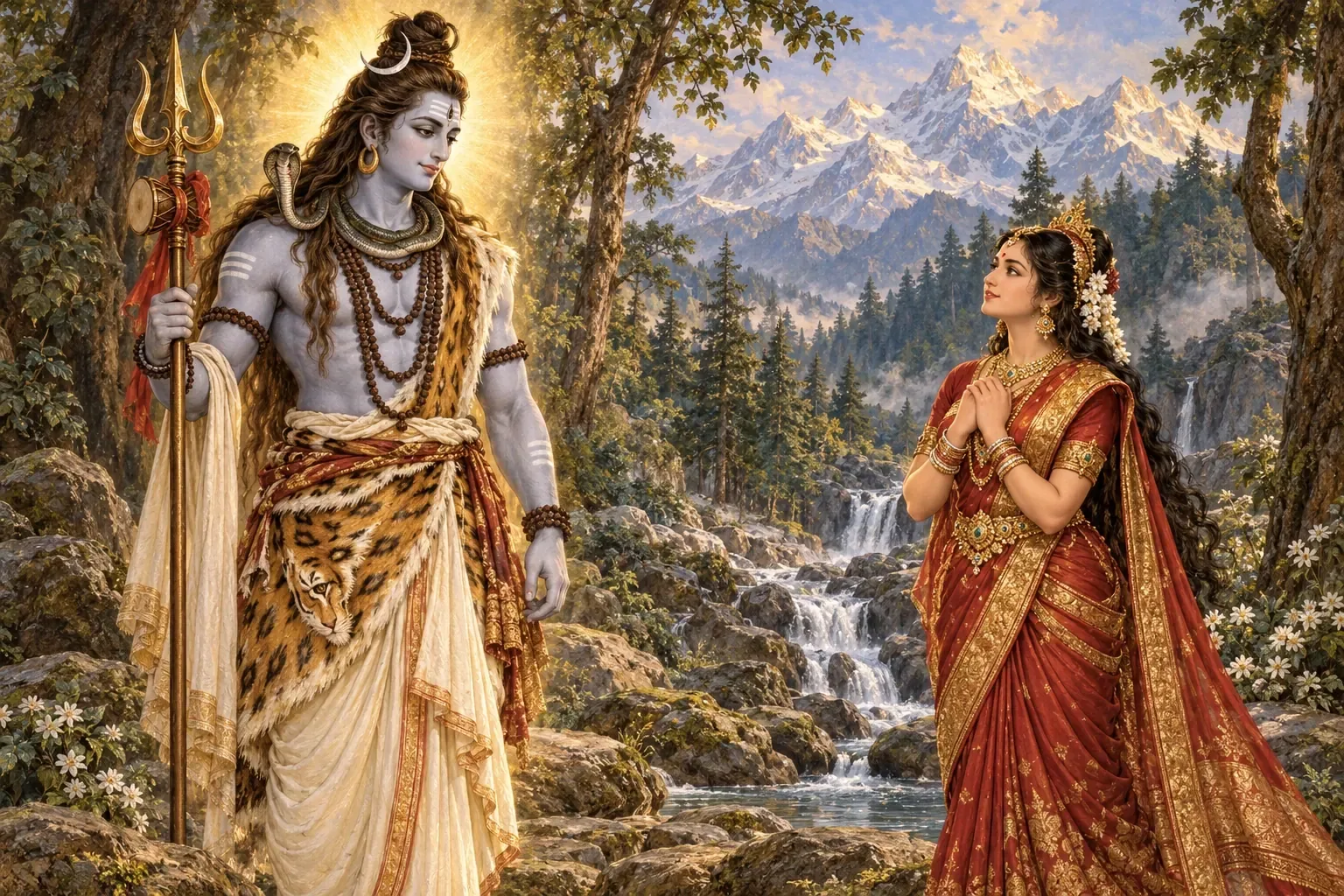
As she prepares to leave, the disguise falls away. Before her stands Shiva in the beautiful form she has contemplated. He acknowledges her steadfastness, asks her forgiveness for the tests, and declares his affection. Her long weariness gives way to joy.
A union shared with the family
Parvati asks that their marriage be celebrated properly with her parents. She wishes Himavat to share in the honour of the union, and the customary rites to be observed. Shiva accepts her request.
The narrative then turns toward the family’s doubts and the work of the sages. Shiva sends the seven sages, accompanied by Arundhati, to Himavat’s home as emissaries. What began in the solitude of the forest now enters the life of a household.
The wedding brings more than two divine figures together. Parents, sages, attendants and devas become part of the celebration. Parvati’s personal resolve is given a public and ceremonial form.
The mountain kingdom celebrates
Shiva’s wedding procession fills the road with devas, sages and his innumerable ganas. Their unusual forms make the arrival unlike any royal procession. Mena, looking for her daughter’s bridegroom, is bewildered by what she sees.
Shiva then appears in a radiant, beautifully adorned form. The crescent moon shines upon him, and the guests rejoice. The ascetic whom Parvati has recognised is now welcomed as the divine bridegroom.
With the priest Garga guiding Himavat, the marriage rites begin. When Shiva’s lineage is questioned, Narada explains that ordinary genealogy cannot contain his divine reality. Himavat offers Parvati in marriage, and the ceremonies proceed amid blessings, music and gifts.
The concluding rites bring Shiva and Parvati together on the same seat. The mountain kingdom is filled with celebration.
Compassion, then a farewell
In the midst of the wedding’s joy, Rati still grieves. She asks Shiva to restore Kama, whose death has left her alone. The celestial women join her appeal. Shiva looks upon the ashes with compassion, and Kama appears again.
The narrative closes another circle: the power that burned desire also responds to sorrow. Rati is reunited with her beloved, and the celebration makes room for her happiness.
When the time comes to depart, Parvati and her family weep at their separation. With blessings from her parents and elders, she begins the journey. Shiva and Parvati return to Kailasa, bringing the story of tapas and marriage to its close.
PAUSE & REFLECT
Devotion with
a voice of its own.
Parvati’s devotion is expressed through choices, discipline and clear speech. She answers those who question her, asks that her family share in the marriage, and remains central to the unfolding union.
TRADITIONS & INTERPRETATION
One sacred account,
many ways to contemplate.
This retelling follows the Shiva Purana’s Shaiva account, in which Shiva is described as supreme reality and Parvati as divine creative nature. Their dialogue also presents them as the cosmic Self and cosmic nature, participating in the world for their devotees.
Alongside the marriage narrative, readers may contemplate the meeting of inward stillness and active devotion. That is a reflection on the story, rather than a separate episode. Other sacred texts and devotional traditions give the Goddess a different theological emphasis.
Kama’s restoration here is performed by Shiva at Rati’s request. The Lalita Mahatmya gives a different account, in which Lalita restores him. Each retelling keeps the setting of its own text.
Read the chapter references