
The promise remembered
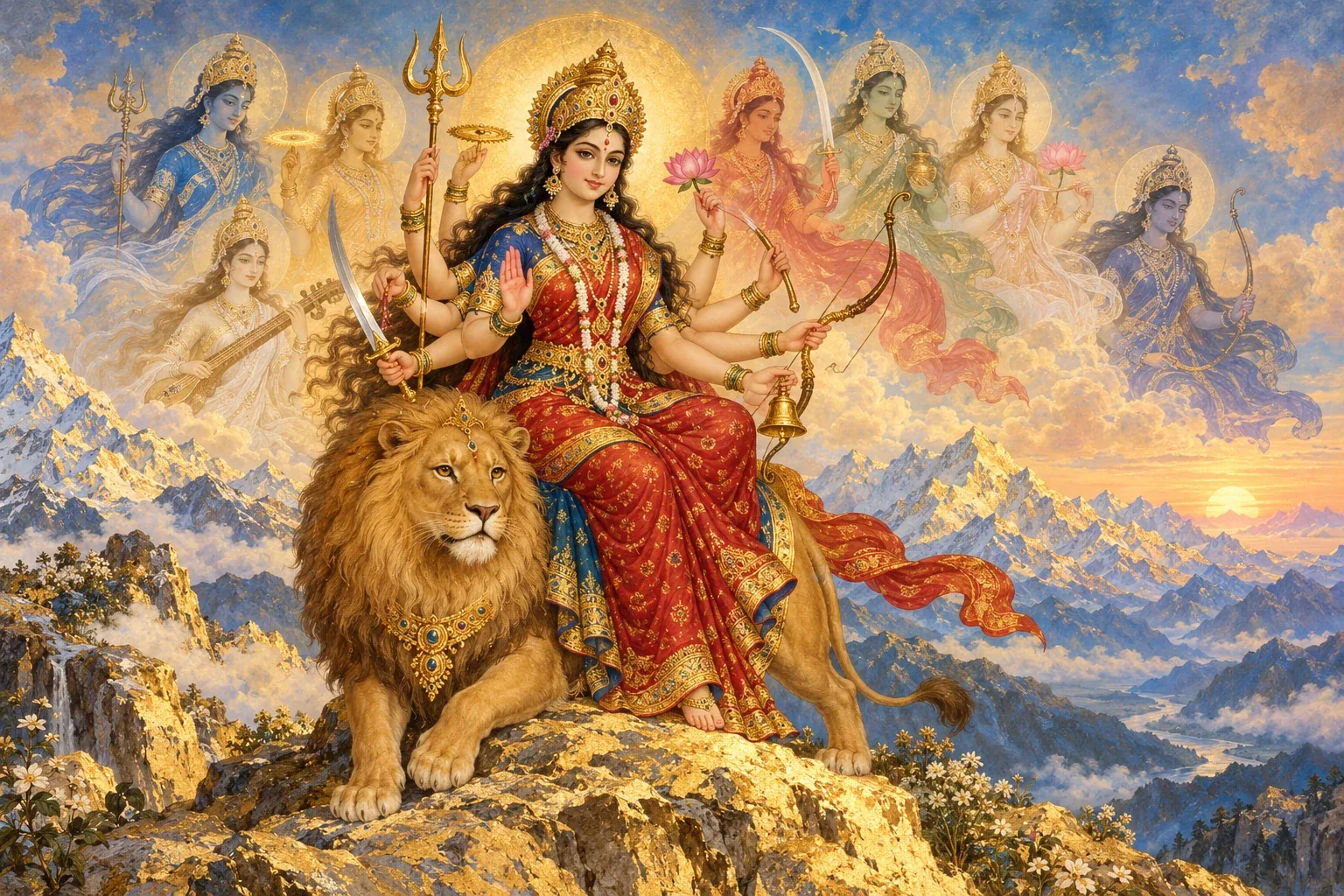
Shumbha and Nishumbha have driven the gods from their stations and claimed the offerings and treasures of the three worlds. Remembering an earlier promise—that the Goddess would answer when called to mind in danger—the gods go to the Himalayas and praise her.
They honour the Goddess who abides in all beings as consciousness, intelligence, sleep, hunger, power, patience and compassion. Their hymn does not address a distant force alone. It recognises divine presence throughout living existence.
While they pray beside the Ganga, Parvati approaches and asks whom they praise. From her body emerges an auspicious Goddess. Because she comes from Parvati’s bodily sheath, the account names her Kaushiki. Parvati’s remaining form becomes dark and is celebrated as Kalika.
Kaushiki and the message
Chanda and Munda see Ambika illuminating the mountain and report her extraordinary radiance to Shumbha. They flatter their king: since he has seized the finest treasures of heaven, they say, this incomparable woman should also belong to him.
Shumbha sends the messenger Sugriva. He lists the king’s conquests and tells the Goddess to choose Shumbha or Nishumbha. Ambika answers without alarm. She acknowledges their power, but recalls a vow: only one who defeats her in battle and equals her strength may claim her hand.
The messenger warns that no single woman could withstand the two brothers. The Goddess nevertheless sends him back with the same answer. The conflict begins not because she has misunderstood the demand, but because she refuses to abandon her own word.
Dhumralochana advances
Enraged by the reply, Shumbha orders his commander Dhumralochana to seize the Goddess by force. The commander reaches the snowy mountain with a large army and repeats the threat.
Ambika tells him that, backed by such force, he may attempt what his king has ordered. Dhumralochana rushes forward. A single fierce utterance from the Goddess reduces him to ashes.
The army attacks with arrows, spears and axes. Her lion springs among them and scatters the force. When Shumbha hears that both his commander and army have fallen, he sends Chanda and Munda with another host.
Chanda, Munda and Chamunda
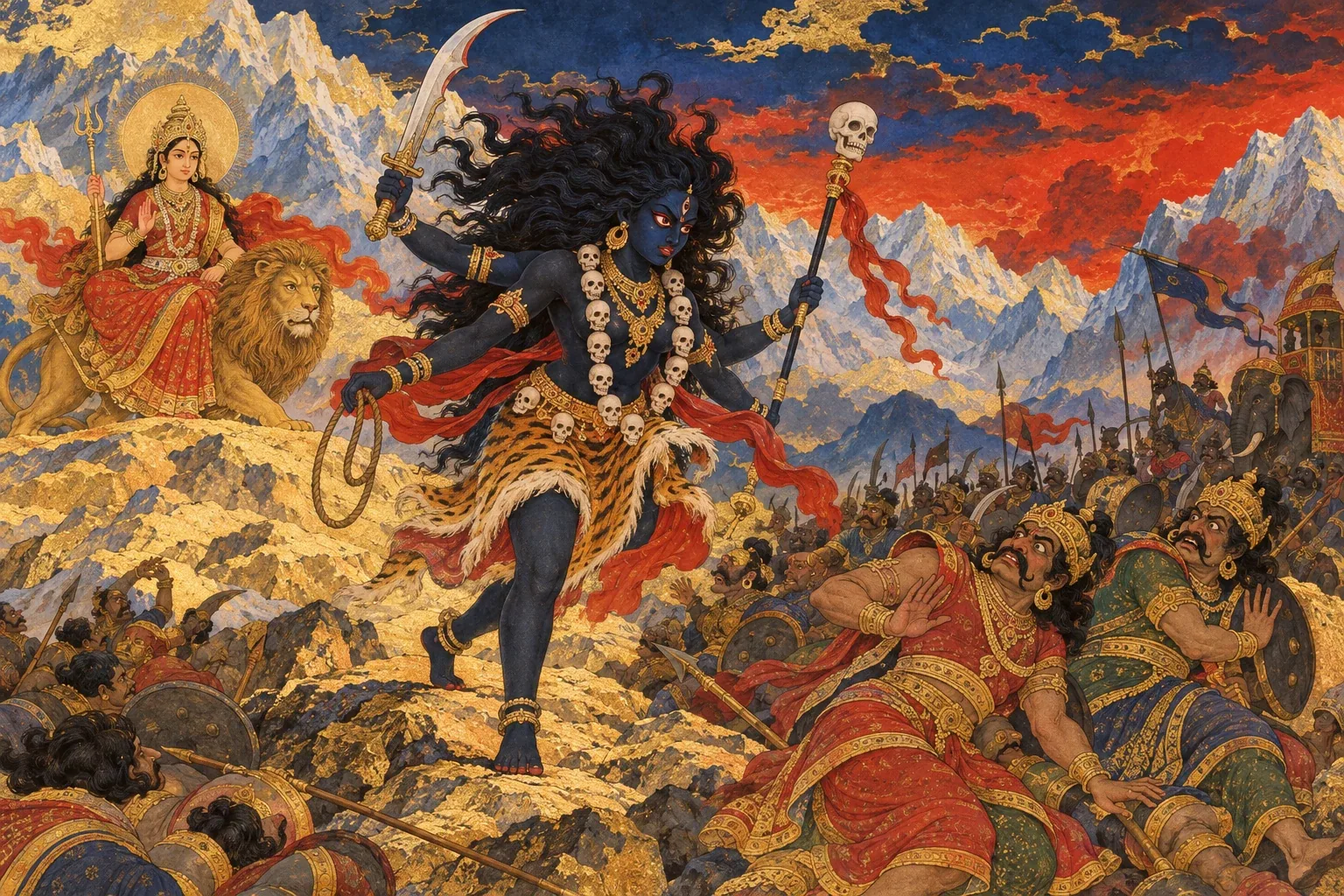
The new army finds Ambika seated upon her lion on a golden mountain peak. As soldiers close around her, her face darkens with anger. From her furrowed forehead bursts Kali—terrible, emaciated and roaring, with sword, noose and skull-topped staff.
Kali moves through the army with unstoppable force. Chanda and Munda attack her with weapons, but she overcomes them both. Carrying the defeated commanders to Chandika, she declares that Shumbha and Nishumbha still remain.
Chandika gives the fierce Goddess a name that joins the names of the two commanders: because she has brought Chanda and Munda, she will be celebrated as Chamunda.
The powers take form
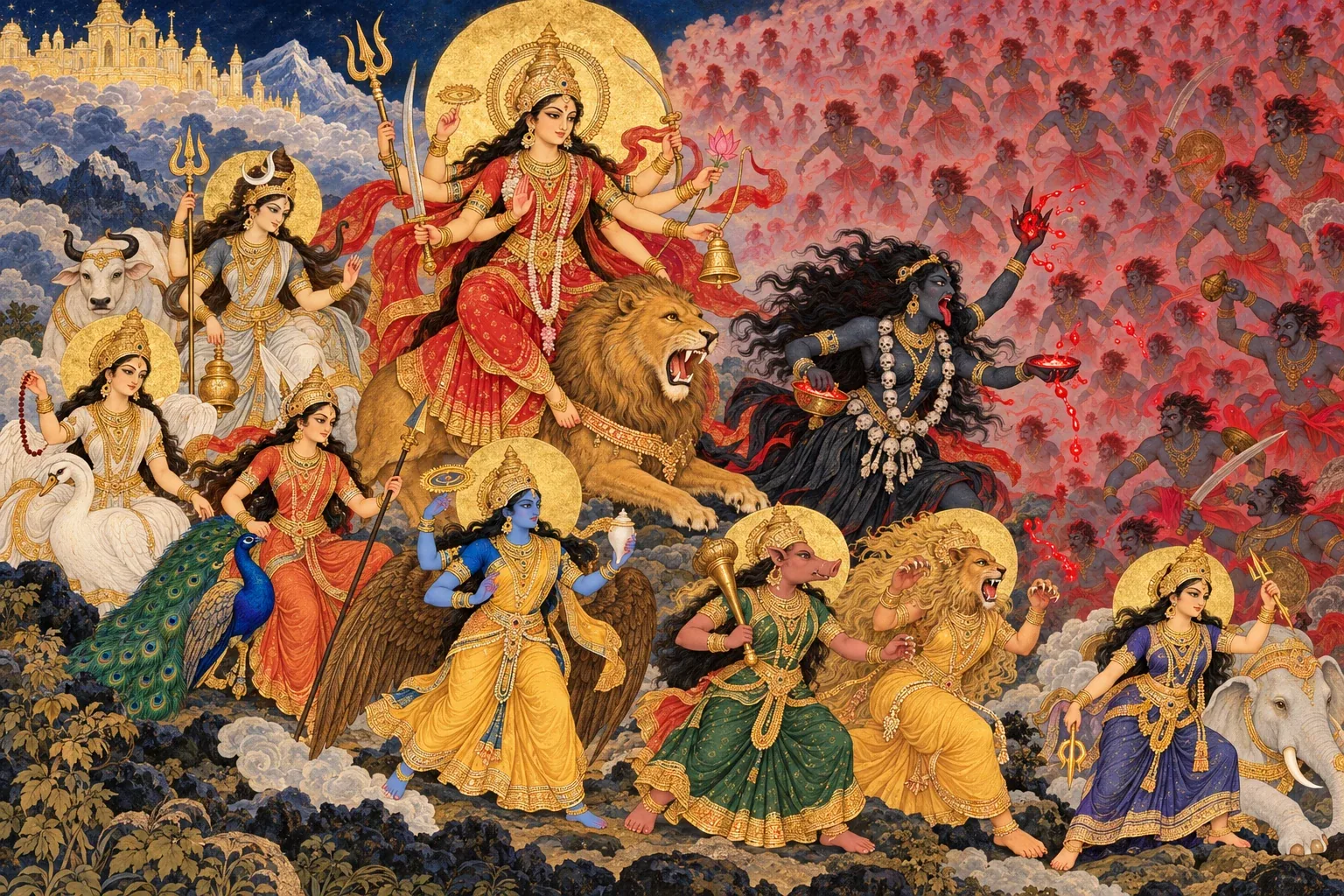
Shumbha now calls his great armies into the field. Chandika’s bowstring, her lion’s roar and her bell fill the space between earth and sky. As the forces gather, feminine energies issue from Brahma, Shiva, Karttikeya, Vishnu and Indra, each bearing the form, ornaments, vehicle and implements associated with that deity.
Brahmani comes with rosary and water pot; Maheshvari with trident and bull; Kaumari with spear and peacock; Vaishnavi with conch, discus and Garuda. Varahi, Narasimhi and Aindri also take their places. These are not presented as unrelated visitors: the narrative calls them divine energies who join Chandika’s battle.
Another fierce power emerges from Chandika herself. She appoints Shiva as her messenger, earning the name Shivaduti. The message offers a final choice: restore the gods’ realm and depart, or come forward to battle. The asuras choose battle.
Raktabija’s multiplying power
The divine energies push back the armies, but Raktabija enters the struggle with an extraordinary power. Whenever a drop of his blood reaches the earth, another warrior of his size and strength springs from it. Every wound multiplies the danger.
Aindri’s thunderbolt, Vaishnavi’s discus and the other weapons strike him, yet the battlefield fills with new forms born from the falling blood. The gods grow alarmed: ordinary victory has become the very means by which the threat increases.
Chandika changes the strategy. She tells Chamunda to open her mouth wide and drink every drop before it reaches the ground, while also consuming the new forms that arise. The divine energies continue their attack; Chamunda intercepts the blood. Unable to reproduce, Raktabija is finally overcome.
Nishumbha’s last assault
With Raktabija defeated, Shumbha and Nishumbha enter the battle themselves. Nishumbha strikes the lion and attacks Chandika with sword and shield. She breaks his weapons one after another and casts him down, but he rises again.
Armed with many weapons, Nishumbha renews the assault. The Goddess answers each attack. When her spear pierces him, another immense warrior emerges from within his body and challenges her. Chandika laughs, severs this emerging force, and Nishumbha finally falls.
Shumbha sees his brother defeated. His anger now turns toward the many Goddess forms surrounding Chandika. He accuses her of depending upon the strength of others.
The Goddess stands alone
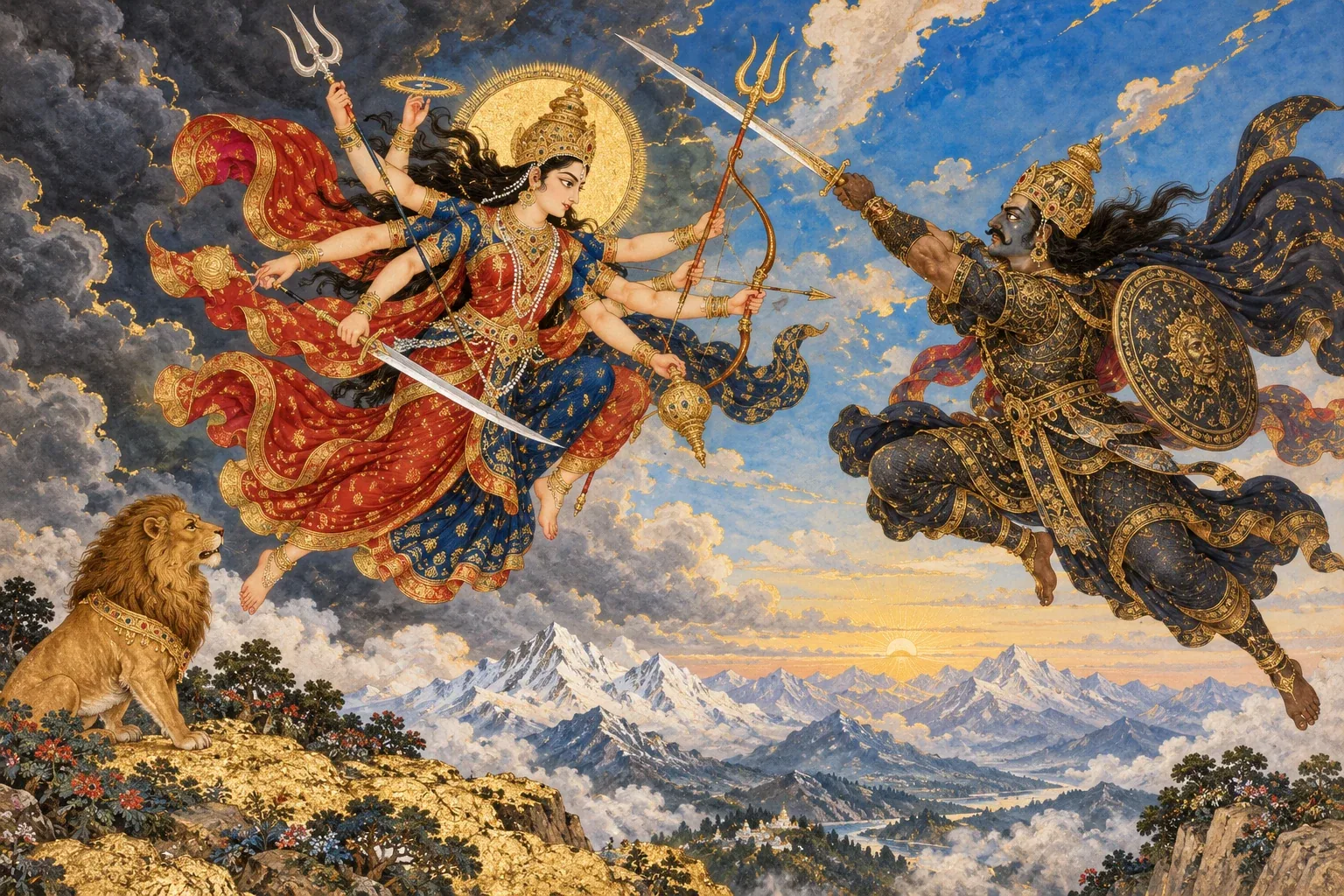
Chandika answers that she alone exists here: the other forms are manifestations of her own power. Before Shumbha’s eyes, the divine energies withdraw into the Goddess. She stands alone and invites him to remain firm in the final contest.
The two exchange arrows and celestial weapons. When Shumbha breaks one weapon, she takes up another. The struggle rises into the sky, where Chandika fights without any visible support. She seizes him, whirls him and casts him down to earth.
Shumbha rises once more and charges with his fist raised. The Goddess meets his last attack and strikes him with her spear. He falls, shaking the earth and its mountains and seas.
Order restored
After Shumbha’s fall, the universe grows calm. Rivers return to their channels, the sky clears, favourable winds blow and the gods rejoice. The restored landscape marks the end of a disorder that had reached across the three worlds.
Indra and the other gods praise the Goddess as Narayani: the support of the world, the power within creation, preservation and dissolution, and the refuge of those in distress. Their hymn honours the many forms that have just appeared in battle while addressing the one Goddess through them all.
The gods ask that she continue to protect the worlds whenever such forces arise. She grants their request and foretells future manifestations. The episode therefore closes not only with a past victory, but with an enduring promise of protection.
EDITORIAL REFLECTION / PAUSE & REFLECT
When the problem multiplies,
wisdom changes the method.
Raktabija cannot be overcome by repeating the same attack. Chandika first understands how the danger reproduces, then coordinates every power toward a different response. Where might clear attention matter more than greater force?
TRADITIONS & INTERPRETATION
Many forms,
one divine power.
This reader follows the third and final episode of the Devi Mahatmya. The text’s own movement is important: divine powers take distinct feminine forms, act together, and then return into Chandika before the final duel. The account presents unity without erasing the significance of manifestation.
Spellings are simplified for English readers. Shumbha and Nishumbha may also appear as Śumbha and Niśumbha; Chanda as Caṇḍa; and Raktabija as Raktabīja. Graphic battle details are condensed, but the emergence of Kali, the naming of Chamunda and Raktabija’s blood-born multiplication remain part of the narrative.
All four paintings are AI-generated devotional interpretations in imagined settings. They are not historical photographs or exact diagrams of every form and attribute described by the text.
Read the chapter references and supplied-edition notes