
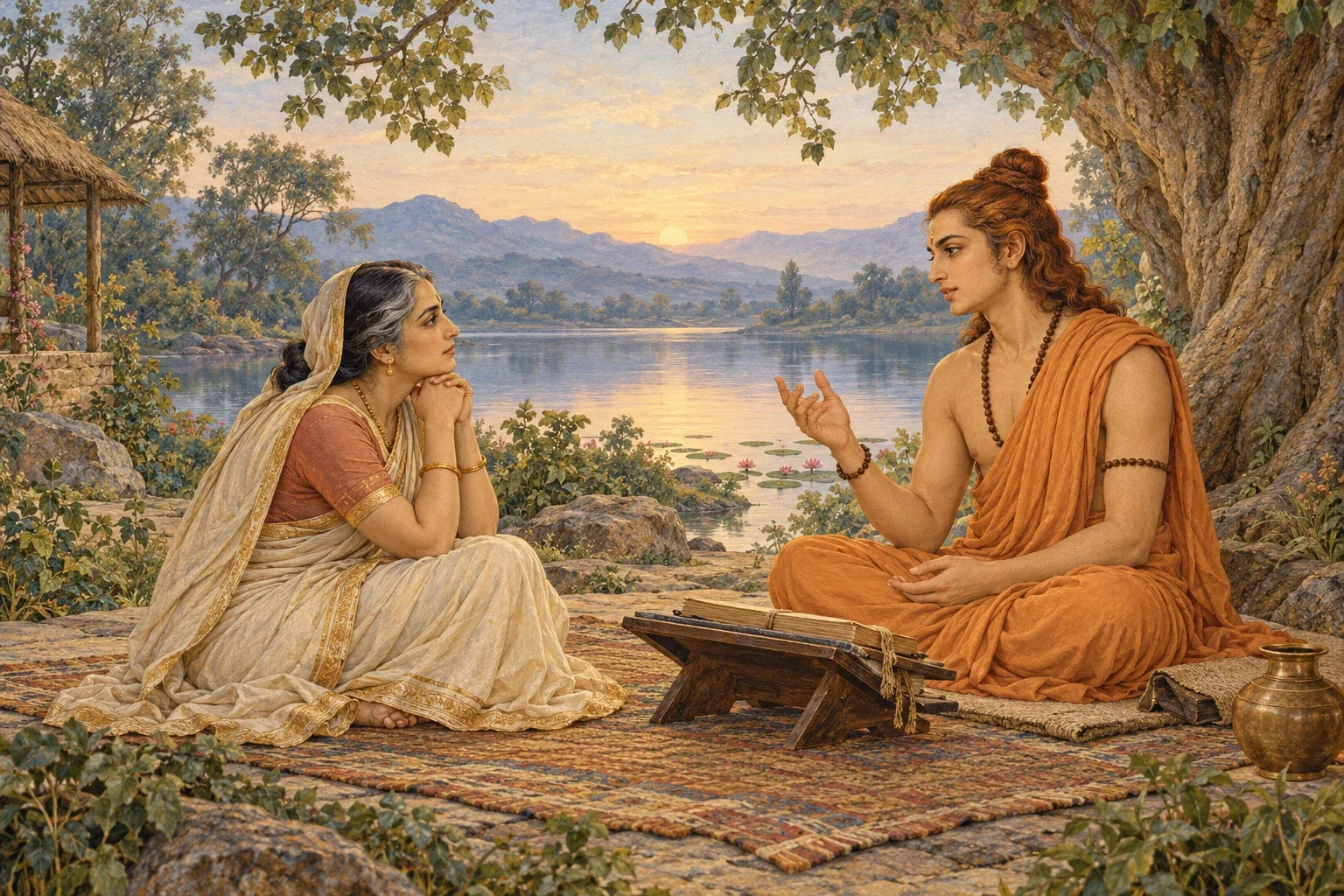
Devahuti’s question
Kardama has left for the forest. Kapila stays with his mother, Devahuti, at Bindu-sarovara. She approaches him with a question born of her own experience: her senses have long chased what they desire, while confusion has grown around what she calls “I” and “mine.” She asks him to lift that confusion.
The Bhagavata tells the encounter through Maitreya’s account to Vidura. It honours Devahuti as an active seeker. She does not simply receive a finished doctrine; she asks what leads from attachment toward freedom and returns with further questions as the teaching unfolds.
The mind and its attachments
Kapila begins with the mind. When it clings to the qualities and objects of nature, it becomes a means of bondage. Turned toward the divine, it can become a means of release. The change is not a denial of experience; it is a change in what the mind takes to be its lasting home.
He speaks of clearing the possessive habits that gather around “I” and “mine.” With knowledge, detachment and devotion, a person may perceive the self beyond the changing play of prakriti. Devahuti’s question about liberation is thus joined to careful attention to the workings of her own mind.
Companionship and devotion
Kapila also asks Devahuti to consider companionship. Attachment can tighten a bond to the world; in the company of compassionate and steady people, that same human capacity for connection can open a way toward freedom. He describes hearing and sharing the Lord’s stories among such companions, through which trust, love and devotion grow.
Devahuti asks what form of devotion and yoga can bring her to the end she seeks. Kapila’s answer keeps practice, understanding and devotion together. This is a teaching spoken within a relationship: a mother’s inquiry gives shape to her son’s explanation.

Nature and the witnessing self
Kapila then names the principles through which experience is understood. Prakriti is the changing field of nature and its qualities; purusha, the self, is described as beyond those qualities and as a witness. The account traces the emergence of mind, senses and the elements, explaining how a person can mistake nature’s activity for the deepest self.
This is Sankhya in the Bhagavata’s own setting: an inquiry through distinctions, taught by Kapila as a divine figure and bound throughout to devotion. The list of principles serves a question about liberation, not a scientific map of the universe. The details are far longer in the source than this reader can reproduce.
Seeing without confusion
Devahuti presses further. If purusha and prakriti are so closely experienced together, how can their relationship cease to bind? Kapila answers with discernment and sustained practice. He compares freedom from nature’s old hold to waking from a dream: what seemed compelling in sleep no longer commands the awakened person in the same way.
His teaching also returns to devotion. Devahuti asks about the way of bhakti, and Kapila speaks of a heart free from hostility, marked by care for living beings. Seeing the divine in others matters alongside worship. The long account continues through yoga, time and the consequences of attachment; this retelling keeps its focus on her central inquiry.
A teaching put into practice
Devahuti praises Kapila and receives his assurance that the path he has taught can bring her to its goal. Kapila departs with her permission. Her next steps matter as much as the conversation: at the hermitage she follows the discipline he described, turning from former comforts toward meditation, devotion and insight.
Maitreya closes by saying that Devahuti reaches liberation through this practice. The ending belongs to her. A teaching that began with a mother’s question becomes a way she lives, until the confusion that prompted her question no longer holds her.
EDITORIAL REFLECTION / PAUSE & REFLECT
What changes
when we ask?
Devahuti’s questions begin with an honest account of attachment and continue through careful listening. Which assumption about yourself becomes clearer when you examine it rather than defend it? This is an editorial reflection, separate from the text’s teaching.
TEXT & INTERPRETATION
A devotional Sankhya,
in its own setting.
This page follows the supplied Bhagavata Purana, Skandha 3, especially chapters 25–29 and 33. It does not equate this devotional teaching with every later or classical Sankhya formulation. Kapila is also named in the site’s Bhagiratha and the Ganga reader from the Ramayana; that separate episode is not blended into Devahuti’s conversation here.
The mother and son, lakeshore and objects in the illustrations are artistic interpretations. The final question above is editorial, and the extended philosophical and cosmological passages are condensed.
Read the edition and chapter references