
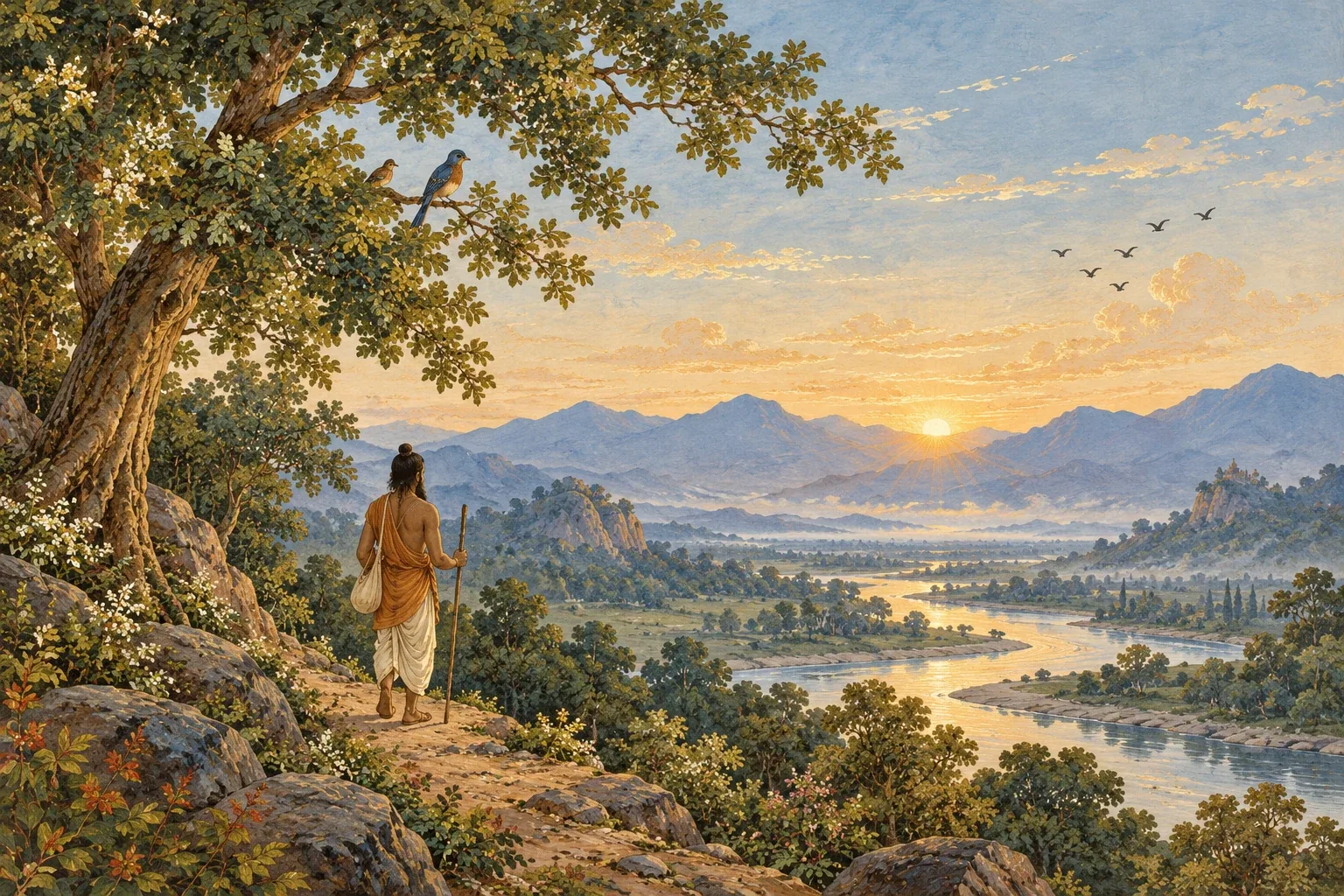
Yadu asks a wanderer
In the Bhagavata Purana, Krishna answers Uddhava by recalling an older exchange. King Yadu sees an Avadhuta wandering freely and asks how he came by such wisdom and ease. The wanderer replies that he has learned from many teachers by observing the world closely.
He names twenty-four in verses 11.7.33–35. Earth, air and sky stand beside animals and people. Their lessons are sometimes examples to follow and sometimes warnings about what binds a person. The teaching is addressed through a renunciant’s way of life; its images invite reflection without turning every ancient ascetic instruction into a rule for all readers.
The Sanskrit passage calls the teacher an Avadhuta or wandering Brahmin. The supplied Gita Press Hindi explanation identifies him as Dattatreya. This guide keeps that distinction visible rather than adding the name to the verses themselves.
The conversation and list: 11.7.19–36 →Earth to pigeon
The first eight teachers are explained in chapter 7. The elements offer images of endurance, openness and clarity. The pigeon’s story turns observation into a warning about attachment that overcomes judgment.
Earth
11.7.37–38The earth bears injury without abandoning its course. Mountains and trees add a second lesson: spend your strength for the good of others.
Air
11.7.39–41Air moves among many places without taking on their qualities. The wanderer learns to meet changing circumstances without being owned by attraction or aversion.
Sky
11.7.42–43Clouds and weather pass through the open sky without marking it. The account uses that spaciousness to contemplate the self beyond passing changes.
Water
11.7.44Clear water refreshes and purifies. The learner is invited to be gentle in speech and a beneficial presence to others.
Fire
11.7.45–47Fire receives what is offered yet is not defined by it. Its hidden and visible forms become an image for inward strength and the self within varied appearances.
Moon
11.7.48The moon appears to wax and wane, while the text distinguishes it from those changing phases. So, it says, the body's stages do not exhaust the self.
Sun
11.7.50–51The sun draws up water and gives it back in rain without keeping it. Reflections in many waters also prompt a meditation on one reality appearing in many forms.
Pigeon
11.7.52–74A pigeon family is caught in a hunter's net. This long warning story concerns attachment that overwhelms discernment, within a teaching addressed to a renunciant.
Python to Pingala
Chapter 8 moves among living creatures and desire. It closes with Pingala’s extended account: she watches and waits through an anxious night, then finds rest by releasing the hope that has held her.
Python
11.8.1–4The python waits for what comes rather than chasing every meal. The ascetic lesson is contentment with what is available, not a general instruction to neglect bodily needs.
Ocean
11.8.5–6Rivers fill the ocean and seasons alter their flow, yet its depth remains. The learner seeks steadiness through abundance and scarcity.
Moth
11.8.7–8Drawn to a flame, the moth is consumed. The image warns of sight and desire outrunning judgment.
Bee
11.8.9–12A bee gathers nectar from many flowers; the seeker may draw the essence from many teachings. The passage also warns that storing too much can become a trap.
Elephant
11.8.13–14The elephant's attraction leads into captivity. In this male renunciant setting, the example warns about being governed by sensual craving.
Honey gatherer
11.8.15–16Someone else takes the honey that bees have stored. The lesson questions accumulation so consuming that its owner never uses or shares it.
Deer
11.8.17–18A deer enchanted by a hunter's music is caught. The story asks the seeker to notice when a pleasing sound becomes a lure.
Fish
11.8.19–21The fish takes bait and meets the hook. For the Avadhuta, taste is one more sense that can command the mind when left unexamined.
Pingala
11.8.22–44Pingala waits anxiously for a paying visitor. When she lets go of that expectation and turns inward, she finally rests; the source gives her change of heart its own extended voice.
The examples of the elephant and deer are voiced from an ascetic setting concerned with sensory restraint. Pingala is a person in the narrative, not merely a symbol: the source gives her a long speech and the decision to change her outlook.
Read chapter 11.8 and its nine teachers →Kurara to wasp
The final seven, in chapter 9, bring the guide closer to everyday life. A bird relinquishes its prize, a young woman quiets her bangles, and an artisan’s attention stays with his craft even as a king passes nearby.
Kurara bird
11.9.1–2Other birds harass a kurara carrying a piece of meat. Releasing it ends the struggle: possession can cost more peace than it brings.
Child
11.9.3–4A child at play is unconcerned with praise or insult. The Avadhuta sees freedom from anxious self-importance.
Maiden
11.9.5–10While preparing food for guests, a young woman removes noisy bangles until one remains on each wrist. The Avadhuta draws a lesson about quiet solitude from her practical decision.
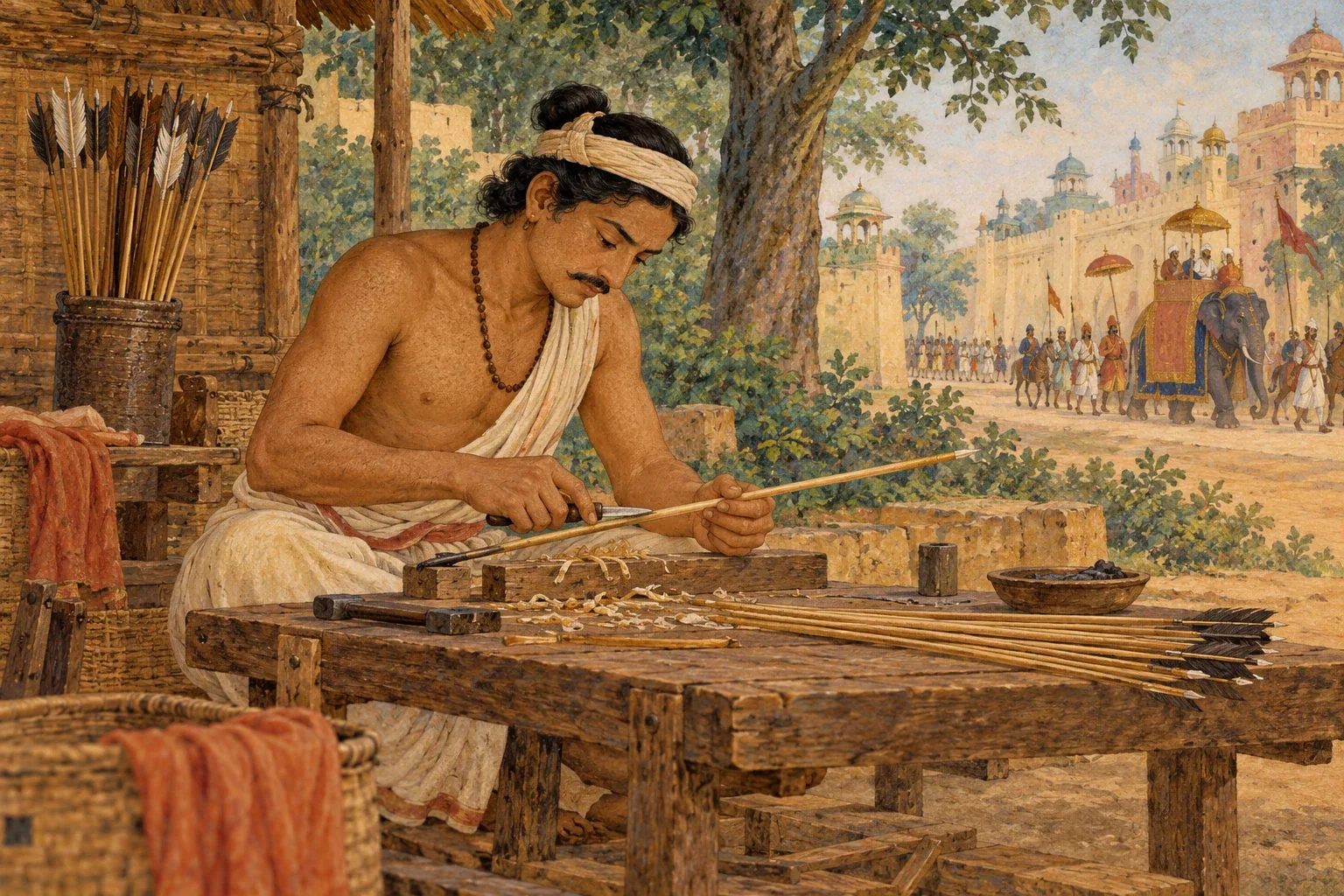
Arrow maker
11.9.11–13An artisan is so intent on shaping an arrow that a passing king goes unnoticed. Focus makes even an ordinary craft a teacher of attention.
Snake
11.9.14–15A snake takes shelter in a place made by another creature. The wandering ascetic sees a way to travel lightly and avoid becoming bound to building a home.
Spider
11.9.16–21A spider spins a web from itself and later draws it back. The text uses this image for the divine manifestation and withdrawal of the world.
Wasp and captive insect
11.9.22–23The tale of an insect absorbed in fear of a wasp becomes a metaphor for the shaping power of sustained attention. It is a spiritual image, not a zoological claim.
The body also teaches
After completing the twenty-four, the Avadhuta turns to his own body as another occasion for discernment. In 11.9.24–25 he calls it a teacher because its changing, vulnerable condition reminds him not to cling to it, even while it makes inquiry possible.
The body is outside the numbered list of twenty-four. Keeping it here preserves the source’s count while allowing the closing thought to be heard.
The closing reflection: 11.9.24–25 →EDITORIAL REFLECTION / PAUSE & REFLECT
Attention can turn
the world into a classroom.
Which ordinary thing has changed the way you act or think because you looked at it closely? This question is an editorial invitation, separate from the text’s specific instructions to an Avadhuta.
TEXT & INTERPRETATION
Twenty-four examples,
one textual setting.
The summaries follow only the owner-supplied Gita Press Sanskrit–Hindi Bhagavata Purana, Volume 2, chapters 11.7–9. They condense the passage in original English prose. The teaching’s ascetic voice and devotional context matter; these lessons are not presented as natural science or universal rules for family life.
The wasp and spider are spiritual analogies in the text. The illustrations are imagined, and the closing reflection is editorial. Edition details and verse locations are collected in the source library.