
A Manu and a Manvantara
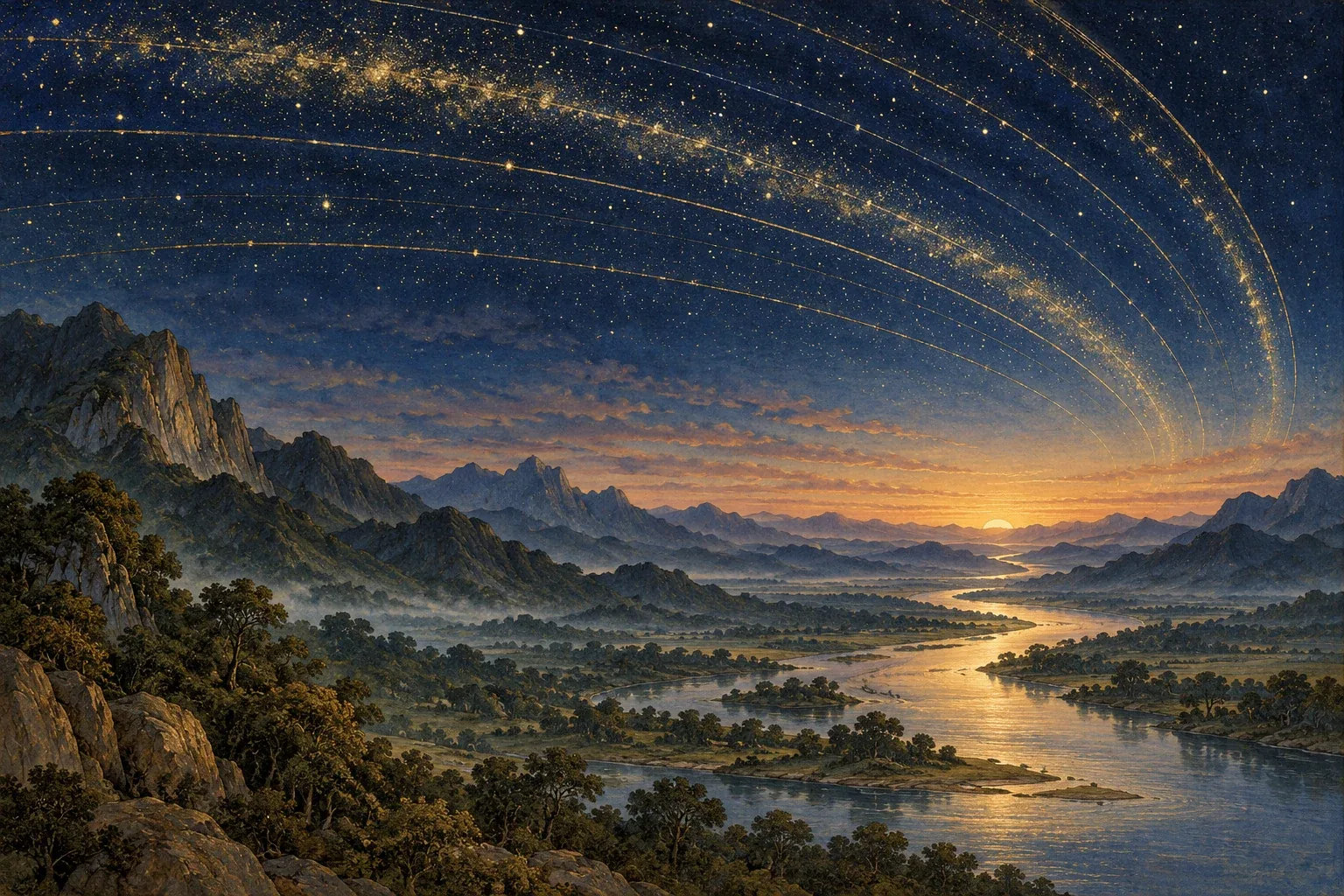
A Manvantara is the period associated with a Manu. In the Bhagavata Purana, successive Manus belong to a recurring order of cosmic time. Their accounts bring together the duration of an age and the responsibilities through which a world is sustained.
- Manu
- A presiding figure who upholds dharma within a particular cosmic period.
- Manvantara
- The age of that Manu, with its associated sages, deities, Indra and other figures.
The Bhagavata places fourteen Manus within a day of Brahma. Each period has its own names and narratives, while the larger pattern of sacred responsibilities recurs. This guide follows that text’s enumeration.
Bhagavata Purana 3.11.23–26 and 8.14.1–7 →Who sustains the world?
“Cosmic administration” is a useful modern phrase for the shared duties described in these passages. The account is theological: Manus and their companions act within a divine order. The chapter presents several complementary responsibilities.
- The Manu upholds dharma in his period.
- The Manu’s sons protect people and uphold dharma within their allotted jurisdictions.
- The seven rishis restore the knowledge of Vedic dharma when it has been lost through the course of time.
- The devas receive the shares of sacrificial offerings described in the account.
- Indra protects and sustains the three worlds, including through rain.
Bhagavata 8.14 places these duties under divine appointment and the guidance of divine manifestations. A Manvantara is therefore more than a label on a calendar: it joins an age to an account of how order is maintained.
The office of Indra also changes with the period. For the coming Savarni Manvantara, 8.13.12 names Bali as Indra.
From a four-yuga cycle to a kalpa
The units belong to different scales. A four-yuga cycle, a Manu’s period and Brahma’s day should be kept distinct.
| Scale | How it fits |
|---|---|
| Four-yuga cycle | A complete cycle of Krita (Satya), Treta, Dvapara and Kali, used as a larger unit of time in this account. |
| Manvantara | A Manu’s period. The supplied explanation of 3.11.24 gives a little more than seventy-one four-yuga cycles. |
| Kalpa | Brahma’s day, containing one thousand four-yuga cycles and fourteen Manus. Brahma’s night has an equal duration. |
The qualification “a little more” matters. This edition’s explanation includes a fractional amount; reducing the relationship to fourteen periods of exactly seventy-one cycles would omit that qualification. The source notes retain its wording and reference.
These are traditional measures within the text’s cosmology. This introduction keeps the account in its own units, without assigning a modern historical date to the beginning of a Manvantara.
Bhagavata Purana 3.11.18–26 and 8.13.36 →The fourteen Manus
The Bhagavata’s eighth Skandha recounts earlier Manus, identifies the present one, and describes those yet to come. The sequence below belongs to that account. Vaivasvata is the seventh; the future sequence begins with Savarni.
| Manu | Place in the account |
|---|---|
| 1. Svayambhuva | Earlier Manvantara |
| 2. Svarocisha | Earlier Manvantara |
| 3. Uttama | Earlier Manvantara |
| 4. Tamasa | Earlier Manvantara |
| 5. Raivata | Earlier Manvantara |
| 6. Cakshusha | Earlier Manvantara |
| 7. Vaivasvata Shraddhadeva | Present Manvantara |
| 8. Savarni | Future Manvantara |
| 9. Daksha-savarni | Future Manvantara |
| 10. Brahma-savarni | Future Manvantara |
| 11. Dharma-savarni | Future Manvantara |
| 12. Rudra-savarni | Future Manvantara |
| 13. Deva-savarni | Future Manvantara |
| 14. Indra-savarni | Future Manvantara |
Names from other Puranic enumerations should be read with their own references. This table retains the Bhagavata’s Deva-savarni and Indra-savarni as its thirteenth and fourteenth Manus.
The sequence: 8.1, 8.5 and 8.13 →Vaivasvata: the present Manu
Bhagavata 8.13.1 names Shraddhadeva, the son of Vivasvan, as the present seventh Manu. He is known as Vaivasvata. This is the reference point from which the chapter turns to the future Manus.
“Present” here identifies our place within the sacred chronology described by the text. It is useful to keep the name of the Manu, the period called his Manvantara, and the larger kalpa clearly distinguished.
The result is a nested view of time: a world is sustained through one Manu’s period, that period belongs within Brahma’s day, and the greater rhythm includes both day and night. Each scale contributes something different to the account.
Vaivasvata in 8.13.1 →Time, worlds and their care
The three cosmology guides approach related questions. Sarga and Visarga concern manifestation and further creation. The Fourteen Lokas introduces the worlds of a cosmos. Manus and Manvantaras bring its recurring periods and responsibilities into focus.
This page follows the supplied Bhagavata edition throughout. It distinguishes the text’s enumeration from other possible accounts, and its traditional chronology from a modern scientific measurement. Detailed chapter references are collected in the source notes.
EDITORIAL REFLECTION
An age to inhabit.
A world to sustain.
Thinking on this scale can turn attention from the length of an age to the care exercised within it. What do we inherit, what do we protect, and what knowledge should we carry forward?
This is an editorial invitation to reflection, separate from the primary textual descriptions.