
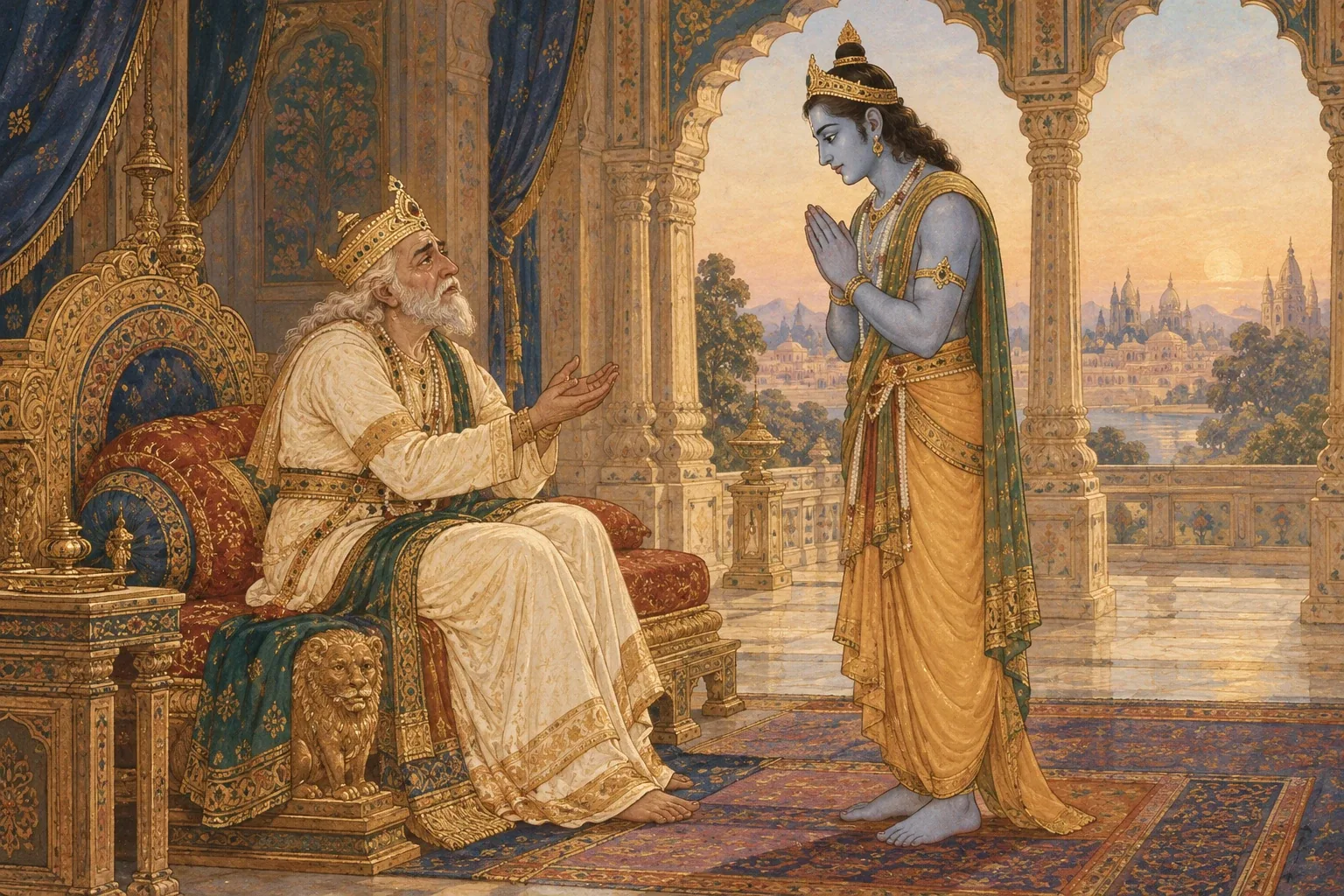
A city preparing to celebrate
Dasharatha brings a proposal before his assembly: Rama should take on the responsibilities of the heir apparent. The response is joyful. Those gathered praise Rama’s conduct, his concern for the people and his fitness to lead.
Yet within the palace another conversation begins. Manthara urges Kaikeyi to see Rama’s elevation as a threat to Bharata’s future. She recalls the two boons Dasharatha once promised the queen and presses her to claim them. The preparations outside continue, while the promise that will overturn them is brought back into view.
Two promises, one changed future
When Rama comes before his father, he finds Dasharatha overcome by distress. The welcome he expects does not come. He asks Kaikeyi what has happened and whether he has caused his father pain.
Kaikeyi tells him of the promised boons. Bharata is to receive the royal consecration; Rama is to leave for the forest for fourteen years, living there in the manner of an ascetic. What had seemed a day of public honour becomes a demand for departure.
The king’s grief is not a detail outside the decision. It stands before Rama, showing how a promise can bind a household even when its consequences are unbearable.
Rama’s answer
Rama accepts the forest exile. He does not make his agreement depend on keeping the position prepared for him. His father’s pledged word, as conveyed by Kaikeyi, is what he chooses to uphold.
He also asks that Bharata be summoned. His response does not turn the succession into a quarrel with his absent brother. The crown and the exile have arrived together, but he does not treat Bharata as the author of his loss.
This composure does not make the family’s sorrow disappear. The palace remains a place of grief. Rama’s resolution gives direction to what he will do next, without making the separation painless.
Sita and Lakshmana choose to go
Sita will not accept a life in Ayodhya apart from Rama. He warns her about the difficulties of forest life, but she insists on sharing his journey. Their exchange is extended and intense; her determination is part of the decision, rather than a silent detail of the departure.
Rama agrees that she will accompany him and asks her to give away possessions before they leave. The life ahead will require relinquishing the comforts they have known.
Lakshmana, too, insists on joining them. Rama first raises the responsibilities that would remain in the city. Lakshmana makes his case for accompanying and serving his brother, and Rama accepts. He sends Lakshmana to fetch their weapons. The exile will be shared by three people, each with a voice in the choice.
Leaving Ayodhya
Rama, Sita and Lakshmana take leave of Dasharatha and their mothers. They bow before the elders; grief accompanies the blessings. Sumitra directs Lakshmana’s affection and care toward Rama and Sita as he enters the forest with them.
Sumantra brings the chariot. The three ascend, and the departure that seemed impossible becomes movement through the city’s streets.
The citizens plead and follow. Dasharatha himself tries to keep pace. Rama asks the charioteer to continue, caught between the suffering behind him and the resolve to leave. Ayodhya’s love does not vanish with the royal procession; it trails after the departing family.
The first night away
At the Tamasa River, Rama pauses for the night. The people who have followed him are still nearby. He thinks of their weariness and the hardship their affection has brought upon them.
Before they wake, he arranges to depart. Sumantra drives so that the chariot’s course will make it difficult for the citizens to follow the onward journey.
The departure from the riverbank is quieter than the departure from the city. There is no new assembly to witness it. The distance from Ayodhya grows while those who came after Rama are left to turn homeward.
Across the Ganga
Guha arranges a boat for the crossing. Sumantra wishes to remain with Rama, but Rama sends him back to Ayodhya with instructions to care for the king and carry reassurance to the household.
Before crossing, Rama and Lakshmana arrange their hair in matted locks with help from the banyan sap Guha provides. The change in their appearance marks the life they are undertaking.
The three board the boat. In midstream, Sita offers prayers to Ganga for the fulfilment of the exile and their safe return. On the far bank they proceed into the forest. The chariot will return to the city; their own path now continues on foot.
A dwelling at Chitrakuta
Rama, Sita and Lakshmana reach Bharadwaja’s hermitage near the meeting of the Ganga and Yamuna. The sage receives them and recommends Chitrakuta as a place to stay.
As they approach the hills, Rama draws attention to the flowering trees and the voices of birds. The forest is more than the place of a sentence: it is a landscape they begin to notice together.
At Rama’s request, Lakshmana builds a leaf-roofed dwelling. After the prescribed rites, they enter it. A royal household has become a small forest household, held together through companionship and practical care.
This is a beginning, not the end of the fourteen years. The wider Ramayana continues beyond this pause; here the reader leaves them at their first home in Chitrakuta.
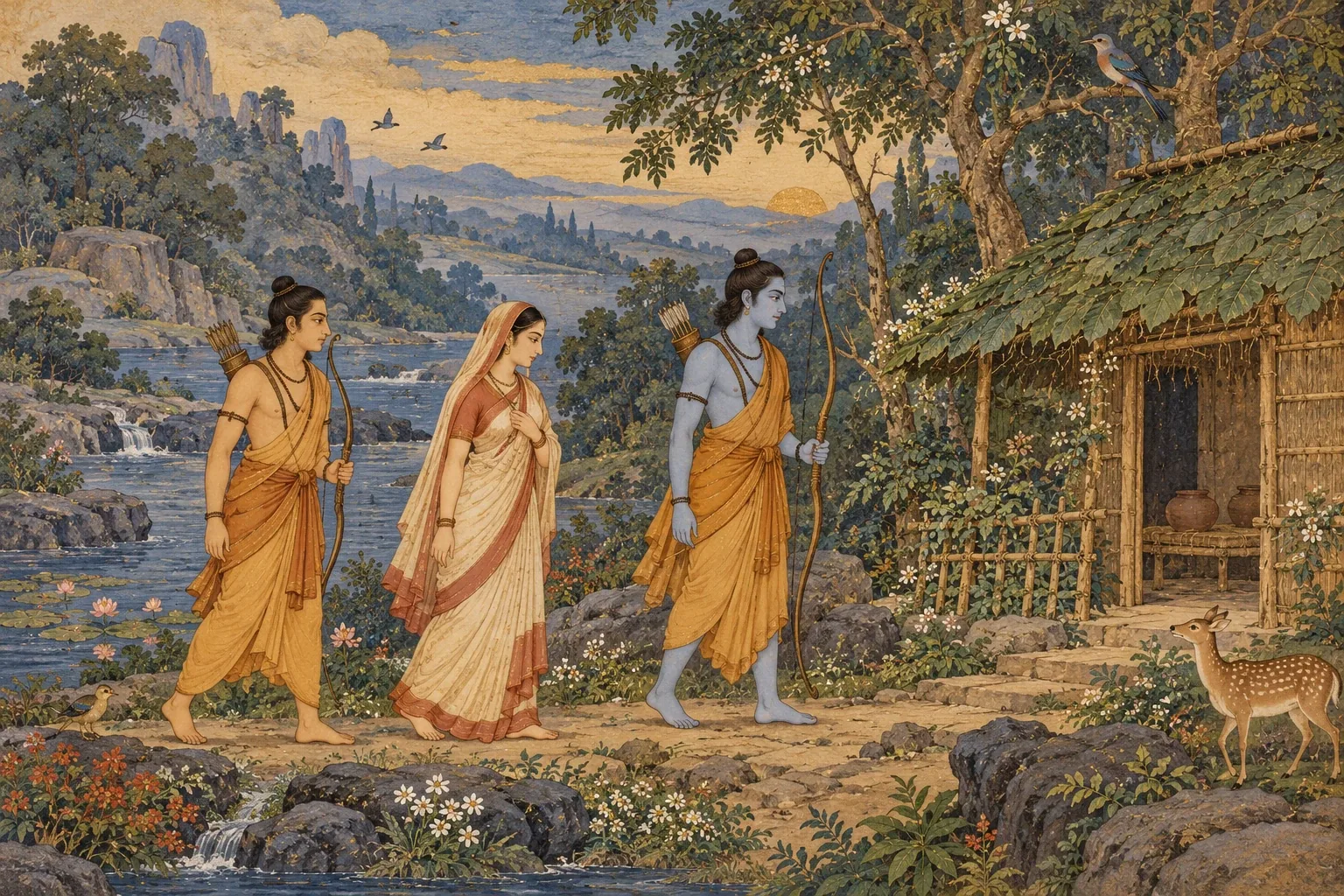
EDITORIAL REFLECTION / PAUSE & REFLECT
What do we carry
when life changes?
Rama carries a commitment; Sita and Lakshmana bring choices of their own. Which relationships and responsibilities would you hold close if the future you expected suddenly changed? How can care become something we do, as well as something we feel?
TRADITIONS & INTERPRETATION
A beginning within a larger epic
This reader follows the Valmiki Ramayana sequence, using simplified names and original condensed prose. It does not combine episodes from later regional or devotional retellings. It ends at Chitrakuta before Bharata’s later meeting with Rama; it does not retell the whole fourteen-year exile.
The reflection above is editorial. The paintings use traditional devotional conventions, including Rama’s blue complexion, within imagined settings. They are AI-generated interpretations, not historical portraits or geographical documentation.
Read the chapter references and edition notes