THE NAME AT THE HEART OF THE STORY
Lalita
The Mother whose manifestation and victory are narrated in the Lalita Mahatmya.

THE DIVINE MOTHER / A CLOSER LOOK
ललिता त्रिपुरसुन्दरी
The radiance of the Mother.
The sovereignty of the Divine.
Meet Lalita through sacred narrative, devotional imagery, Sri Chakra and the layered vision of Sri Vidya.
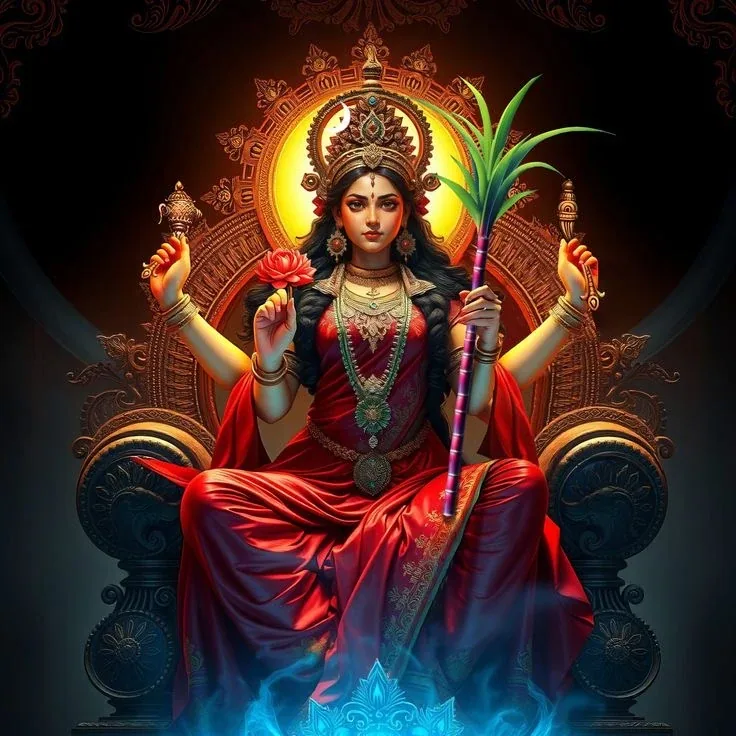
01 / THE DIVINE MOTHER
In the Lalita Mahatmya, she is praised as the source, support and resting place of the universe.
The devas address Lalita as the Mother of all, while also praising her as the reality beyond form and beyond the reach of words. The narrative brings together a radiant personal presence and an ultimate reality that cannot be contained in an image.
The introduction to the supplied Srividyarnavatantram likewise presents Mahatripurasundari as the highest reality approached through the feminine divine. This is a Shakta theological vision. Other Hindu traditions explain divine relationships from their own perspectives.
THE NAME AT THE HEART OF THE STORY
The Mother whose manifestation and victory are narrated in the Lalita Mahatmya.
THE SOVEREIGN OF THE THREE
The Srividyarnavatantram introduction explains her as the sovereign of three spheres associated with Brahma, Vishnu and Rudra. The Lalita Mahatmya also praises her as Tripura.
WITH KAMESHVARA
The narrative addresses her as Kameshvari and celebrates her union with Kameshvara.
02 / THREE APPROACHES
The Srividyarnavatantram introduction describes a threefold approach to Mahatripurasundari.
It names sthula, the gross or embodied form; sukshma, the subtle or verbal form; and para, the transcendent form understood as universal consciousness. These are not three separate goddesses, but three ways the text organizes attention toward the same divine reality.
This page offers an introductory map rather than ritual instruction. The text itself places these subjects within a transmitted discipline and gives an essential role to the teacher.
STHULA / GROSS FORM
Icon, colour, emblems and narrative make the divine presence available to sight, memory and devotion.
SUKSHMA / SUBTLE FORM
The introduction connects this level with sacred mnemonic formulae. Their initiatory content is not reproduced here.
PARA / TRANSCENDENT FORM
The highest approach points beyond a limited image toward consciousness in which division is overcome.
03 / HER DIVINE FORM
At her manifestation, the Lalita Mahatmya describes Lalita with the lustre of the rising sun, red garments and a merciful glance.
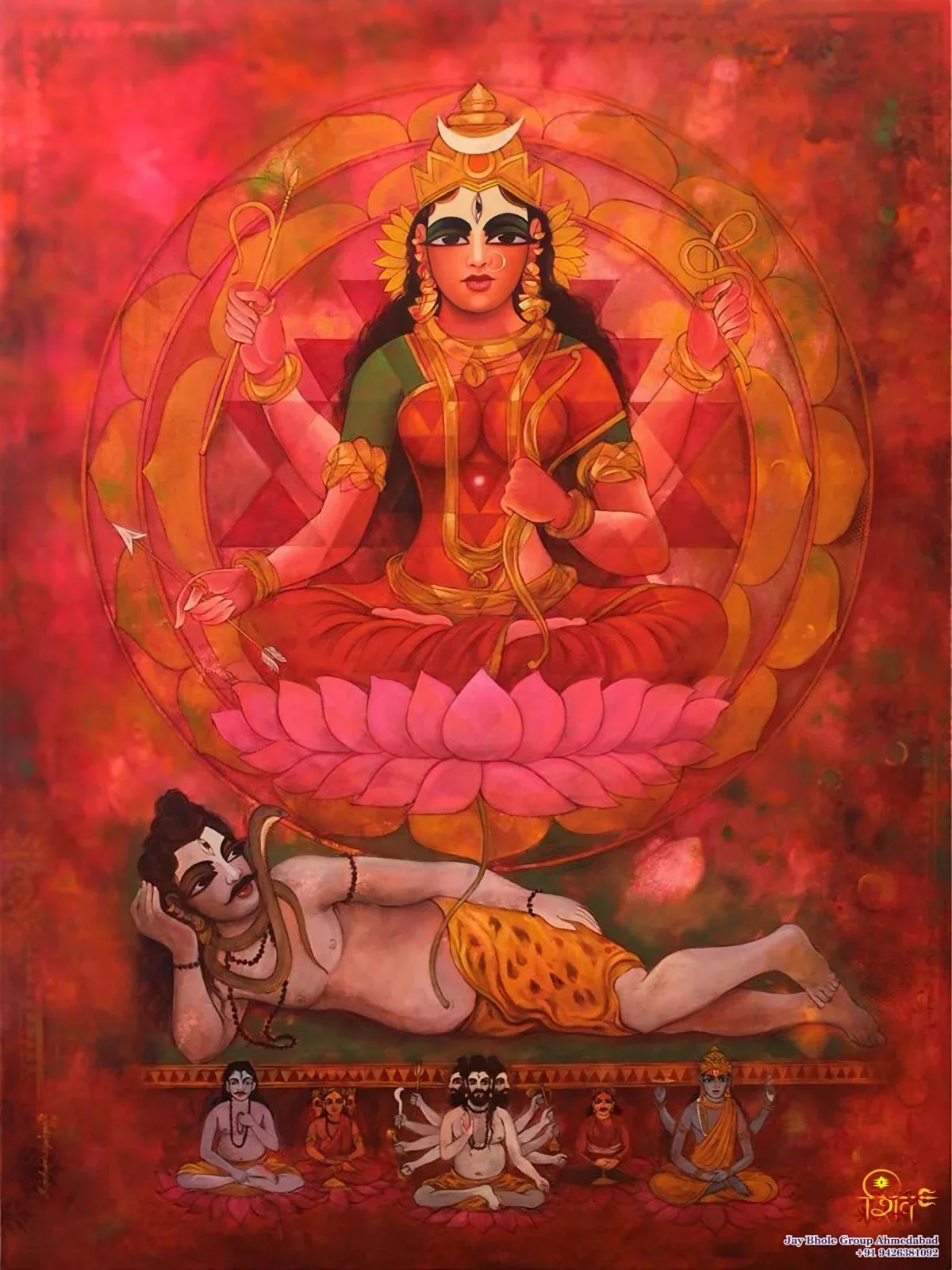
The distinctive bow named in the description of her appearance.
Five flower arrows accompany the bow in the same passage.
One of the four emblems held in her hands.
The goad appears both in her divine form and in the army narrative, where Sampatkari arises from it.
Symbolic explanations vary by commentary and lineage. The page keeps the textual emblems distinct from any one later interpretation.
04 / ENTER HER STORY
From Kama’s ashes to the manifestation of the Goddess. Follow Bala’s courage, Ganesha’s removal of an obstacle, and the victory that ends with restoration.
Read the illustrated story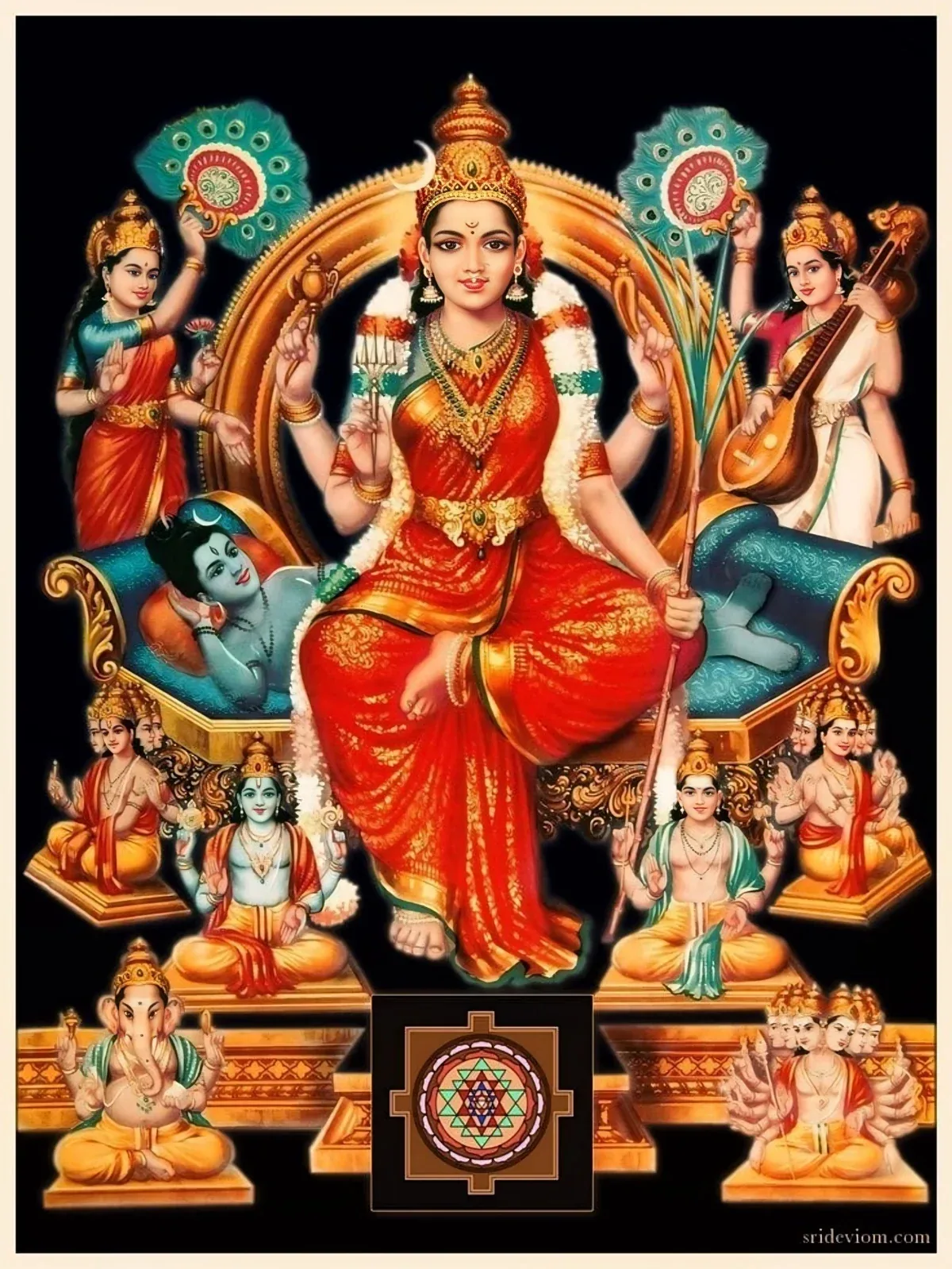
05 / SRI CHAKRA
Sri Chakra is also called Sri Yantra. The ArunaLahari commentary on the Bhavanopanishad connects its contemplation with the body and the Self.
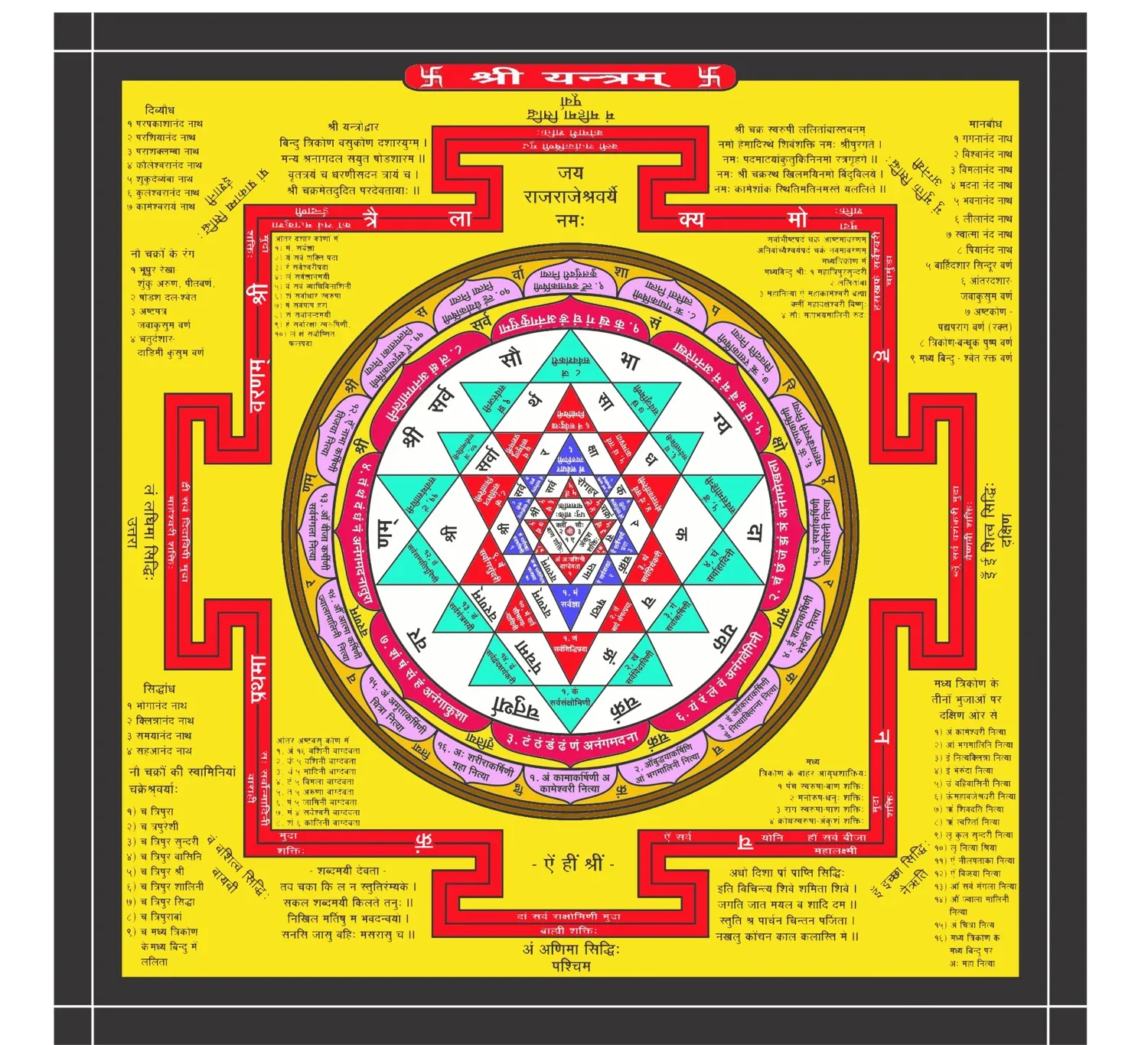
The ArunaLahari commentary distinguishes external worship, internal worship and bhavana, or contemplative understanding. Its introduction relates the yantra and mantra to the body itself, and directs attention towards the Self as not different from Devi.
In the Brahmanda Purana’s hymn, Lalita is praised in relation to the bindu, the central point. The story, the diagram and the contemplative text are different entrances into her sacred presence; one is not a substitute for the others.
06 / A TEXTUAL MAP
The supplied Srividyarnavatantram gathers a broad ritual and contemplative world around Mahatripurasundari.
Its introduction names Sri Chakra, divine forms, planets, constellations, Yoginis, zodiacal signs, Shaktis, the Nityas and the teacher-disciple relationship among the fields brought into relation. The point is not a random catalogue: the text presents multiple levels of the cosmos and practitioner as coordinated around one sacred centre.
The five supplied books contain thirty-six shvasas, or chapters, divided into Purvardha and Uttarardha. The editor describes the first division as concentrating on the threefold approach to Mahatripurasundari and the second as widening the textual field to other deities and transmitted instruction.
07 / A DOORWAY INTO SRI VIDYA
An introduction to a tradition centred on Lalita, sacred mantra and Sri Chakra.
The Bhavanopanishad commentary connects worship with recognition of the Self. The Srividyarnavatantram introduction adds a complementary map: visible form, subtle verbal form and transcendent consciousness, held together through disciplined transmission.
Both sources give an important place to the teacher. They present particular traditional interpretations rather than one explanation shared identically by every Sri Vidya lineage. For that reason, this public introduction explains relationships and source structure without reproducing restricted mantra or detailed ritual procedure.
Explore Agamas & Tantras08 / WHERE TO BEGIN
Begin with the story, then follow the question that interests you.
Meet the Goddess through her manifestation, her companions and her victory over Bhandasura.
Read the storyTHE INWARD PERSPECTIVEExplore how the ArunaLahari commentary connects sacred form, contemplation and the Self.
See the source noteTHE TEXTUAL OCEANFollow the five-volume map from form, sacred sound and consciousness into a wider field of Sri Vidya correspondences.
See the edition detailsCONTINUE EXPLORING