
A boon with one narrow opening
After Kartikeya defeats Taraka, Taraka’s sons—Tarakaksha, Kamalaksha and Vidyunmali—undertake severe austerities. Brahma appears and asks them to choose a boon that remains within the order of creation.
They ask for three cities that cannot ordinarily be overcome. The cities will move on different courses and come into one line only at a rare appointed moment. Their destruction will then be possible only if Shiva strikes all three with a single arrow.
The request sounds like a condition too exact ever to be met. Yet the boon does not erase consequence; it leaves one narrow opening through which responsibility may return.
Gold, silver and iron
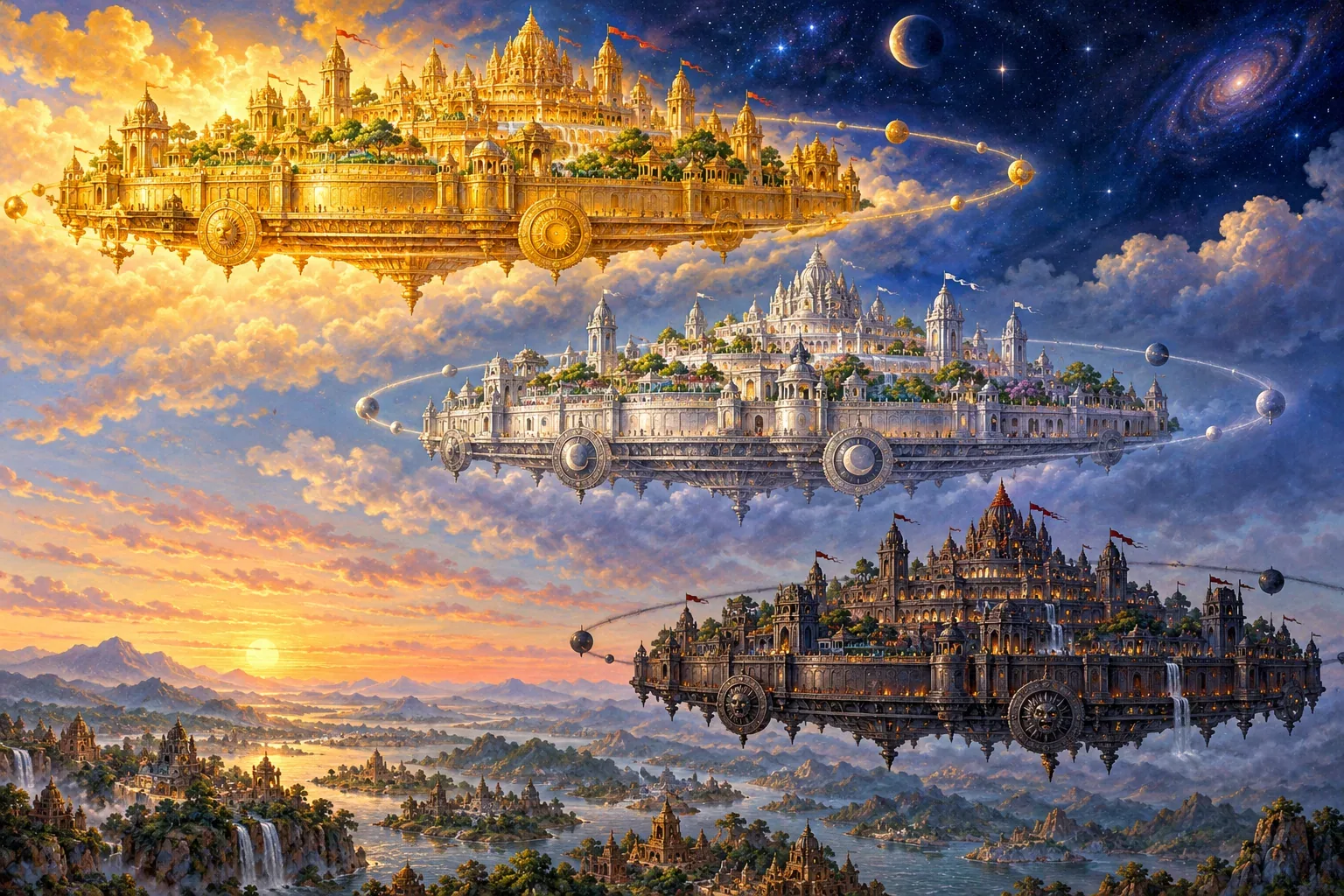
Maya builds the three fortresses: a golden city for Tarakaksha, a silver city for Kamalaksha and an iron city for Vidyunmali. The supplied text places them across heaven, the middle region and the earthly realm.
They are not empty weapons. They contain palaces, gardens, halls, wells and the structures of flourishing urban life. For a long time their inhabitants are also described as devoted to Shiva and protected by their own meritorious conduct.
Power becomes dangerous not because splendour exists, but because splendour begins to serve domination. The devas approach Brahma and Shiva as the rulers of Tripura disturb the worlds.
When power loses its centre
Shiva does not attack merely because the devas complain. In the supplied account he observes that the people of Tripura remain protected while they are devoted and righteous. The narrative therefore pauses: force alone cannot solve a disorder whose inhabitants still possess moral protection.
Across the next chapters, Vishnu devises a means by which the cities abandon their former discipline. The Purana presents this as a sacred narrative of delusion and decline. This reader condenses the polemical detail and does not use it to judge any living community or tradition.
Once arrogance, disorder and oppression take the place of restraint, the plea for protection returns to Shiva. The issue is no longer the existence of magnificent cities. It is the use of power without responsibility.
The cosmos becomes a chariot
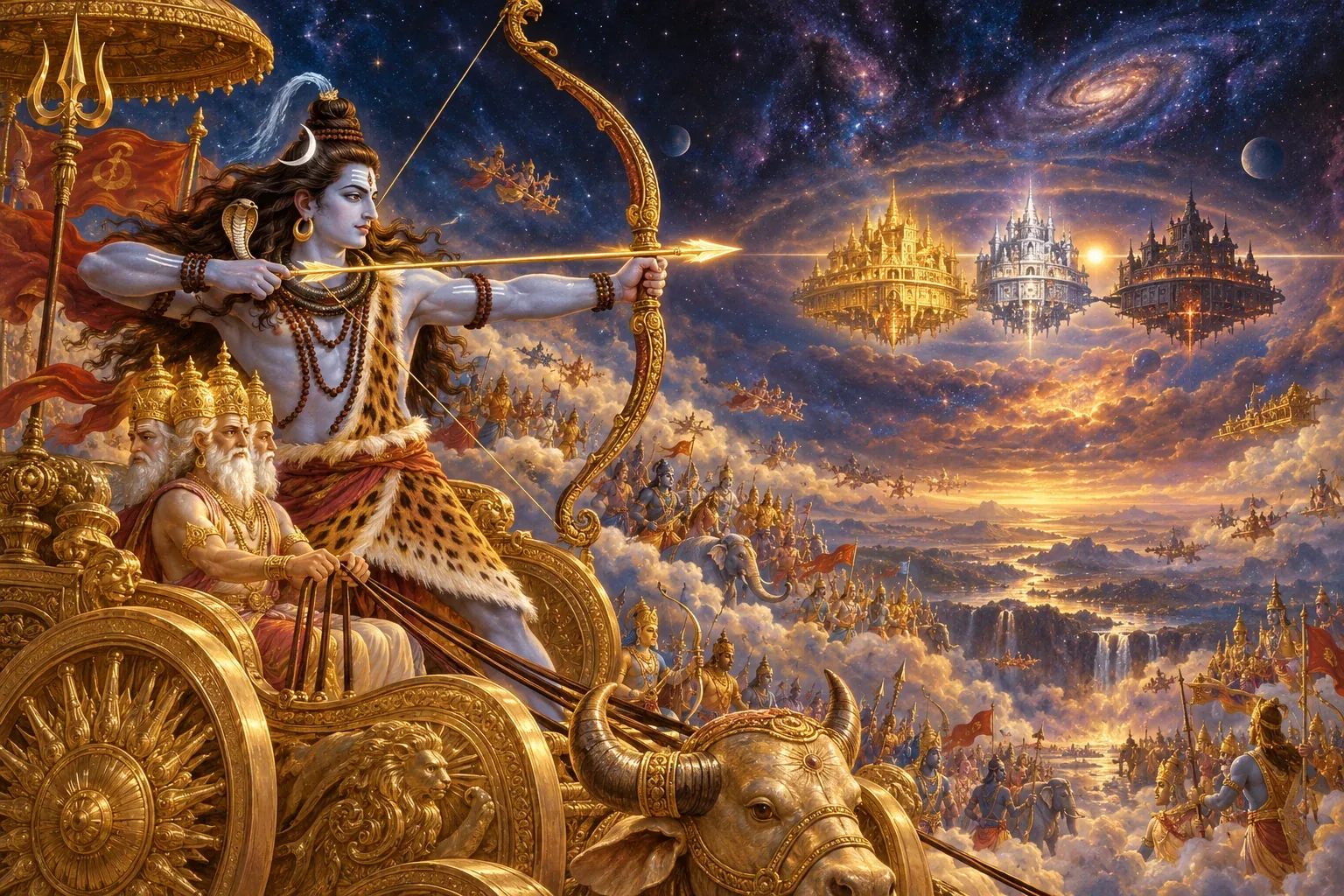
The answer is not prepared by Shiva alone. The divine assembly offers the powers of the cosmos as the parts of one immense chariot, bow and arrow. The earth becomes the chariot’s foundation; the sun and moon become its wheels; the mountains, serpent, wind, fire and divine beings take their places in the sacred construction.
Brahma becomes the charioteer. Vishnu enters the arrow. The arrangement makes a theological point through image: the final act belongs to Shiva, but the worlds participate in their own restoration.
Tripurantaka is therefore not imagined as an isolated warrior seeking conquest. He stands at the centre of a coordinated cosmic responsibility.
Shiva takes the bow
Shiva mounts the chariot and takes the great bow. The devas, his ganas and the assembled powers accompany him. The Yuddha Khanda connects this preparation with the name Pashupati: Shiva as Lord of beings, guiding those who have placed themselves under his protection.
Even this vast arrangement does not make the appointed moment arrive more quickly. The three cities continue on their separate paths. The divine host must wait for the single instant in which action can be both possible and complete.
Before the shot, an obstacle arises. An announcement directs Shiva to honour Ganesha, remover of obstacles. Worship is offered; only then does the path become clear.
The moment of alignment
At the appointed Abhijit moment, under the Pushya constellation as the text describes it, gold, silver and iron enter one line. What seemed nearly impossible becomes visible for an instant.
Shiva draws the bow and releases one arrow. It passes through the three cities, and Tripura is consumed in a single fiery act. The episode is decisive, but it is not presented as destruction for spectacle. The oppression ends and the balance of the worlds is restored.
The name Tripurantaka—“the ender of Tripura”—holds together concentration, timing and power. Countless forces have gathered, yet the conclusion is one motion.
After the fire
The story does not finish with the burning cities. The devas are awed by Shiva’s fierce form and offer praise. Shiva receives them and grants devotion rather than leaving the worlds in fear.
Maya, the builder of Tripura, approaches Shiva for refuge. Because his devotion has endured, Shiva spares him and grants him a protected dwelling in Vitala. The maker is not treated as identical with the misuse of what he made.
Power has been checked, but devotion and skill are not erased. The closing chapters turn destruction toward discernment: what must end, what can be preserved and what can be redirected?
EDITORIAL REFLECTION / PAUSE & REFLECT
Strength becomes sacred
when it serves right timing.
The whole cosmos gathers, yet Shiva waits for one exact opening. Where might patient concentration accomplish what repeated force cannot?
COSMIC SYMBOLISM & INTERPRETATION
Three outer cities.
Many inward readings.
In the supplied chapter sequence, Tripura is first a set of three extraordinary fortified cities, ruled by Taraka’s sons and destroyed when they align. The cosmic chariot makes the event larger than an ordinary battle: earth, sun, moon, mountains and divine powers become one instrument.
Later Shaiva teachers and devotional readers also interpret the three cities inwardly—as layered forms of bondage, ego, impurity, the three bodies or other triads. These mappings vary by school. This page presents them as interpretive pathways, not as a single definition stated by Yuddha Khanda 1–12.
The paintings are contemporary devotional interpretations. The architecture, celestial mechanics, armies and landscape are imagined; they are not archaeological reconstructions. The hero image retains the story’s single arrow, three aligned cities and Brahma as charioteer while simplifying the full catalogue of cosmic components.
Read the supplied-edition references