
A life held in two hands
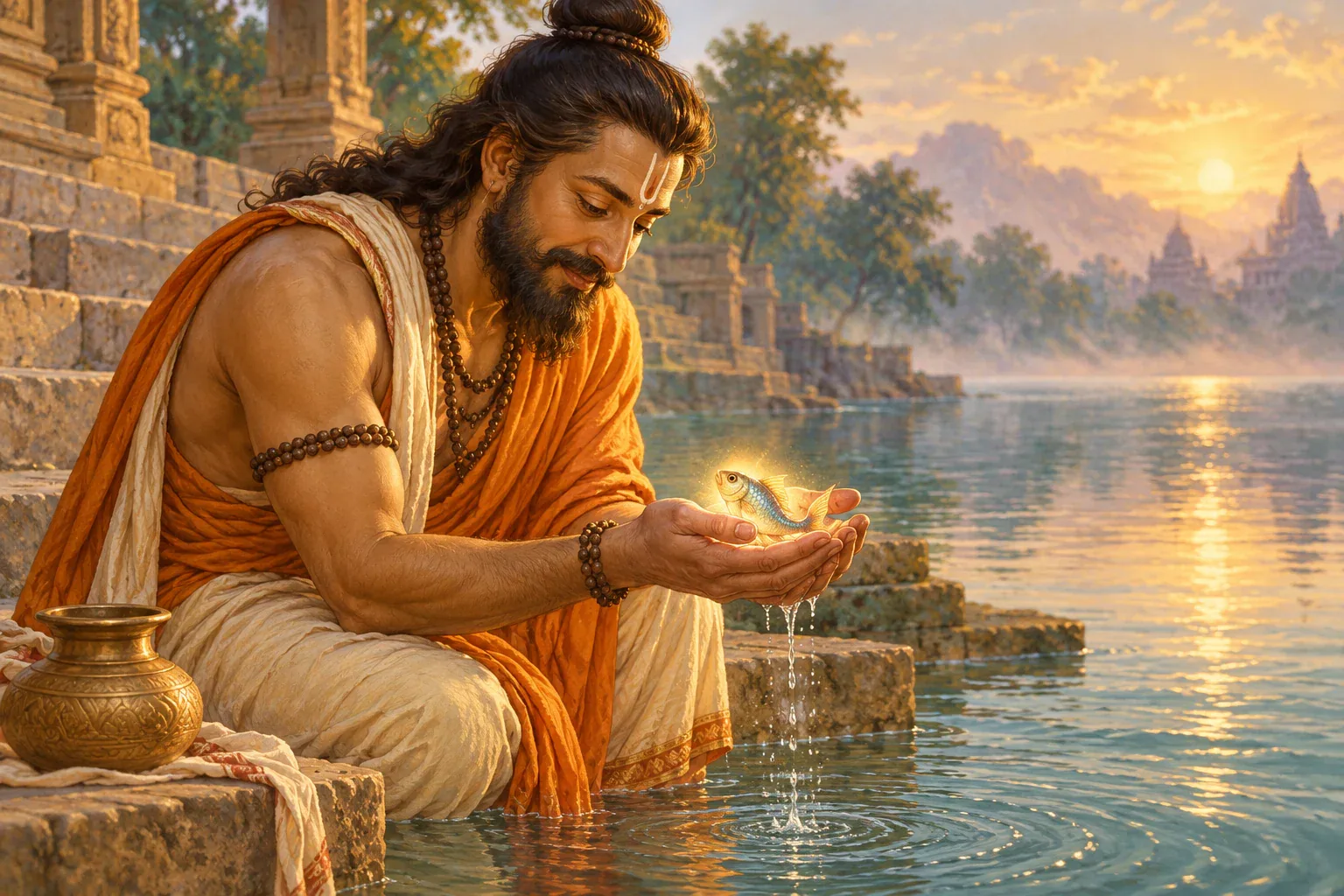
King Manu has withdrawn to a place of austerity near the waters, seeking a boon that will enable him to protect living beings when dissolution comes. One day, while he offers water, a tiny fish falls into his hands.
The fish asks for refuge from the larger creatures of the river. Manu does not dismiss a life because it is small. Moved by compassion, he places it in his water pot and carries it to safety.
The request seems simple: protect me. Yet the one who asks is already preparing the protector for a task larger than he can see.
Beyond every vessel
By the next day the fish has outgrown the pot. Manu moves it to a larger vessel, but that too becomes too small. He carries it to a well, then to a lake, and finally toward the ocean.
Each refuge that seems spacious is quickly surpassed. The impossible growth turns an act of care into recognition: this is no ordinary creature seeking safety.
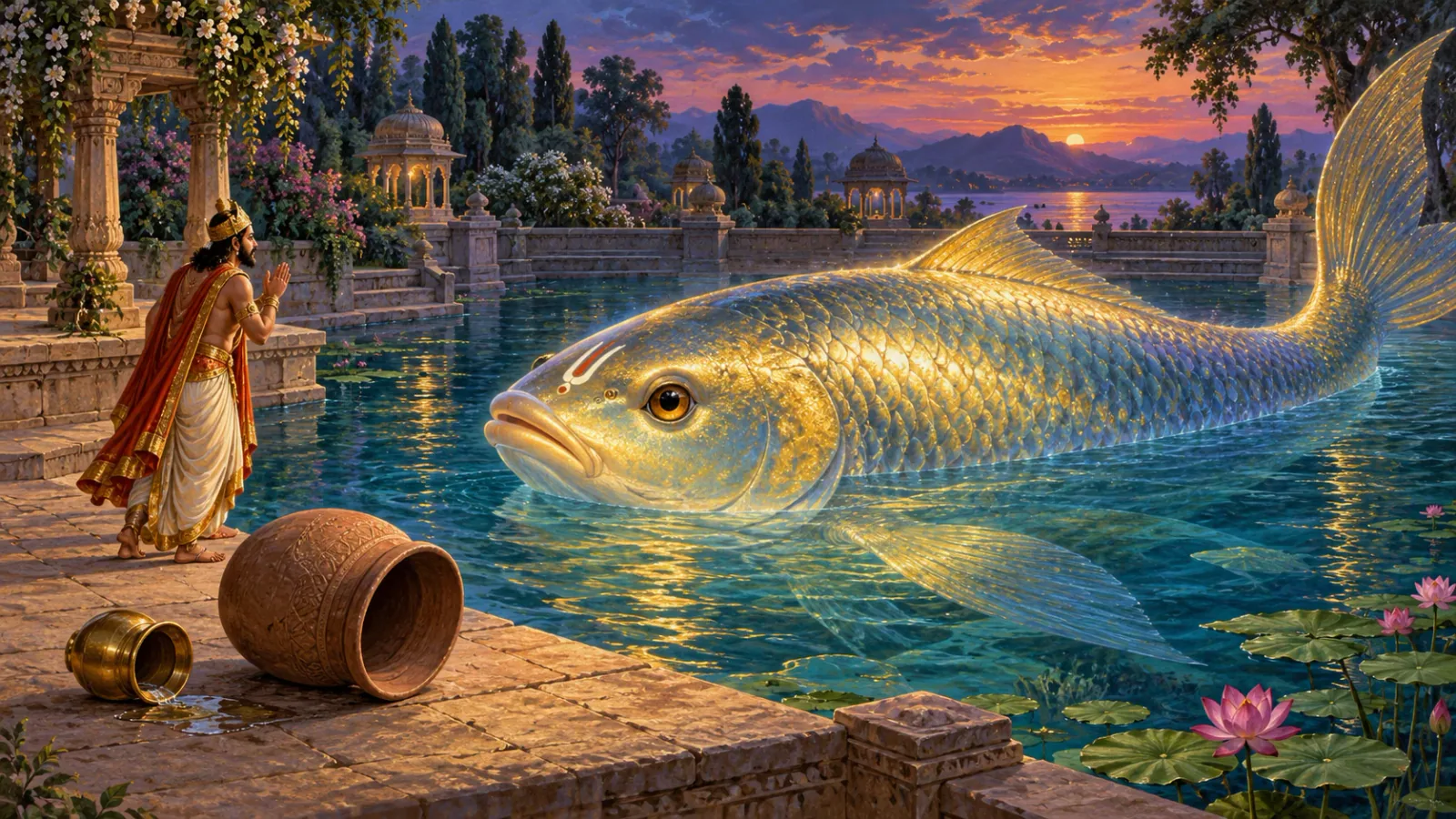
When Manu prepares to release the fish into the sea, it warns that the ocean also holds danger. The king understands the divine play before him and bows to Vishnu in the form of Matsya.
The warning of the flood
Matsya tells Manu that a time of dissolution is approaching. The account imagines a long drought, fierce heat and destructive fires, followed by waters that cover the earth.
The warning is not given to produce helpless fear. It comes with a responsibility. Manu is to prepare for what must be carried through the deluge and to remain attentive for the means of rescue.
Matsya promises that a boat made by divine power will arrive. When every familiar landmark disappears and the winds move the waters, Manu will not be left without direction.
A vessel for life
Manu is instructed to gather the sources of continuing life. The supplied edition names forms born from moisture, eggs, vegetation and the womb. The boat therefore carries more than survivors: it carries the possibility of a renewed living world.
The seven sages join him. Seeds, living forms and the means of future growth are placed aboard. Preservation here is not possession for its own sake; it is stewardship on behalf of those who do not yet exist.
The text also places Vedas, Puranas and branches of learning around this vessel of continuity. Life and knowledge are not separated: the next beginning will need both.
The horn and the serpent-rope
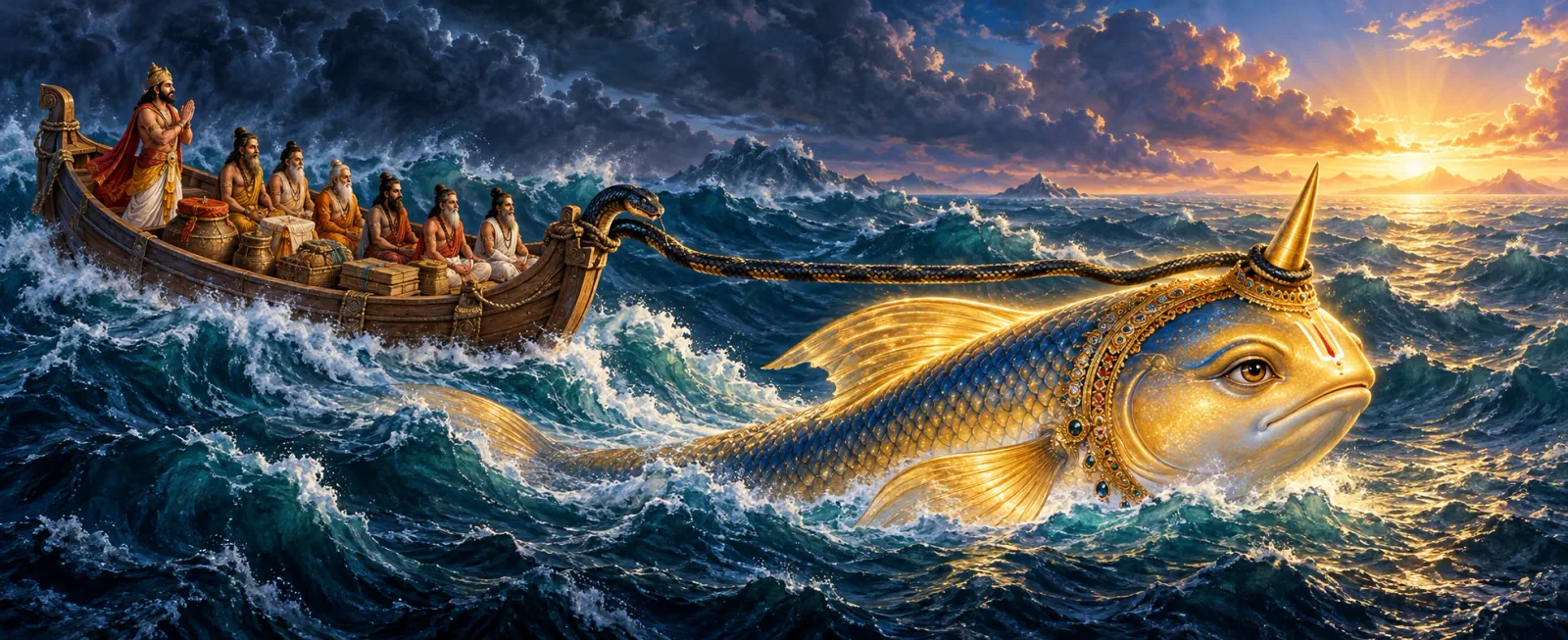
The flood arrives. The world becomes an expanse without shore, and the boat is carried by powerful winds. Then Matsya appears in the vast form he had promised, bearing a single horn.
A great serpent becomes the rope. Manu fastens the boat to Matsya’s horn, and the divine fish draws the vessel across the waters. What began with the king sheltering a small fish has been reversed: the one he protected now protects him and all that has been entrusted to him.
The sages remain aboard as the boat moves through the darkness. Matsya is not merely a force pulling them forward; he is their orientation when the old world can no longer supply one.
Knowledge across the waters
While the deluge continues, Manu asks about creation, time, lineages, duties and sacred practice. Matsya answers. The opening of the Purana frames the teachings that follow as knowledge spoken during this crossing.
Chapter 2 says that the Vedas, Puranas and sciences remain preserved through the dissolution and will be set in order again when creation begins. Sacred knowledge is therefore not a decorative cargo. It is a living inheritance meant to guide the world that follows.
The teaching changes the boat from a refuge into a moving place of learning. Even when land is absent, inquiry, memory and instruction continue.
The beginning after an ending
Matsya tells Manu that when the waters recede he will become the progenitor of the renewed age. In this account the king is called Manu and is identified with the future Vaivasvata Manu, the ruler of the next Manvantara.
The deluge does not erase responsibility. It enlarges it. Manu must carry life, receive teaching and become the point from which a new order can begin.
The story closes its flood episode by turning toward the questions Manu has asked. The rescue leads into the Purana’s greater project: explaining a cosmos that is created, dissolved, remembered and renewed.
EDITORIAL REFLECTION / PAUSE & REFLECT
What we protect
protects the future.
Manu first responds to what is small enough to fit in his hands. That attention prepares him to carry an entire inheritance. Which quiet acts of care today may become the shelter of something far larger tomorrow?
TRADITIONS & INTERPRETATION
One flood story,
distinct sacred tellings.
This reader follows the supplied Matsya Mahapurana, Adi Khanda 1–2. It does not combine every flood account into one narrative. The name “Satyavrata” is familiar from the Bhagavata Purana; the supplied Matsya Purana calls the king Manu and says that he will become Vaivasvata Manu.
The chapter sequence joins preservation of living forms with preservation and reordering of Vedas, Puranas and branches of knowledge. The sages, serpent-rope, one-horned Matsya and divine boat belong to this text’s sacred cosmology.
The paintings are contemporary devotional interpretations. Clothing, boat construction, landscape, vessels and manuscript bundles are imagined; they are not archaeological reconstructions. The reflection on small acts of care is editorial contemplation.
Read the supplied-edition references