
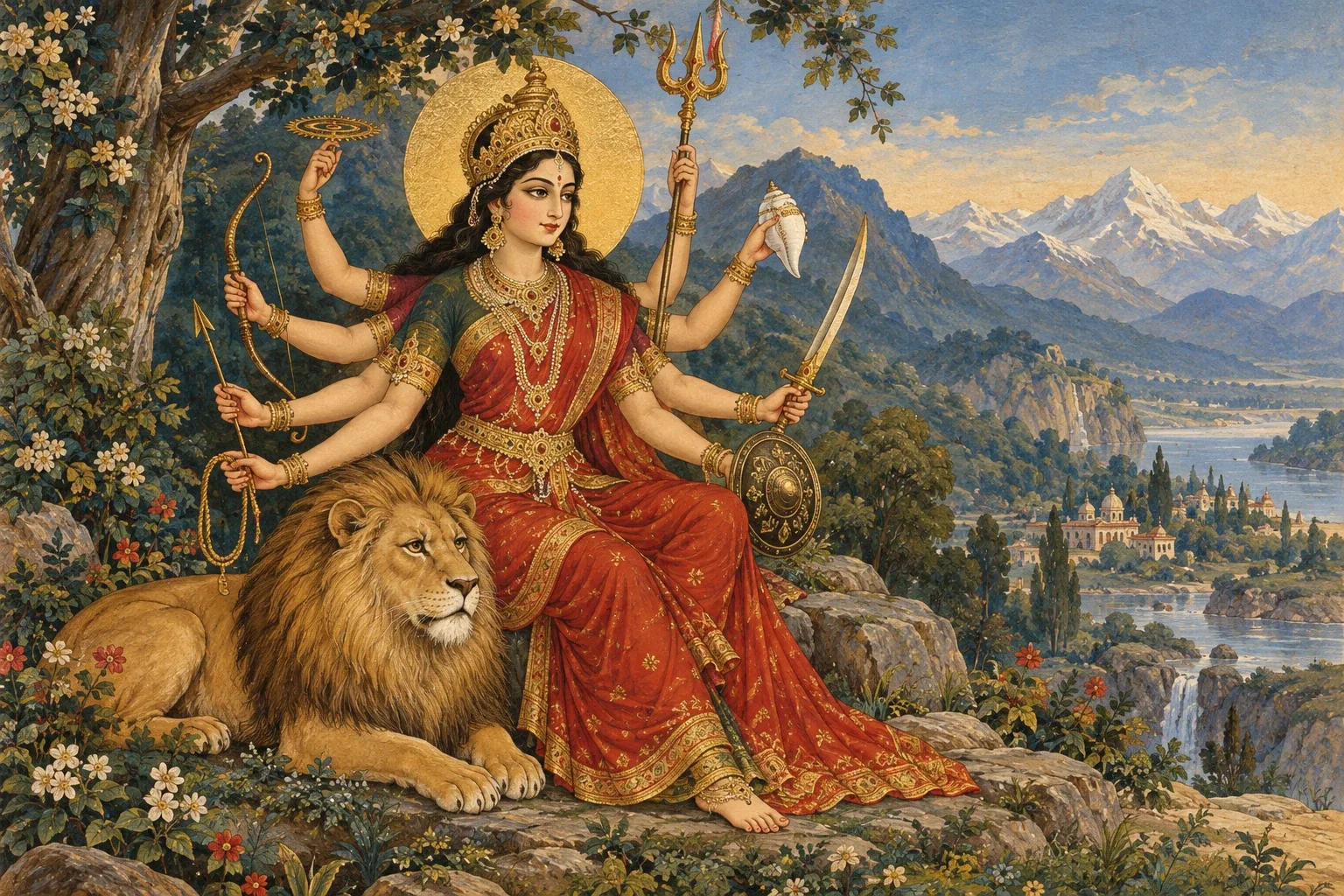
The gods driven from heaven
Mahishasura has defeated the gods and taken their places of authority. Driven from heaven, they wander on earth. Led by Brahma, they go to Vishnu and Shiva and describe what has happened.
Their appeal names a disorder larger than a lost throne. Mahishasura has claimed the functions of the sun, fire, wind and other divine powers. They seek refuge and a way to end his domination.
Radiance takes form
Hearing their account, Vishnu and Shiva are angered. Radiance comes forth from them, from Brahma, and from the other gods. The lights gather into one immense brilliance.
From that united radiance the Goddess appears, illuminating the three worlds. The account describes the different divine energies forming her presence. Those who had come in distress now look upon her with joy.
The gifts of the gods
The gods honour her with weapons and adornments. Shiva gives a trident, Vishnu a discus, Varuna a conch and noose, and Vayu a bow and arrows. Other gifts follow, including a sword, shield, bell and armour.
Himavat gives her a lion as her mount. Equipped and radiant, the Goddess lets out a mighty roar. Its echo shakes the worlds. The gods acclaim her, while the asura forces rise to meet the challenge.
The battle opens
Mahishasura’s armies advance with chariots, elephants, horses and weapons. Chandika meets their attacks without losing her composure. Her lion moves among the opposing forces.
From her breath arise troops sustained by her power. Together they fight the asuras. The vast army is overcome, but the struggle is not yet finished.
Cikshura and Chamara lead further attacks. The Goddess defeats Cikshura; her lion overcomes Chamara. The other commanders fall, leaving Mahishasura to confront her himself.
Mahishasura’s fury
In buffalo form, Mahishasura charges against the Goddess’s forces. His hooves, horns, tail and breath become instruments of destruction. He rushes toward her lion.
The narrative expands his rage across the landscape: the earth breaks beneath him, the sea is disturbed and mountains are thrown into the air. His strength has become a force that unsettles everything around it.
Chandika prepares to end his attack. She throws her noose and binds him. He abandons the buffalo form, and the confrontation changes.
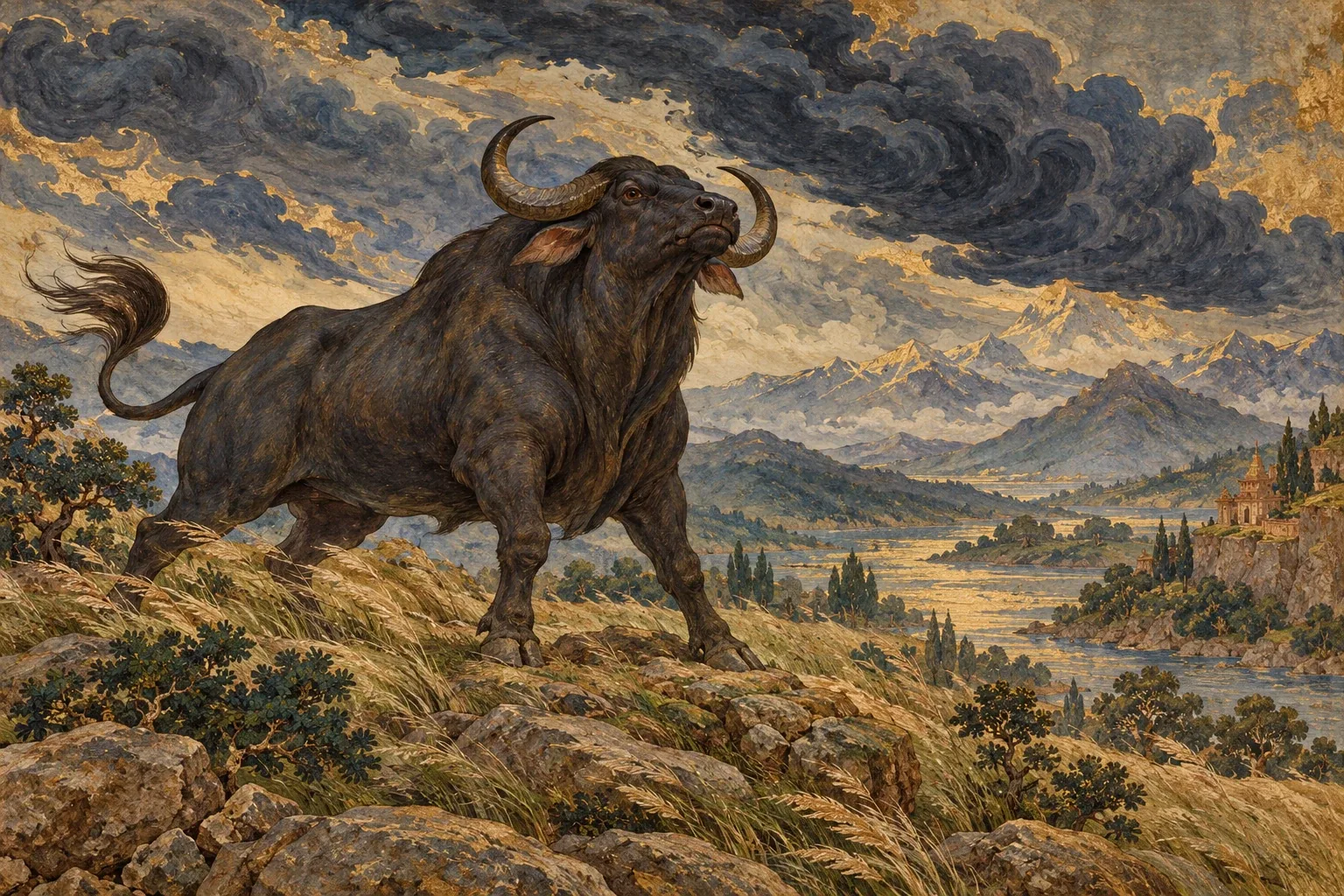
A changing adversary
Mahishasura becomes a lion. As the Goddess strikes, he appears as a man carrying a sword. She attacks that form with arrows, and he becomes an elephant.
The elephant seizes her lion with its trunk. She cuts the trunk with her sword. Mahishasura then returns to buffalo form and again shakes the worlds.
Each transformation changes the attack, but none ends her resistance. The Goddess continues to face him through every shape he assumes.
The Goddess’s victory
Mahishasura hurls mountains toward Chandika; her arrows break them apart. She drinks from her cup and addresses him, declaring that the gods will soon celebrate his defeat.
Then she leaps upon him, presses down his neck with her foot and strikes him with her spear. As he begins to emerge from the buffalo’s mouth, she prevents his escape. She cuts off the emerging asura’s head with her sword.
Mahishasura falls. His army is defeated. The gods and heavenly seers praise the Goddess, while celestial musicians sing and dancers celebrate.
Praise and protection
The gods’ hymn carries the story beyond the battlefield. They praise Ambika as the power that sustains the world, as wisdom and as a refuge from fear. Their words honour her compassion together with her formidable strength.
They ask for protection in every direction, through her gentle forms and her fierce ones. Victory becomes an occasion for devotion rather than simply a display of force.
The Goddess invites them to choose a boon. They ask that she remove their calamities whenever they remember her, and that those who praise her receive her blessings. She grants their request and disappears. The episode closes with the relationship between the Goddess and those who turn to her.
EDITORIAL REFLECTION / PAUSE & REFLECT
Courage that confronts.
Care that protects.
What makes strength protective? The hymn invites us to consider compassion beside resolve. When a difficult situation changes shape, how can we keep sight of whom our actions should help?
TRADITIONS & INTERPRETATION
The Devi Mahatmya’s account
This reader follows the Goddess-centred narrative of the Devi Mahatmya. Chandika and Ambika are names used for the Goddess in this episode; Durga appears in the hymn of praise. The account is kept distinct from the Lalita and Bhandasura story and from other Mahishasura tellings.
The reflection above is editorial, not a claim that the characters have only one symbolic meaning. Combat remains part of the narrative, while its graphic descriptions are condensed. The cover’s eight-armed form and selected attributes are a devotional artistic convention, not a literal inventory of every weapon or arm described in the text.
Both paintings are AI-generated interpretations in imagined settings. They are not historical photographs or exact reconstructions of the episode.
Read the chapter references and edition notes