
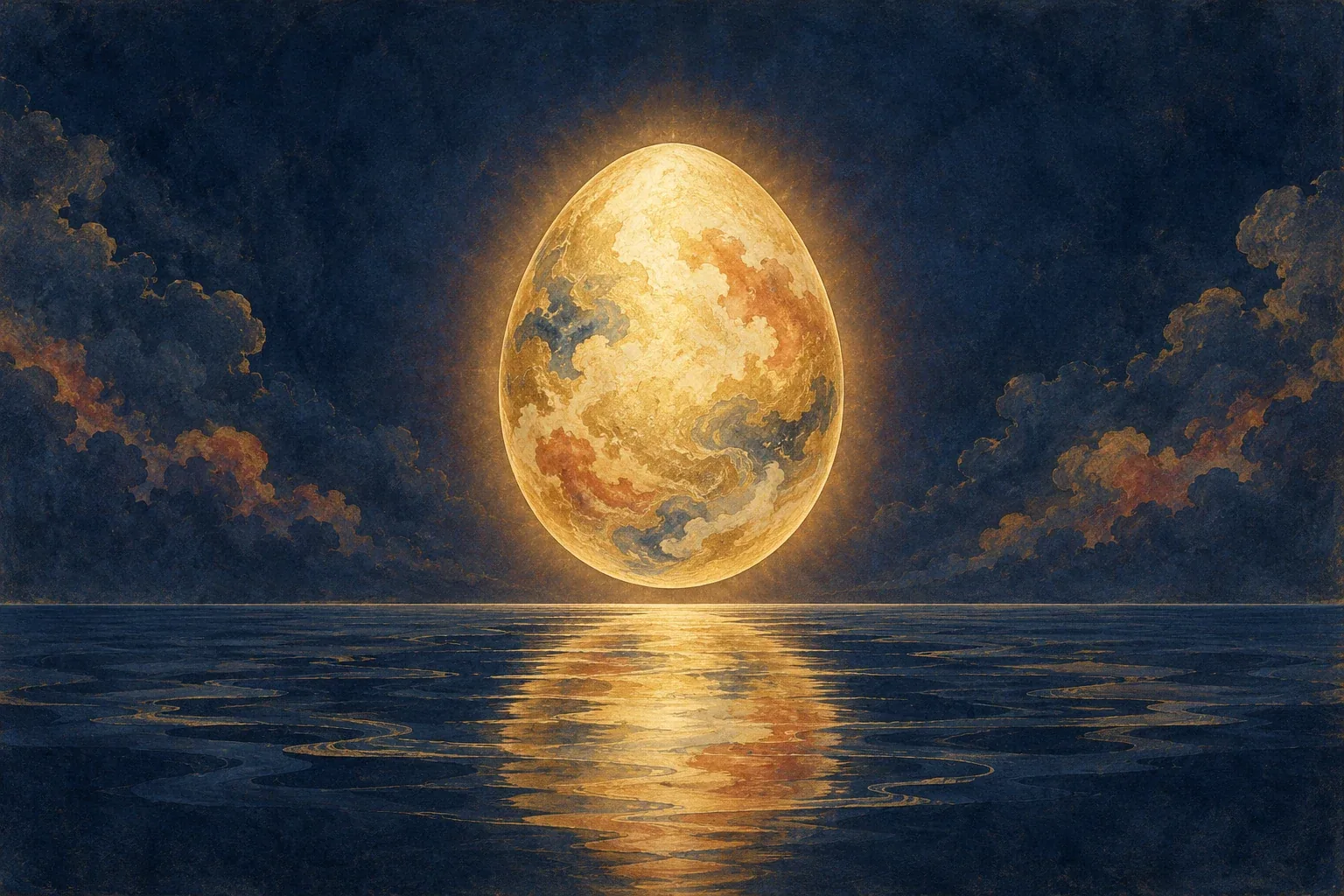
Two questions about creation
The Bhagavata Purana includes Sarga and Visarga among its principal subjects. Its definition in 2.10.3 distinguishes the arising of the constituents of the cosmos from the further creation associated with Brahma. The distinction helps us ask both how a manifest world is constituted and how its many forms come to be.
- सर्ग Sarga
- Primary creation. The emergence of elements, subtle sense-qualities, senses and the principles of mind and differentiation.
- विसर्ग Visarga
- Secondary creation. Brahma’s further creation of the varied moving and non-moving forms within the manifest cosmos.
Read together, the terms distinguish the constituents and powers of a cosmos from the living forms that inhabit it.
Bhagavata Purana 2.10.1–3 →Sarga: the unfolding of a cosmos
The vocabulary of primary creation reaches beyond the familiar objects around us. It includes the subtle qualities through which a world can be experienced, the senses through which it is known, and principles such as mahat and ahamkara. Creation concerns an ordered field of experience as well as material forms.
In the supplied Brahmanda Purana, the account begins with unmanifest Prakriti, also called Pradhana. The three gunas are in equilibrium. When that equilibrium changes, Mahat, the great principle, emerges. This belongs to that text’s account of manifestation.
The Linga Purana gives its own Shaiva framing: Shiva is the uncharacterized source, and its account describes Pradhana, Mahat, ahamkara, subtle qualities and gross elements. The elements named here are ether or space, air, fire, water and earth; their account is connected with sound, touch, form, taste and smell.
These terms should be read within the text’s cosmology. The Linga Purana itself cautions that what it explains gradually need not occur as separate events one after another. Its explanatory order is not simply a clock ticking through a physical experiment.
The supplied Brahmanda and Linga passages →Visarga: a world of living forms
The focus now turns from the constituents of a cosmos to the diversity of its inhabitants. In the supplied Bhagavata edition’s explanation of 2.10.3, Visarga concerns Brahma’s varied creation of moving and non-moving forms. The distinction brings the living world into view.
Bhagavata Purana 3.10 develops a more detailed classification. It distinguishes Prakrta creations from Vaikrta creations and discusses plants, animals and human beings, with divine beings and the Kumara creation treated in their own setting. The chapter’s distinctions should be followed on their own terms.
For a first reading, the useful contrast is between the unfolding of cosmic principles and the differentiation of living forms. Visarga is not a second universe made independently of the first: the further creation belongs within the cosmos whose constituents have been described.
The image of the cosmic egg
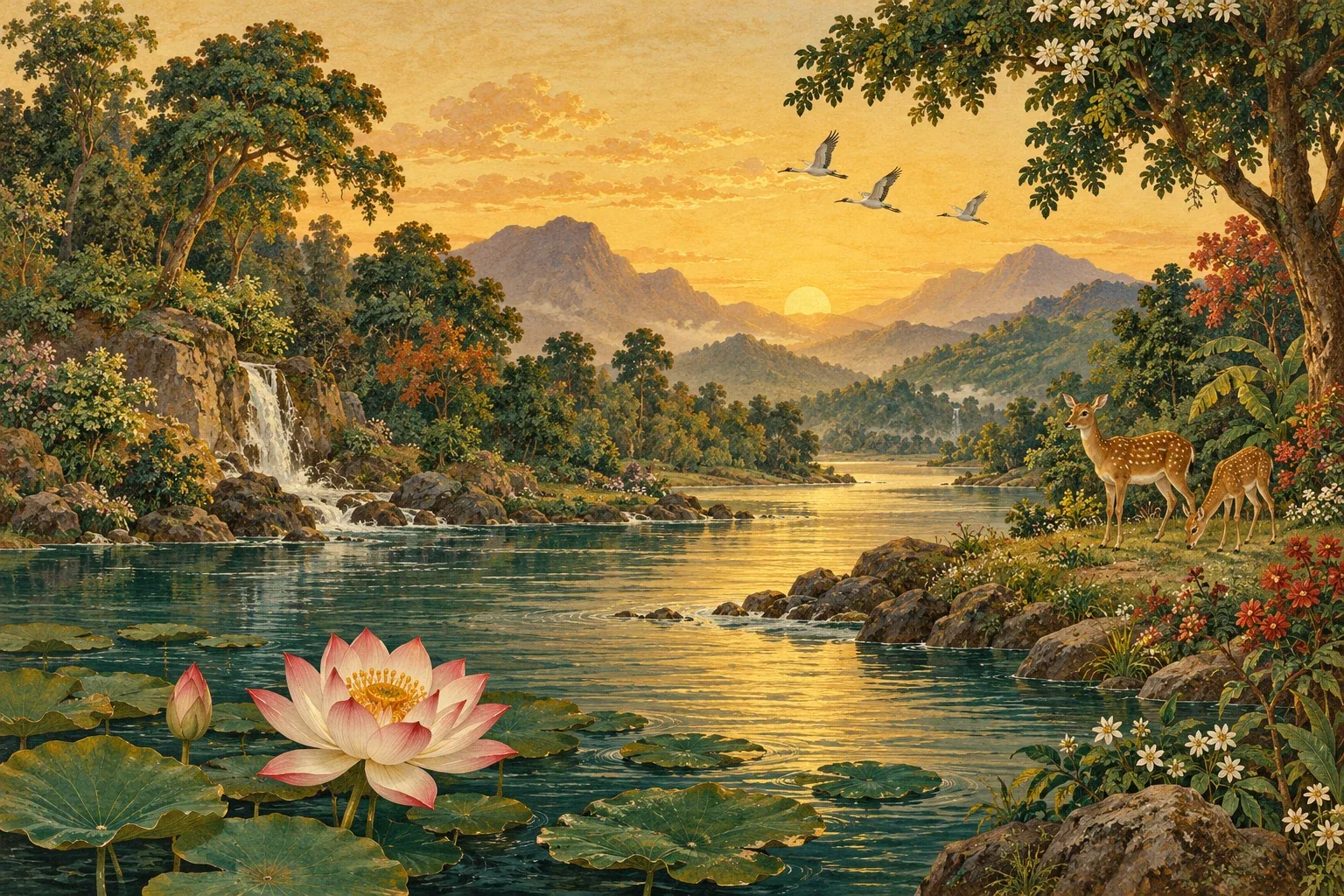
The cosmic egg gathers a complex account of manifestation into a memorable image. In the Linga Purana, the constituents of creation form the cosmic egg, Brahma arises within it, and the worlds are described as contained within it. The Brahmanda Purana likewise presents a cosmic egg and the appearance of Hiranyagarbha.
This image gives a reader a way to contemplate an ordered whole: many worlds and forms held within one enclosing cosmos. The illustration above is a contemporary interpretation of that image. Its colours, light and reflected waters are artistic choices, not a diagram supplied by either book.
Cosmic-egg passages in the supplied editions →Manifestation, withdrawal, renewal
Puranic creation is placed within recurring cycles. The Linga Purana speaks of Brahma’s day and night, the withdrawal of created beings, and their renewed appearance. The Bhagavata also describes the renewal of worlds that had previously been dissolved and places creation within the rhythm of kalpas.
A kalpa belongs to this vast scale of sacred time. A first introduction need not reduce the whole account to a single numerical date. What matters here is the recurring relationship between manifestation and withdrawal, rather than a creation that can never recur.
Keep a related word distinct: Pratisarga. In the Brahmanda Purana’s list of Puranic subjects, it concerns dissolution and recreation. It is not simply another spelling or an interchangeable label for the Bhagavata’s Visarga.
Kalpas, renewal and Pratisarga →One subject, distinct accounts
The Puranas share cosmological vocabulary without presenting every account in precisely the same form. Their theological settings and classifications deserve to remain visible.
| Text | Distinction to retain |
|---|---|
| Bhagavata Purana | Sarga and Visarga are defined together in 2.10.3. Chapter 3.10 develops its creation classifications. |
| Brahmanda Purana | Sarga and Pratisarga occur among Puranic subjects; its creation account also distinguishes Prakrta and Vaikrta. |
| Linga Purana | The account has an explicit Shaiva setting and its own treatment of primary creation, living forms and cosmic cycles. |
Reading these side by side can deepen understanding without turning them into a single combined timeline. This page uses the Bhagavata for the Sarga–Visarga distinction, then identifies the other Puranas when drawing on their accounts.
Detailed chapter references and edition notes →EDITORIAL REFLECTION
A world made manifest.
A place within it.
These accounts invite attention to more than a beginning. They ask us to contemplate the relationship between an underlying order, the diversity of living forms and the cycles within which life unfolds. What changes when we think of our world as something we inhabit together?
This is an editorial invitation to reflection, separate from the primary textual accounts.
Continue into the Fourteen Lokas: the worlds within a cosmos →