
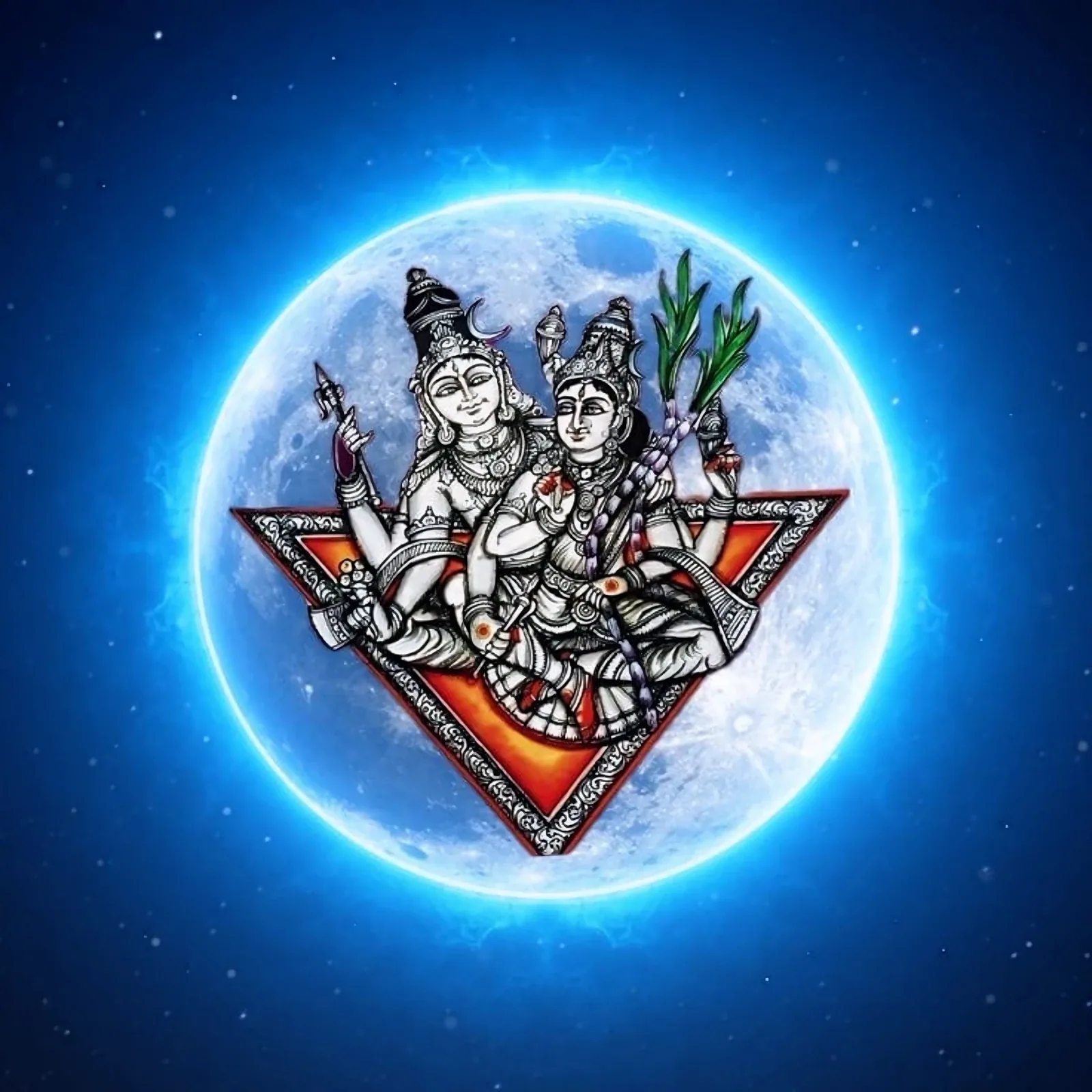
From ashes, a formidable king
The story begins with an earlier crisis. The devas needed Shiva to turn towards Parvati so that their son could confront Taraka. Kama, the god of love, approached Shiva with his flower arrows. Shiva’s third eye opened, and Kama was reduced to ashes.
From those ashes, Citrakarma fashioned a human figure. Under Shiva’s gaze, it came to life. The radiant being praised Shiva and received a formidable boon: half an opponent’s strength would join his own, and his arrows would make the opponent’s weapons ineffective. He became known as Bhanda.
With Shukra’s support, Bhanda established a splendid kingdom in the rebuilt city of Shonitapura. His power grew while the devas’ strength diminished. The narrative first shows him surrounded by ritual learning and prosperity; the danger lies in the immense power he later turns against the gods.
The Mother answers their prayer
Vishnu’s maya temporarily distracted Bhanda, giving the devas a respite. Narada warned Indra that this relief would not last: they needed to seek the grace of Parashakti, the supreme divine power. The devas began sustained worship in the Himalayan region.
Bhanda tried to interrupt them. A radiant wall rose before him; whenever he shattered it, it appeared again. Unable to pass it, he returned to his city. The devas continued their sacrificial worship. At its culmination, an immense radiance appeared, and within it they beheld the Goddess.
Lalita shone like the rising sun. In her hands were a noose, a goad, a sugarcane bow and five arrows. Her glance restored the devas’ strength. They praised her as the Mother of the universe and sought refuge. She promised to defeat Bhanda and free them from fear.
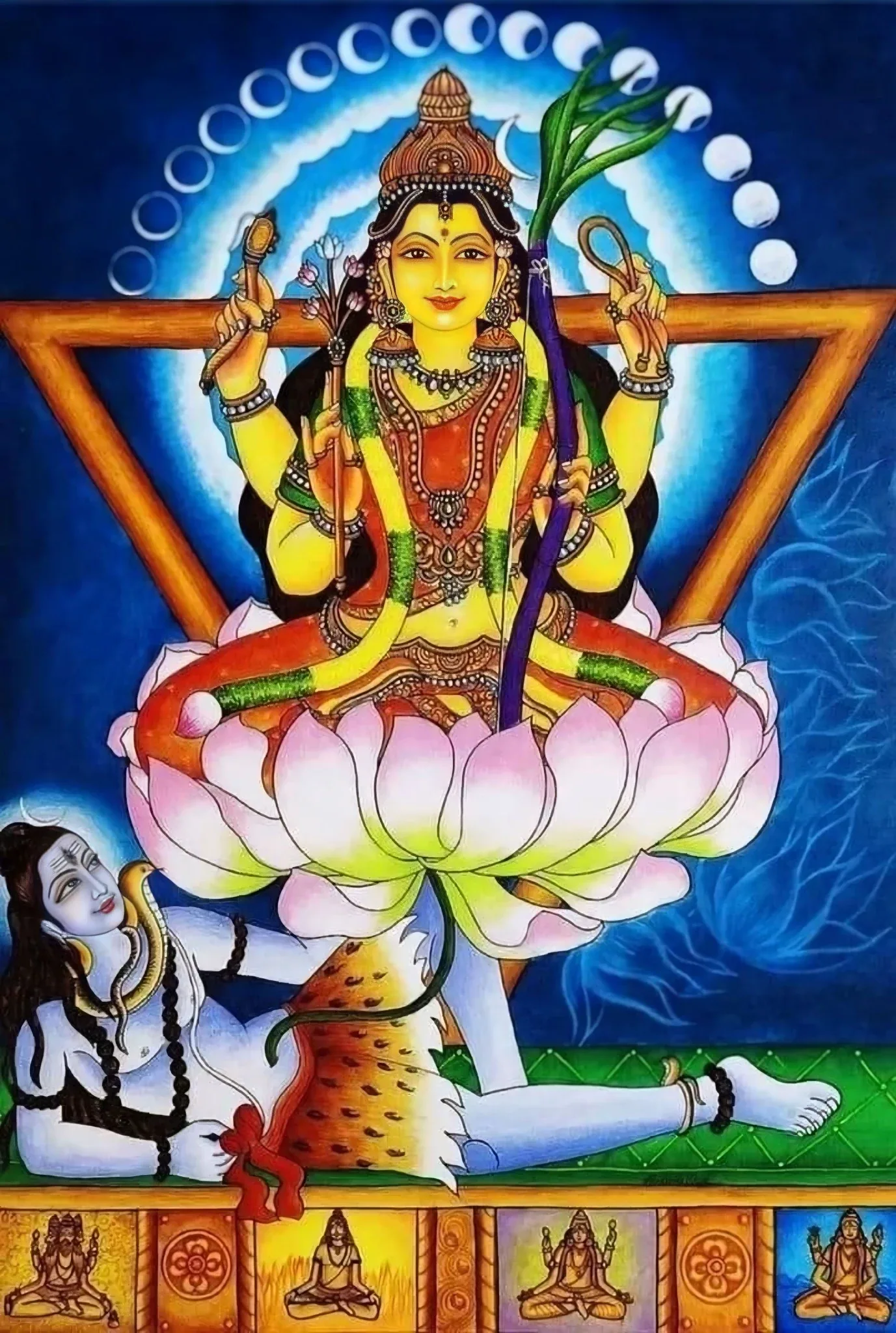
The divine queen sets out
The narrative pauses for Lalita’s union with Kameshvara and their royal consecration. The gods gather in reverence. Lalita then prepares to confront Bhanda with an army of Shaktis—divine powers appearing as goddesses.
The march fills the sky with drums, banners and royal umbrellas. Sampatkari leads the elephant forces; Ashvarudha leads the cavalry. Shyamala, also called Mantrini, and Dandanatha are central leaders of the campaign. Lalita herself rides the magnificent Chakraraja chariot.
The account unfolds through many encounters, with attacks, counterattacks and the defence of the divine camp. Its elaborate armies and chariots are part of the sacred narrative’s vision of Lalita’s sovereignty.
Bala enters the battle
When Bhanda’s thirty sons come to the battlefield, Bala asks permission to confront them. The text presents her as Lalita’s daughter, eternally appearing as a nine-year-old goddess and possessing extraordinary knowledge and martial power.
Lalita first refuses out of concern for her tender daughter. Bala persists. At last Lalita embraces her, gives her armour and weapons, and permits her to go. Mantrini and Dandanatha accompany her as protectors.
Bala’s single form seems to appear separately before each opponent, like the sun reflected many times. She overcomes their army and defeats all thirty sons. Her guardians embrace her, and she returns in triumph. Bhanda’s grief then gives way to renewed fury.
A smile that removes an obstacle
Bhanda sends Vishukra to sabotage Lalita’s camp. He casts the Jayavighna yantra, an obstacle-producing device, into the enclosure. Its effect is devastating: the Shaktis lose their resolve, put down their weapons and sink into lethargy.
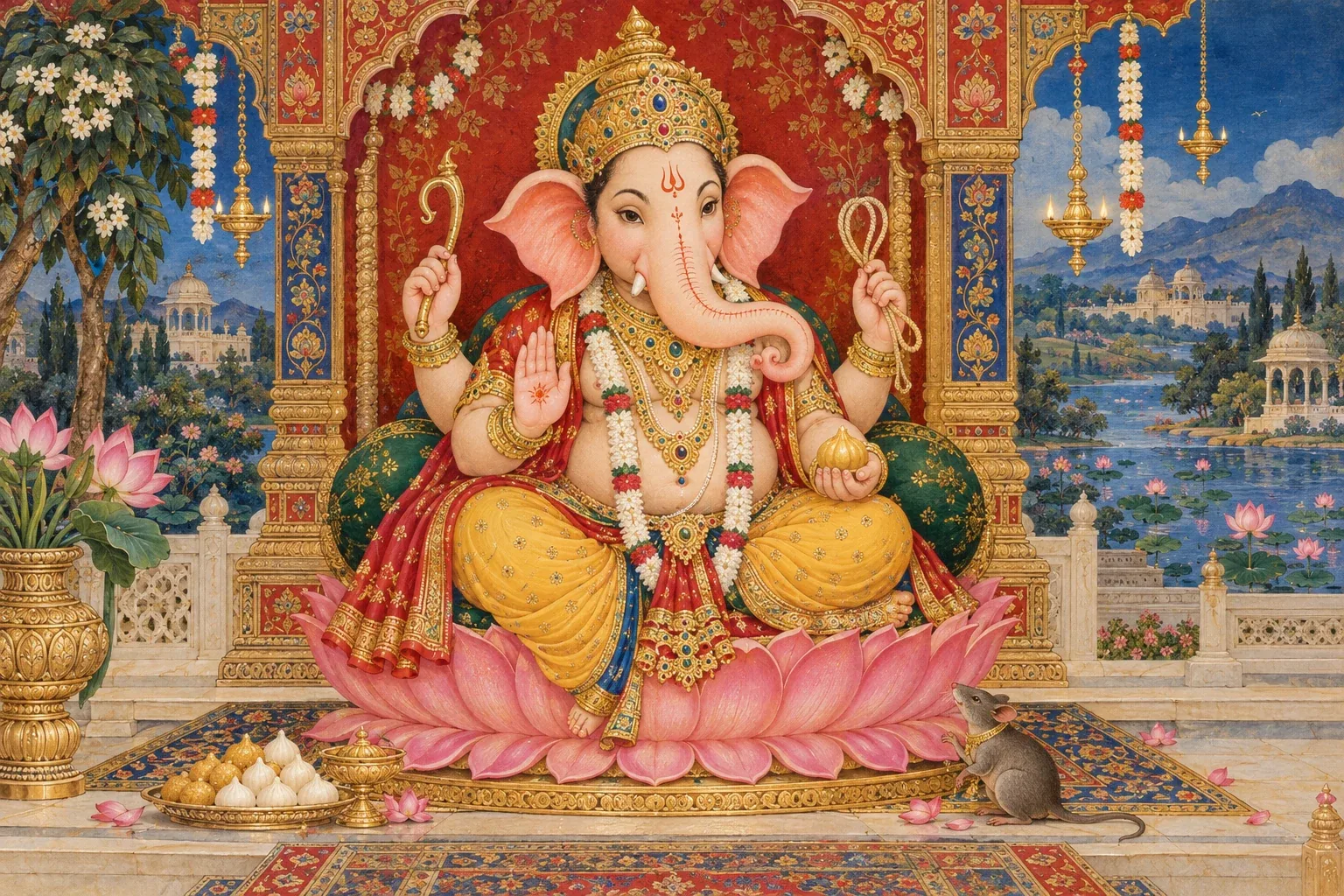
Mantrini and Dandanatha remain unaffected and appeal to Lalita. The Goddess looks towards Kameshvara and smiles. From the radiance of that smile, the elephant-faced Ganesha appears.
Blessed by Lalita, Ganesha finds the concealed device and shatters it with his tusks. The army’s energy returns. After his further victories, Lalita grants him the honour of being worshipped before the other deities. This is the Ganesha manifestation told within this particular Lalita narrative.
The commanders hold the field
Bhanda next sends his brothers, Vishukra and Vishanga, with a vast army. Mantrini and Dandanatha go out together to meet them. The text describes their chariots, weapons and the many Shaktis who fight beside them.
Vishukra releases a missile that afflicts the divine army with terrible thirst. The episode makes the struggle more than a contest of physical strength: the forces must endure assaults on their very ability to continue.
The commanders overcome these attacks, and the two brothers fall in the battle. With his sons and principal supporters defeated, Bhanda prepares to face Lalita himself.
Lalita faces Bhandasura
On the fourth day, Lalita and Bhanda enter a fierce contest of arrows and supernatural missiles. Every assault meets a response. Darkness is dispelled by a solar missile; the loss of memory is countered by a power of retention. Fear and great delusion also become weapons in the battle.
Bhanda summons hosts of asuras. Durga arises and defeats the demonic forces associated with her earlier battles. Other attacks call forth divine forms from Lalita’s fingernails, including Vishnu’s manifestations. Within this Shakta account, these powers answer to the supreme Goddess.
At last Lalita destroys the remaining armies and generals. Bhanda stands alone. She releases the Mahakameshvara missile, radiant like a thousand suns, and defeats him. His city is consumed by its fire. The three worlds rejoice at the end of his oppression.
After victory, compassion
Lalita brings the exhausted Shaktis back to camp. Her compassionate glance refreshes those wounded and wearied by the battle. The gods approach her again in praise, but they also bring a request.
Rati still mourns Kama, whose burning began the chain of events that led to Bhanda’s birth. The devas ask Lalita to restore him. Seeing Rati’s grief, Lalita looks upon her with mercy, and Kama appears again, beautiful and joyful.
Rati is reunited with him. Their union is celebrated, and Kama bows before Lalita in gratitude. The story that began with the destruction of love closes with its restoration: the victorious Mother is also the one who heals and renews.
PAUSE & REFLECT
Power that protects.
Mercy that restores.
The narrative places both victory and renewal in Lalita’s hands. Her final act is to respond to grief and restore life.
TRADITIONS & INTERPRETATION
A Shakta telling
In this Lalita Mahatmya narrative, Lalita is the supreme Goddess, and the divine powers act within her sovereignty. This framing belongs to the text’s Shakta setting. Other traditions place different divine forms at the centre of their worship and narratives.
The Ganesha manifestation here arises from Lalita’s smile toward Kameshvara. It is one particular sacred account, rather than a replacement for other Ganesha stories. Tagare’s commentary also reads the opposing weapons as harmful and beneficial forces; that interpretation is distinct from the story’s literal sequence of divine battles.
Read the references and commentary notes