
Poison in the Yamuna
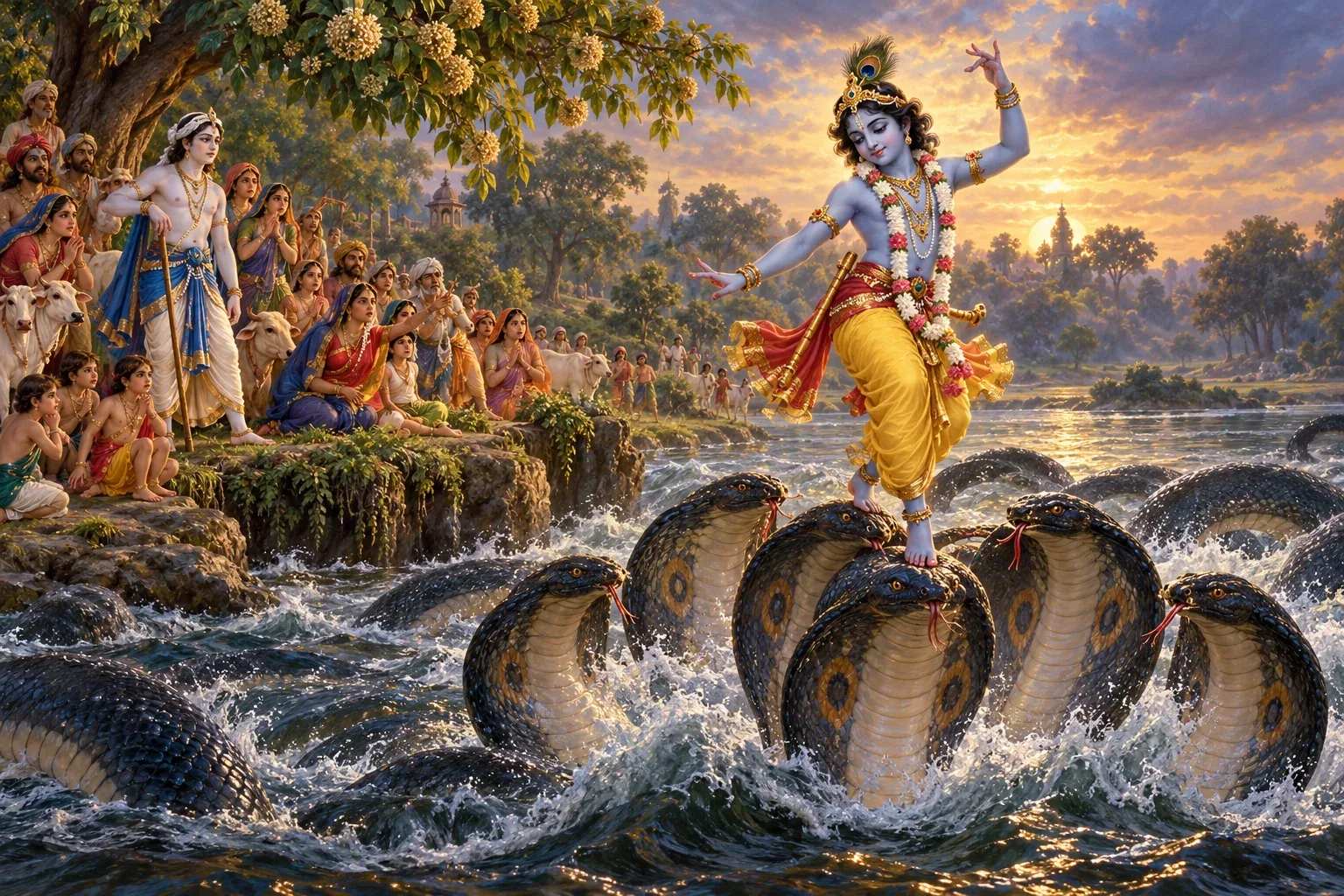
Within the Yamuna lies a lake occupied by Kaliya. The Bhagavata describes water made fierce by his poison: vapours rise from it, birds fall when they pass above and life cannot safely remain along the bank.
Krishna sees that the serpent’s presence has closed part of the river to the people and cattle of Vraja. The danger is not distant. It stands within the landscape that sustains the community.
He decides to remove the poison and confront the one who has made the water uninhabitable.
The leap from the kadamba
Krishna tightens his belt, climbs a kadamba tree and looks over the dark water. Then he leaps.
His impact sends the lake surging. He moves through it with the fearless energy of play, splashing and sounding the water until Kaliya hears the disturbance in the territory he claims as his own.
The serpent rises. Many hoods break the surface, and his gaze fixes upon the boy whose radiance remains undiminished by the poison.
Kaliya’s coils
Kaliya strikes and winds his coils around Krishna. For a time the young cowherds and cattle see him held within the serpent’s grasp. Their confidence collapses into fear.
In Vraja, troubling signs draw the community toward the Yamuna. Yashoda, Nanda and the others follow the marks of Krishna’s feet until they reach the lake and see the scene before them.
The narrative allows their distress to remain real. They do not yet see the outcome; they see the child they love surrounded by danger.
Vraja reaches the bank
Yashoda moves toward the water, but the cowherd women hold her back. Others are ready to follow Krishna into the lake. Balarama, aware of Krishna’s power, restrains them and waits.
Krishna sees the people of Vraja overwhelmed by grief. He expands his body within Kaliya’s coils. The serpent can no longer hold him and is forced to release his grip.
What seemed like helplessness becomes freedom. Krishna rises from the coils and begins to circle Kaliya, drawing the serpent into a contest of movement and attention.
The dance upon the hoods
Each time Kaliya lifts a hood, Krishna turns toward it. At last he springs onto the serpent’s heads and begins to dance.
The Bhagavata presents the scene as both chastisement and divine performance. Celestial musicians accompany the rhythm while flowers fall. Kaliya’s strength fails under feet that the tradition reveres as a source of refuge.
Krishna does not continue without limit. When the serpent’s resistance is broken and his life is near its end, another voice enters the encounter.
The Nagapatnis’ prayer
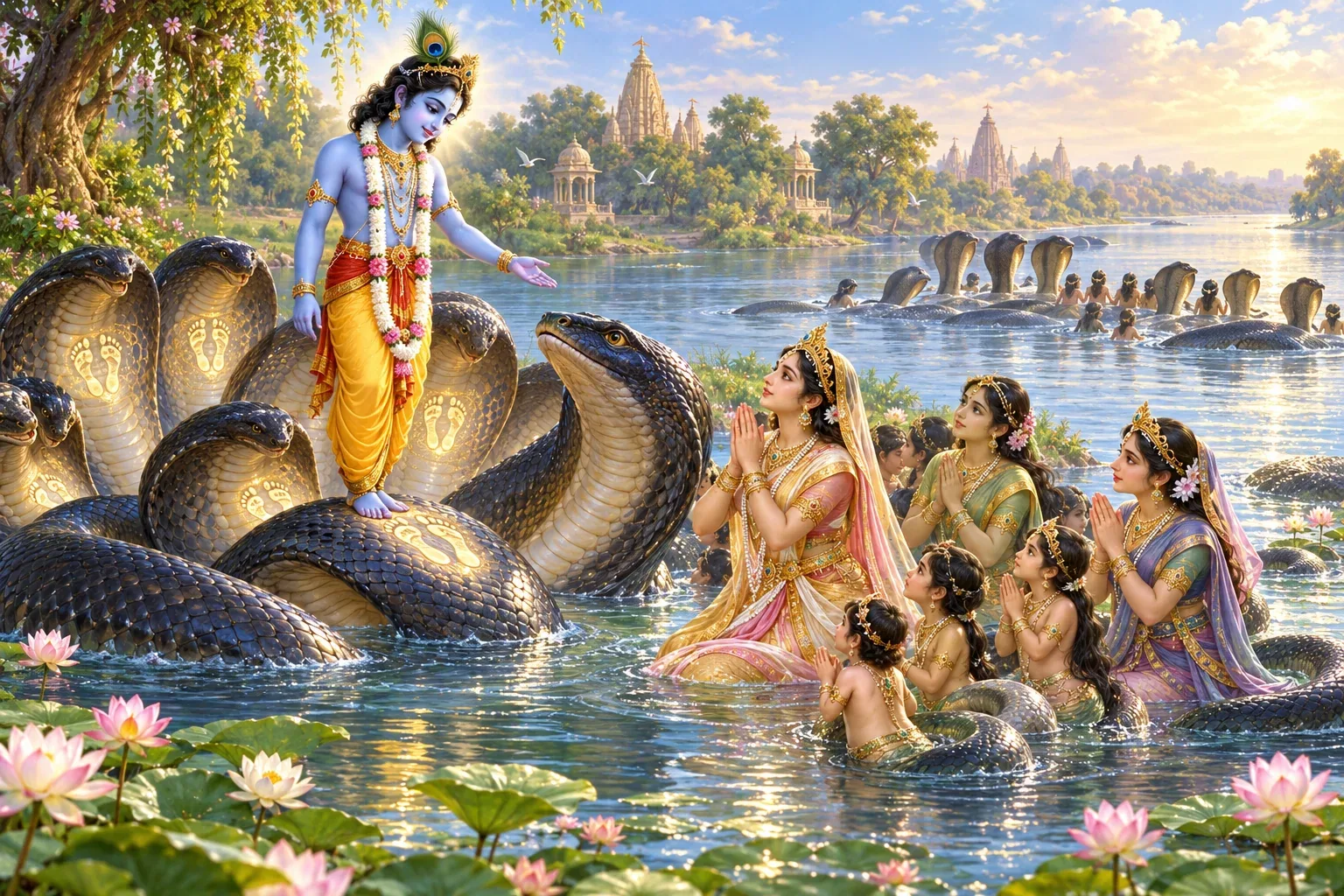
Kaliya’s wives approach with their children. Their hair and ornaments are disordered by fear, yet they bow and speak with clarity. They acknowledge Kaliya’s offence and Krishna’s impartial correction, then ask that their husband be spared.
Their prayer does not deny the harm done to the Yamuna. It asks that justice make room for mercy once the serpent’s pride and resistance have been overcome.
Kaliya also submits. He admits the fierce nature that has governed him and places the future of his family in Krishna’s hands.
A command and protection
Krishna releases Kaliya, but mercy does not mean that the serpent may remain. He orders Kaliya to leave the Yamuna with his wives, children and followers and return to the ocean at Ramanaka.
Kaliya fears Garuda, whose hostility had driven him from Ramanaka. Krishna answers that the marks of his feet upon Kaliya’s hoods will serve as protection. Garuda will recognise them and not attack.
The command joins consequence to a path forward. The river is returned to Vraja, while Kaliya’s family is given a place to live beyond it.
The Yamuna restored
Kaliya and the Nagapatnis honour Krishna, circle him and depart with their family. As they leave, the Bhagavata says that the Yamuna’s water immediately becomes free of poison and sweet once more.
Krishna emerges from the lake adorned with gifts. The people of Vraja receive him as one returned from death. Yashoda embraces him; Nanda and the elders are filled with relief; Balarama smiles.
The episode closes not with conquest for its own sake, but with restored relationship: a river reopened, a family redirected and a frightened community reunited around the one it loves.
EDITORIAL REFLECTION / PAUSE & REFLECT
Strength that makes
life possible again.
What does a good correction restore? The story invites us to distinguish revenge from responsibility. Krishna stops the harm, protects the community and still leaves Kaliya a future beyond the river.
TRADITIONS & INTERPRETATION
Following the Bhagavata’s account
This reader follows the Krishna-centred Vaishnava narrative of Bhagavata Purana 10.16, with Kaliya’s earlier conflict with Garuda and Krishna’s reunion with Vraja drawn from 10.17. It does not combine later regional identifications of the lake or festival customs with the scripture’s sequence.
The source describes Kaliya with many hoods. The paintings condense that number into a readable visual arrangement and are devotional interpretations, not historical records. The reflection above is editorial and distinct from the scripture.
Read the verse groups and edition notes