
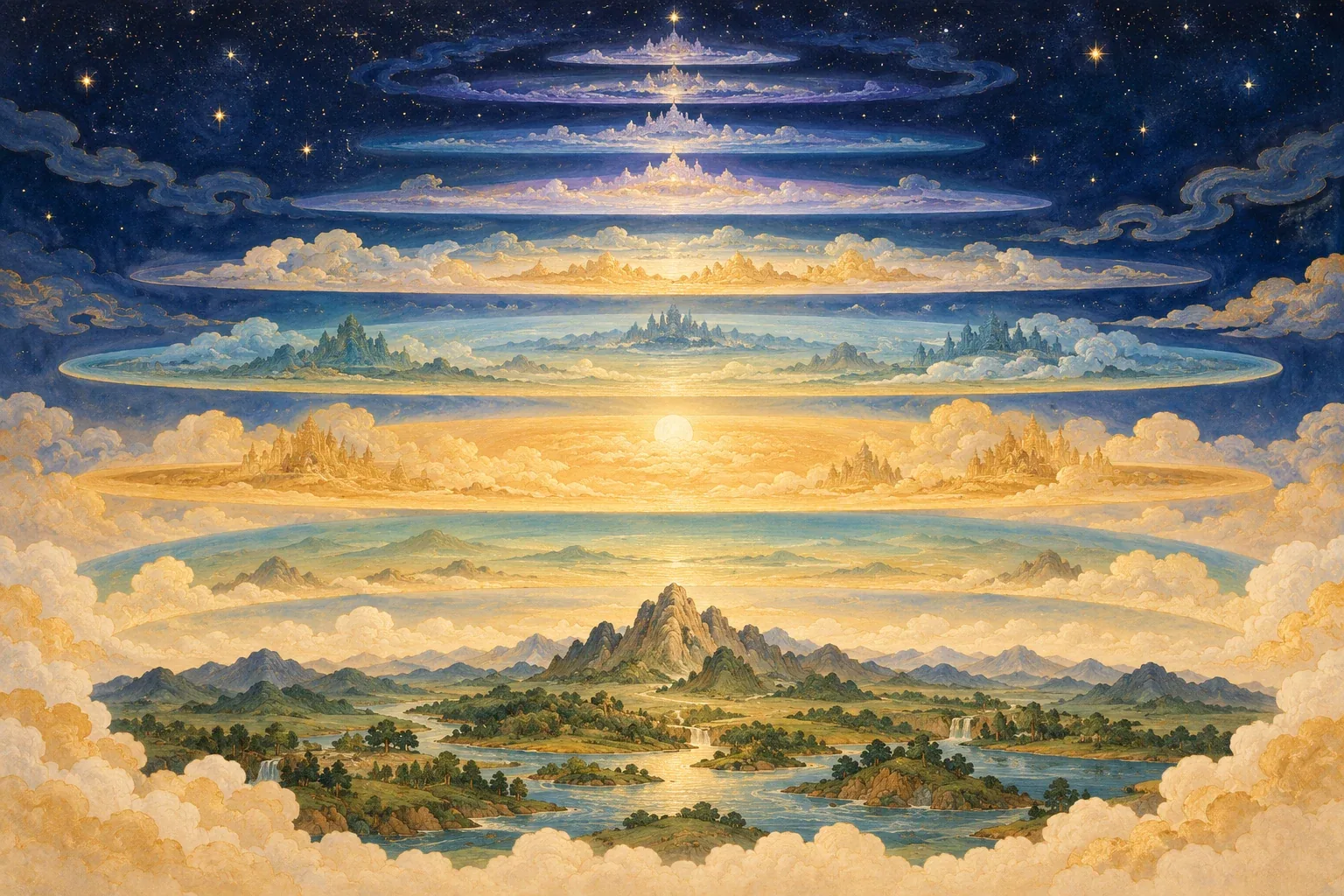
A cosmos of many worlds
A loka is a world or realm. In the Bhagavata Purana’s fourteen-world account, seven worlds are placed above and seven below. The earthly world belongs to the upper seven; “upper” here does not mean that all seven are heavens.
The setting matters. Bhagavata 2.5.36–42 contemplates the worlds through the body of the cosmic person, the Virat Purusha. It names the fourteen realms and also offers a three-world arrangement. The text gives readers more than one way to contemplate the cosmos.
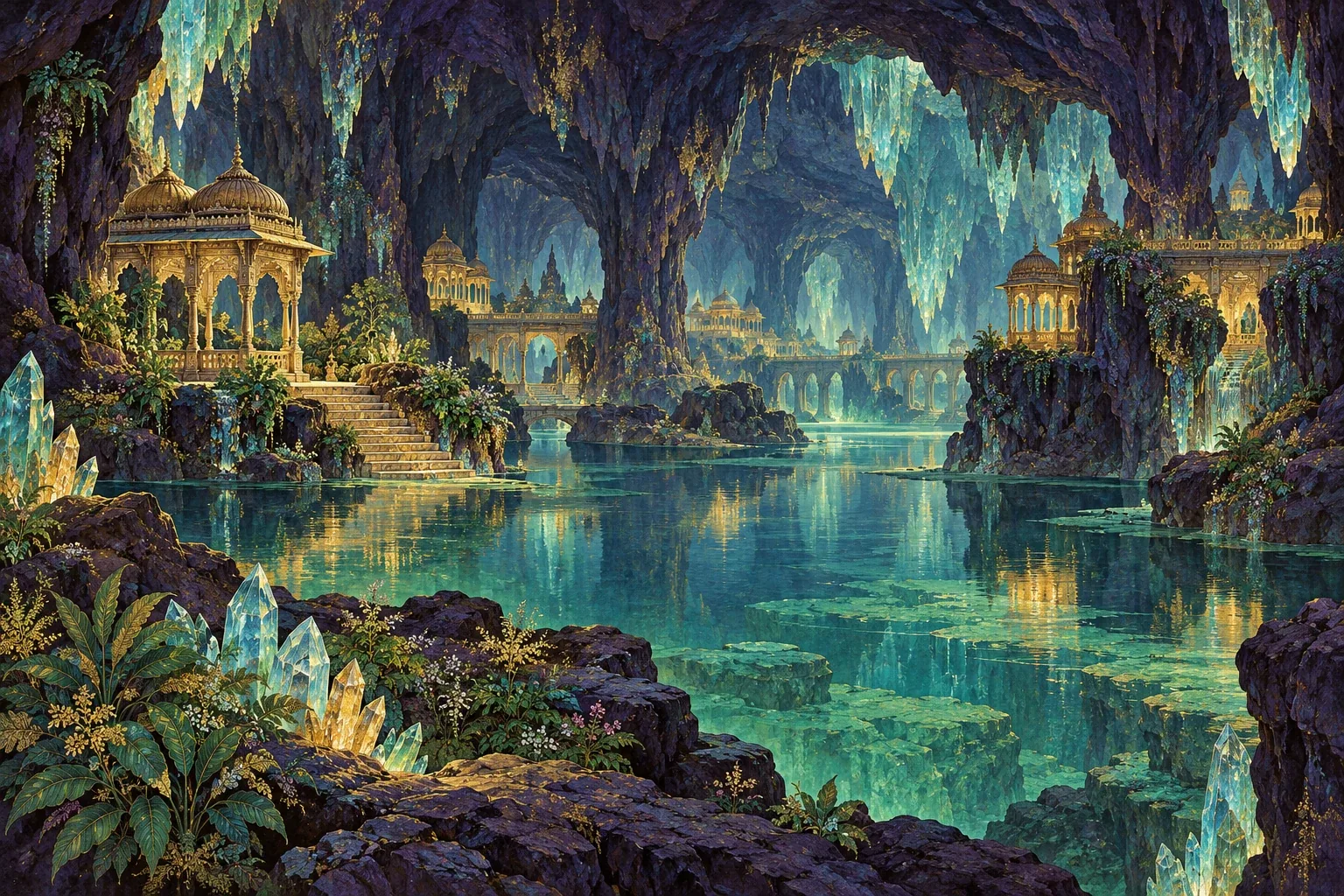
This guide follows that supplied edition’s names and draws on its fifth Skandha for the lower realms. The illustrations are contemporary artistic interpretations. Their landscapes, architecture and light are imagined rather than measurements or literal reconstructions.
Bhagavata Purana 2.5.36–42 →The seven upper Lokas
The sequence below begins with the earthly realm and proceeds upward. These are the names in the passage’s seven-world arrangement; its contemplative associations belong to that particular account.
Bhuloka Bhūloka
The earthly world, the starting point of this ascending sequence. The passage associates it with the cosmic person’s feet.
Bhuvarloka Bhuvarloka
The next realm above Bhuloka, associated here with the navel of the cosmic person.
Svarloka Svarloka
Named above Bhuvarloka and associated with the heart in this contemplative arrangement.
Maharloka Maharloka
The fourth in this sequence, associated with the chest of the cosmic person.
Janaloka Janaloka
Placed above Maharloka; the passage locates it at the cosmic person’s neck.
Tapoloka Tapoloka
The next realm in the enumeration, associated in this passage with the two breasts of the cosmic person.
Satyaloka Satyaloka / Brahmaloka
The highest of these seven, placed at the head and described as Brahma’s dwelling. The Sanskrit passage also calls it Brahmaloka.
These body associations express a contemplative correspondence. They should not be read as anatomical coordinates or silently substituted for the passage’s alternative three-world arrangement.
Upper-realm names and associations: 2.5.38–42 →The seven realms below
Bhagavata 5.24 turns to the subterranean realms, naming the following seven in order below the earth. Its account describes palaces, gardens, remarkable pleasures and inhabitants including Daityas, Danavas and Nagas. The word bila-svarga, used in the chapter, conveys the surprising character of these subterranean paradises.
Atala
The first realm in this descending list. The account associates it with Bala, a son of Maya.
Vitala
Associated with Shiva as Hatakeshvara, dwelling with Bhavani.
Sutala
The realm of Bali, whose account is shaped by Vishnu’s grace. The chapter later describes Narayana at Bali’s gate.
Talatala Talātala
Associated with Maya, protected by Mahadeva. It is a distinct realm from Atala.
Mahatala Mahātala
The dwelling of many-headed serpents descended from Kadru.
Rasatala Rasātala
Described as a dwelling of Daityas and Danavas.
Patala Pātāla
The deepest of these seven in this enumeration, associated with Naga lords led by Vasuki. The jewels of their hoods illuminate the realm.
The names appear together in 2.5.40–41 and again in 5.24.7. The descriptions above follow 5.24.16–31. This page uses Patala for the named seventh realm when presenting the list.
The lower seven: 5.24.7–13, 16–31 →A different subject: Naraka
Calling all seven lower realms “hell” loses an important distinction in this text. The Bhagavata describes their splendour and enjoyment in chapter 5.24, then treats Naraka separately in chapter 5.26.
That later chapter describes Yama and the consequences of actions, presenting realms of punishment. Its Narakas are a separate category from the seven subterranean worlds listed here. A shared association with what lies below does not make the two lists interchangeable.
This distinction also keeps the story of Bali’s Sutala from being reduced to a simple image of punishment. Each realm needs to be read within its own narrative and theological setting.
Compare Bhagavata 5.24 with 5.26.4–7 →How to read this guide
The fourteen-world enumeration and the Virat body meditation belong to a traditional religious account of the cosmos. The arrangement here follows the Bhagavata passages cited, rather than combining every Puranic description into one universal chart.
Its different scales and arrangements deserve attention on their own terms. Notice how 2.5 names fourteen worlds yet also gives a three-world contemplation, and how 5.24 develops the character of the lower realms through narrative detail. A short diagram cannot hold everything the text is doing.
For the related question of how a cosmos becomes manifest, continue with Sarga and Visarga: the creation of the universe. For the edition and exact locations behind this guide, visit the source notes.
EDITORIAL REFLECTION
Many worlds.
A wider perspective.
What happens when the world we know is placed within a much larger sacred cosmos? These accounts invite a reader to think beyond the familiar horizon, while paying careful attention to the particular text and tradition being read.
This reflection is an editorial invitation, separate from the primary textual descriptions.