
A promise of power
Hiranyakashipu undertakes severe tapas and receives extraordinary protections from Brahma. He asks not to die by any creature Brahma has made, indoors or outdoors, by day or night, on earth or in the sky, or by weapon. He asks for mastery that no rival can overcome.
Armed with this boon, he conquers the worlds and takes the authority of their guardians. Fear enters places of worship and learning. Power that once sought safety now demands submission.
The distressed devas seek refuge in Vishnu. A divine assurance answers them: the ruler’s oppression is known, and its end will come when he turns against his own peaceful son, Prahlada.
The child who remembered
Prahlada grows within the asura household, yet his attention rests elsewhere. The Bhagavata describes him as gentle, truthful, self-controlled and friendly toward all beings. Even as a child, he sees the Lord’s presence within and around him.
Hiranyakashipu entrusts him to Shanda and Amarka, sons of Shukracharya. They teach the politics of allies and enemies, rule and rivalry. Prahlada listens, but the division of the world into those to possess and those to defeat does not take root in him.
His father first receives him with affection. He lifts the child onto his lap and asks what he considers the finest thing he has learned.
What is best?
Prahlada answers from a vision larger than the court. A mind captured by the restless claims of “I” and “mine,” he says, should turn toward Hari. Later, when questioned again, he describes devotion through hearing, singing, remembering, serving, worship, prayer, service, friendship and self-offering.
Hiranyakashipu does not hear a child’s faith; he hears disobedience. He suspects that someone has secretly placed Vishnu’s teaching in the school. Shanda and Amarka deny it, and Prahlada says the understanding does not come from them.
The ruler’s affection gives way to fury. To him, devotion is not an inward freedom but a rival authority—one he believes must be removed.
Devotion under threat
Hiranyakashipu orders that Prahlada be killed. The text names many attempts: weapons, serpents, elephants, poison, fire, water, wind, confinement and crushing weight. This retelling does not dwell on the violence.
None of the attempts succeeds. Prahlada does not meet force with force. Absorbed in remembrance, he remains free of hatred toward those sent against him.
His father becomes more disturbed, not less. The power to command armies and worlds cannot command the interior life of one child. Prahlada is sent back to his teachers, but the lesson Hiranyakashipu wants still does not take root.
A lesson among children
When their teachers step away, the other children gather around Prahlada. He does not ask them to wait for age or authority. Human life is precious and uncertain, he tells them; the work of devotion can begin in childhood.
He speaks of compassion, simplicity and the Lord who dwells in every being. The same presence cannot be honoured through contempt for others. His classmates listen because the teaching comes from someone their own age, offered without demand.
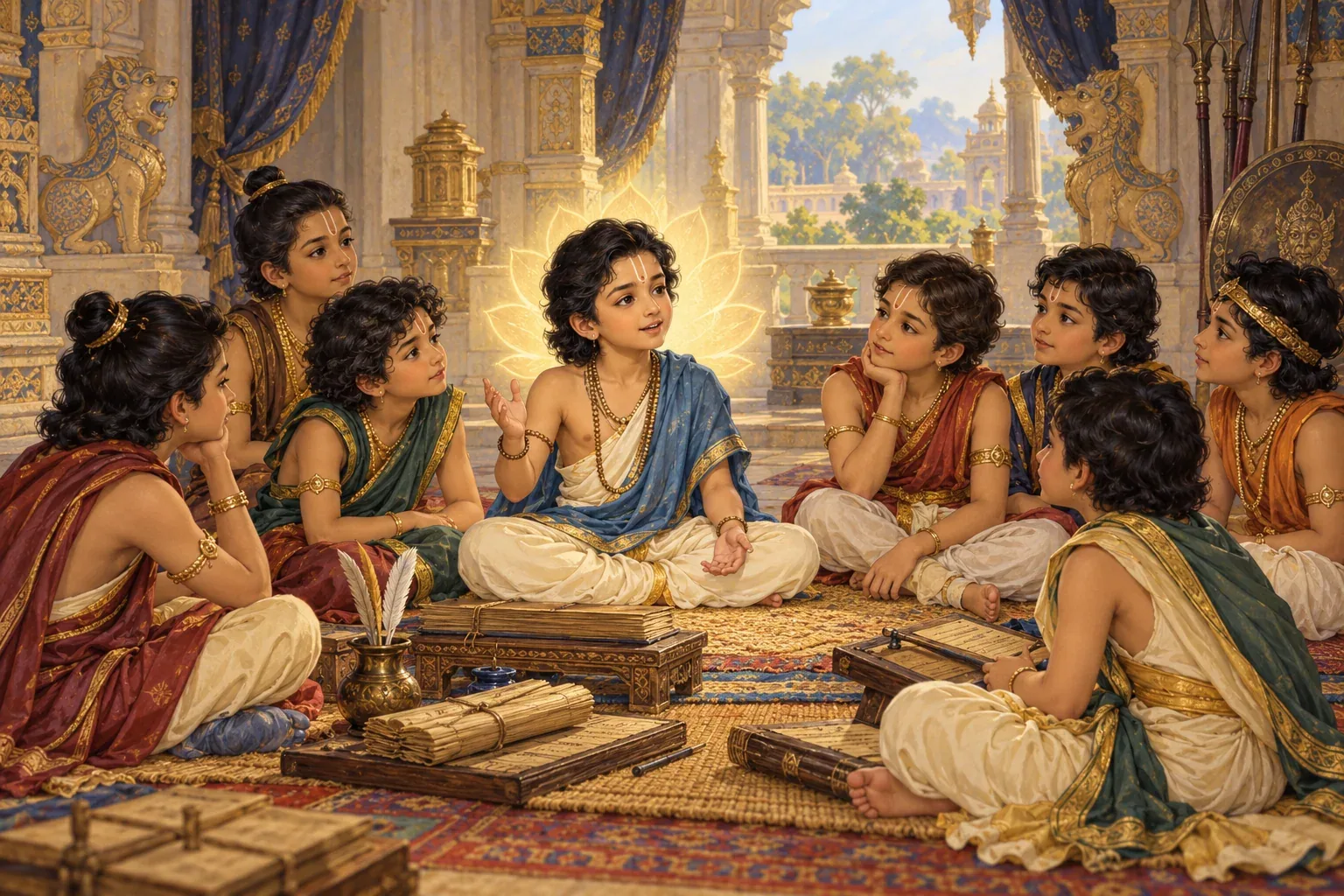
Asked where this knowledge came from, Prahlada recalls Narada’s teaching. While his mother Kayadhu was sheltered in the sage’s ashram, the unborn child heard the instruction and retained it.
Is he in this pillar?
Prahlada is brought again before Hiranyakashipu. The ruler asks where the child finds the strength to defy him. Prahlada answers that the source of his strength is also the source of his father’s strength—and of every being’s.
He urges his father to give up the mind that creates enemies. The Lord is not confined to one place, Prahlada says. He is present everywhere.
Hiranyakashipu points to a pillar in the hall. If this Lord is everywhere, is he present there too? Prahlada does not withdraw his answer. Enraged, the king strikes the pillar with his fist.
A sound unlike anything in the gathered worlds breaks through the hall.
Neither man nor beast
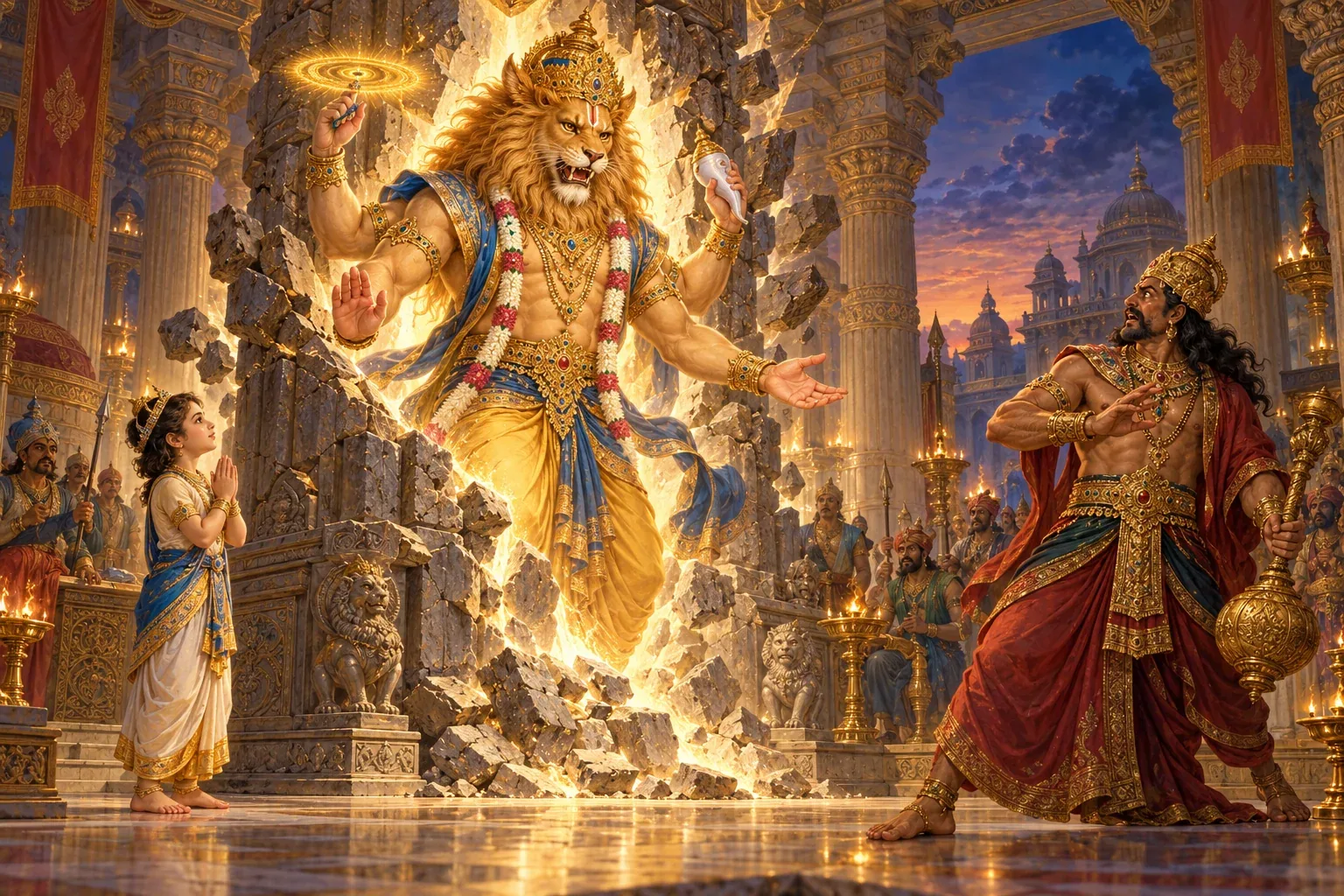
From the pillar appears a form that confounds the categories of the boon: Narasimha, with the features of lion and human. The manifestation is fierce, radiant and impossible for Hiranyakashipu to dismiss as the faith of a child.
The confrontation ends at twilight, on the threshold of the hall. Narasimha places Hiranyakashipu upon his lap—neither earth nor sky—and defeats him with claws rather than a weapon. The source describes the scene vividly; this retelling keeps the violence non-graphic.
The logic of domination had tried to place every possibility inside a condition. The manifestation reveals what that logic could not contain.
The child who approached
Even after the danger has ended, Narasimha’s intensity fills the hall. The gods offer praise but do not draw near. Lakshmi does not approach this unprecedented form. Brahma turns to Prahlada.
The child bows. Narasimha places a hand upon his head, and fear gives way to prayer. Prahlada does not celebrate an enemy’s fall. He asks for freedom from selfish desire and speaks with concern for beings caught in suffering.
When offered a boon, he refuses to make devotion into a transaction. If he must ask, he says, let desire itself leave his heart. Then he asks that his father be purified. Narasimha assures him of his father’s release and instructs him to honour the duties that remain.
Prahlada performs his father’s rites and is installed as ruler. The story closes not with a child inheriting tyranny, but with devotion asked to enter responsibility without becoming its opposite.
EDITORIAL REFLECTION / PAUSE & REFLECT
A devotion
no command can own.
Prahlada’s courage is not loud. He does not need to humiliate his father in order to remain truthful. What conviction in your own life can stay firm without becoming cruel?
TRADITIONS & INTERPRETATION
A form beyond
the boundaries of a boon.
This reader follows the Bhagavata Purana’s Prahlada narrative in Skandha 7. The account of Narasimha’s manifestation is presented within that text’s Vaishnava theology; details from other Puranas and later devotional traditions are not silently added.
The hero painting uses a four-armed devotional convention with conch and discus. The Bhagavata’s manifestation passage describes a vast, extraordinary form with expansive poetic imagery; the artwork is an interpretation, not an attempt to catalogue every feature.
Prahlada’s philosophical teaching and prayers are substantially condensed. The reflection on conviction without cruelty is editorial contemplation.
Read the supplied-edition references