
A dispute becomes dangerous
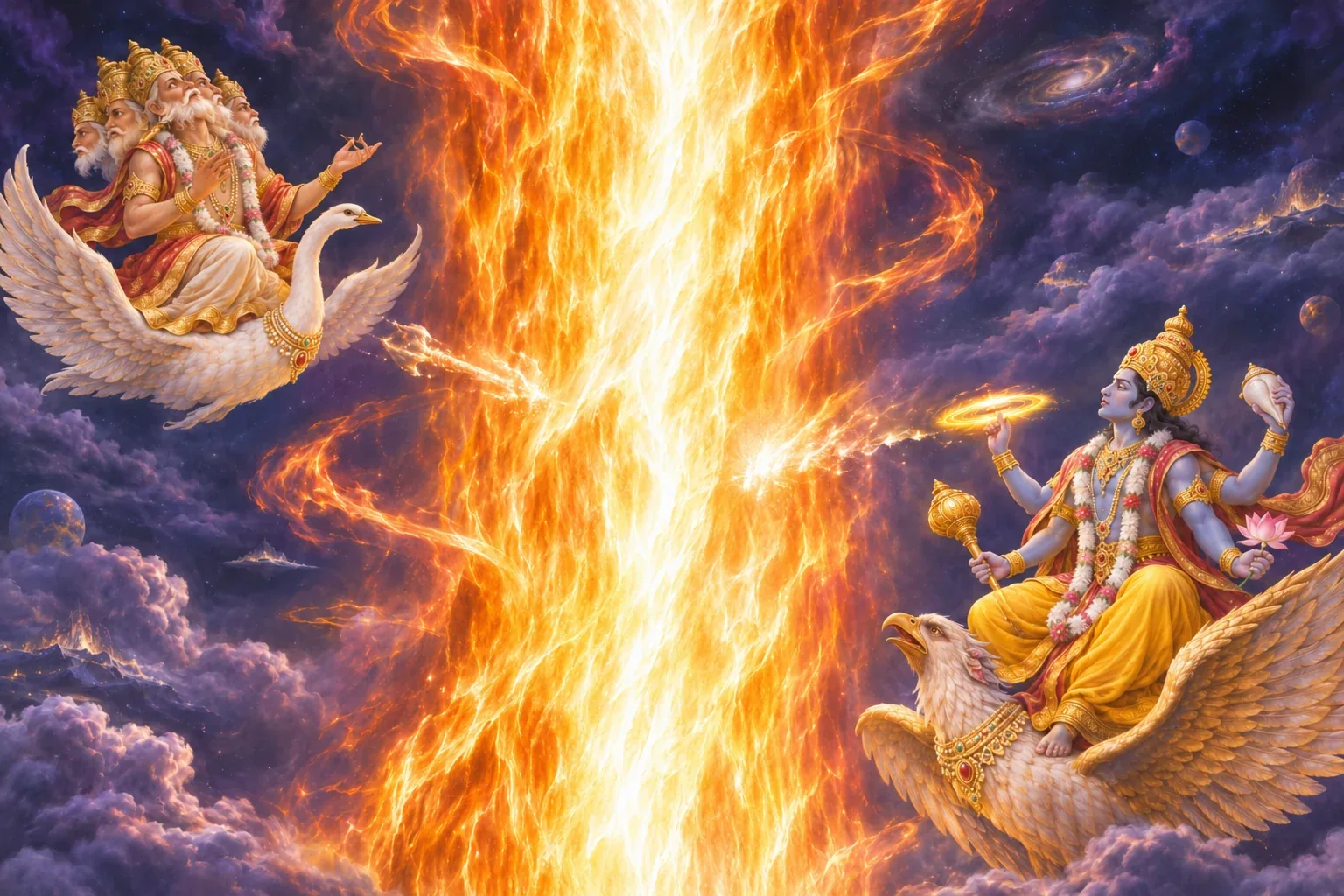
Brahma comes upon Vishnu resting on his serpent couch. What begins as a question of honour quickly becomes a contest of supremacy. Each presents himself as lord, source and protector of the universe.
Words harden into combat. Their attendants clash, and the gods gather in alarm. At last Brahma and Vishnu release weapons so powerful that their meeting threatens the three worlds.
The devas turn toward Kailasa. The Shiva Purana does not present the conflict as proof of greatness; it presents pride as a force that has made great powers forget their proper relationship.
The answer appears as light
Shiva already knows the danger. He goes to the battlefield with Uma and the divine assembly, then becomes unseen.
Between Brahma and Vishnu, an immense column of fire appears. The two weapons fall into it and lose their destructive force. The blaze has no visible beginning or end. It does not enter the argument as one more weapon or one more claimant; its presence makes the terms of the argument too small.
Wonder interrupts conflict. Brahma and Vishnu agree to seek the limits of this form that lies beyond their senses.
One searches above, one below
They divide the search. Vishnu assumes the form of a powerful boar and descends through the lower regions, seeking the root. Brahma becomes a white hamsa and rises with the speed of wind, seeking the summit.
Both journeys extend beyond ordinary distance and duration. The narrative makes their failure meaningful: neither direction converts the infinite into an object that can be possessed, compared or used to settle pride.
The column remains exactly what first confronted them—without a discoverable root, middle or top.
Vishnu returns to the truth
Vishnu travels downward until exhaustion makes the limit of his search unmistakable. He finds no foundation. He returns to the place where the column first appeared.
His search has not produced the victory he wanted. Yet his return produces something more important: he does not turn the absence of proof into a claim of success.
In this episode, truth is not the possession of the infinite. It begins with the honest recognition that the infinite has not been mastered.
The flower and the claim
Brahma also grows weary in the upward flight. Then he sees a Ketaki flower descending beside the column. It has been falling for an immense span, yet it has not come from a summit the hamsa can reach.
Rather than return with the same admission as Vishnu, Brahma asks the flower to support another account: that he has found the top. Back at the battlefield, Vishnu states that he could not find the root. Brahma claims success, and the Ketaki flower repeats the claim.
The contrast is deliberate. Both searches fail; only one seeker allows failure to become truth.
Shiva reveals himself
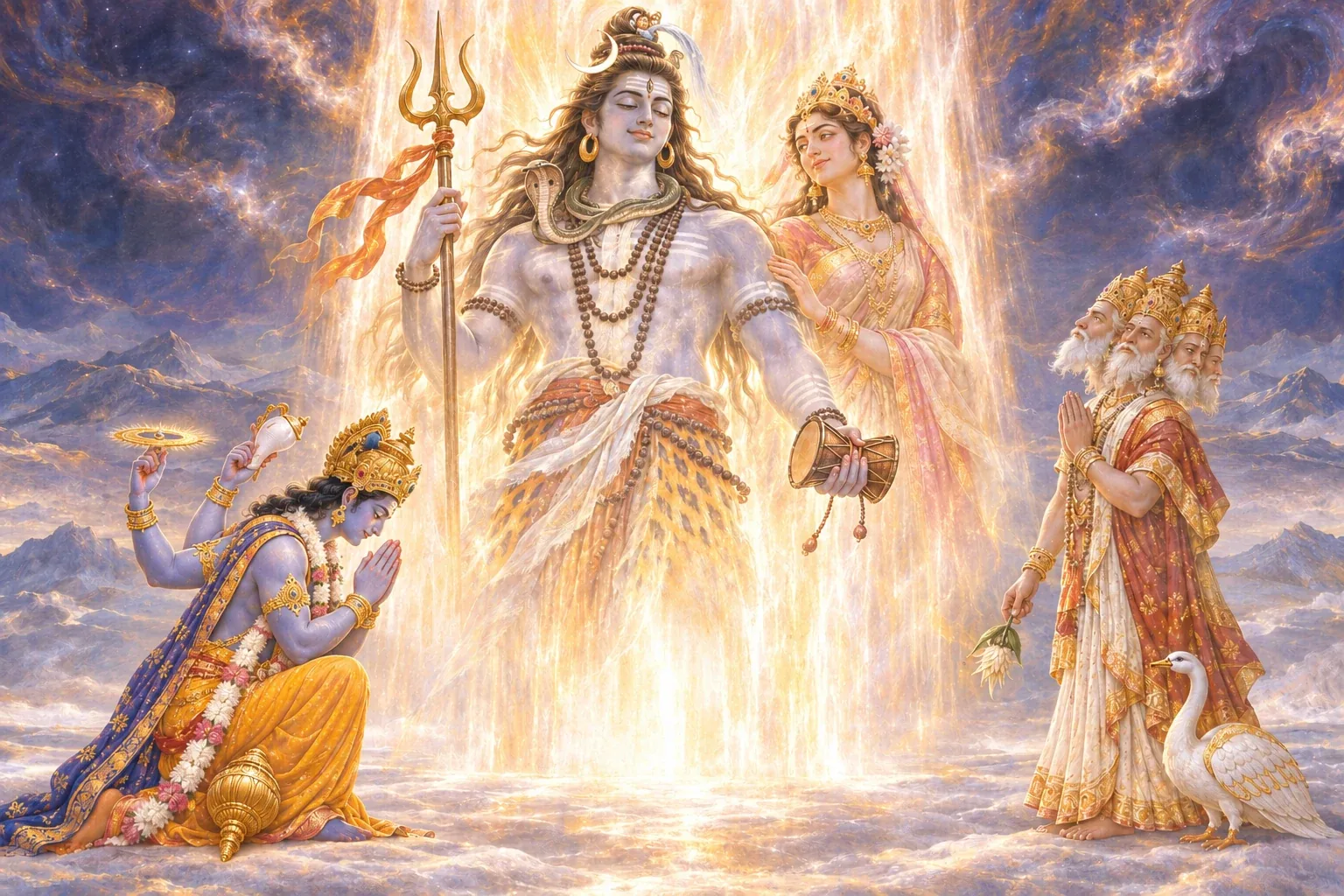
The column opens into revelation. Shiva appears in embodied form, no longer only the light that exceeds all measure. Vishnu bows and acknowledges that ignorance and delusion led them into the impossible contest.
Shiva responds to the truthfulness of Vishnu with favour. The story therefore joins two modes of knowing: the column cannot be bounded by the search, yet relationship becomes possible when pride yields to honesty.
Correction without abandonment
The text gives Brahma’s false claim a serious consequence, but its sequence does not end in simple rejection. Vishnu intercedes. Shiva halts the threatened punishment, corrects Brahma’s demand for honour, and then confirms his continuing responsibility within sacrifice and cosmic administration.
The Ketaki flower is excluded from Shiva’s direct worship in this account, yet it too receives a limited place through decoration by Shiva’s attendants. Correction remains real; mercy does not pretend the falsehood never happened.
This reader keeps the scene non-graphic. Its centre is not humiliation, but the restoration of truth and right relationship after pride.
The sign of the immeasurable
Shiva explains the two forms through which the episode has unfolded. The limitless column discloses his unmanifest aspect; the revealed Lord discloses his manifest aspect. The linga is the sign through which the unbounded is made approachable without being reduced to ordinary measure.
For the sake of vision and worship, the rootless and summitless column may be encountered in a smaller sacred form. The form does not claim to contain the infinite. It makes relationship with the infinite possible.
This is the theological emphasis of this Shiva Purana account. Other Shaiva texts and communities offer further teachings about the linga, and this reader does not collapse them into a single explanation.
EDITORIAL REFLECTION / PAUSE & REFLECT
What becomes visible
when the need to win falls away?
Brahma and Vishnu begin by trying to establish who is greater. The limitless column cannot be turned into evidence for either side. The decisive difference appears only when the search ends: one admits his limit, while the other tries to escape it.
TEXT & INTERPRETATION
A sacred form.
Not a boundary around Shiva.
This reader follows the Vidyeshvara Samhita’s own movement from conflict to column, search, revelation, correction and teaching. The Sanskrit word linga can mean a mark or sign; here the narrative explicitly joins the fiery column to Shiva’s unmanifest aspect and his embodied appearance to the manifest aspect.
The story is presented from the Shaiva theological perspective of the Shiva Purana. It should not be converted into a ranking slogan detached from the text’s deeper concern with pride, truth, grace and the limits of measurement.
The paintings are contemporary devotional interpretations. Faces, clothing, cosmic landscape and the visible shape of the radiance are imagined; they are not historical reconstructions or literal diagrams of the infinite.
Read the chapter references and edition notes