
Born in darkness, held with care
At Mandara, Parvati playfully covers Shiva’s eyes. For a moment the worlds are without light. From the heat and moisture of that contact a child appears—dark in complexion, strong in form and blind from birth.
Shiva names him Andhaka. Parvati does not treat the child’s difference as blame. She arranges his care with compassion, and the narrative calls him her son.
Elsewhere, Hiranyaksha undertakes penance seeking a son. Shiva entrusts Andhaka to him. The child therefore grows in another household, carrying an origin and a relationship he does not yet understand.
A wound becomes ambition
After Hiranyaksha’s death, Andhaka’s cousins mock his blindness and his adoption. Their cruelty does not determine what he must become, but it wounds him. He leaves the kingdom and turns to formidable penance.
Brahma grants him restored sight and extraordinary strength. Andhaka also frames a condition for his death: it will come when he covets the incomparable woman whom he ought to regard as mother. The boon contains a boundary he does not yet recognise as his own.
The source describes severe bodily austerities. This reader condenses them. What matters for the story’s movement is that Andhaka returns able to see, powerful enough to rule—and still responsible for how that power is directed.
Power without direction
Andhaka regains his throne and expands his dominion. The world around him yields tribute, pleasure and praise. Success becomes the atmosphere in which refusal feels impossible.
The Shiva Purana now speaks of pride, desire and harmful counsel. These are not continuations of his former bodily blindness. They are choices and habits that distort judgment after sight has already been restored.
When ministers report an extraordinary woman beside an ascetic at Mandara, Andhaka does not ask who she is or what relationship surrounds her. He turns description into entitlement.
The demand at Mandara
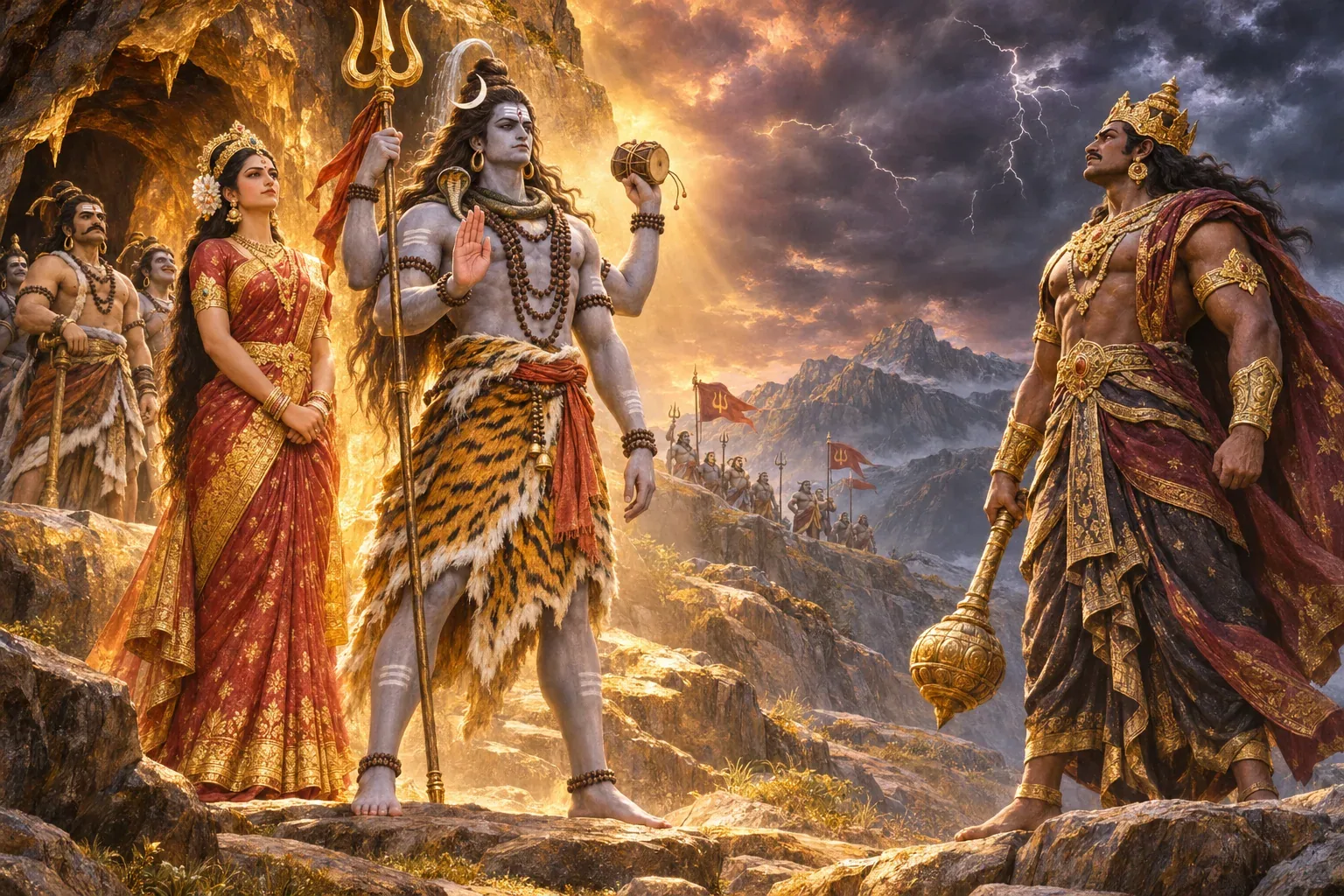
A messenger reaches Shiva’s mountain cave and demands that Parvati be surrendered. The request treats the Goddess as an object to be transferred and Shiva’s dwelling as another territory to command.
Shiva’s answer exposes the emptiness of that claim. Parvati is not property, and no messenger can erase her agency. The demand has already revealed the deeper conflict: power has mistaken access for right.
Andhaka advances toward Mandara. Viraka stands at the entrance. The guardian does not bargain with the demand; he holds the threshold.
Parvati holds the threshold
While Shiva is away in penance, the conflict reaches the cave. Viraka resists the invading force, but the pressure continues.
Parvati does not disappear from her own story while others decide her fate. She calls upon divine powers associated with Brahma, Vishnu and the devas. They arrive in feminine forms and stand with her.
The defence of Mandara is therefore not merely a contest between two male warriors. The person whom Andhaka tried to reduce to a prize becomes an active centre of resistance, alliance and protection.
Conflict cannot master the sacred
Shiva returns and honours Parvati’s courage. The battle widens, and Andhaka repeatedly refuses every opportunity to stop. The source tells the encounter with fierce and graphic detail; this reader keeps the violence outside the frame.
Shiva finally subdues Andhaka with the trident. The weapon marks a limit that conquest could not recognise. Andhaka can no longer advance, command or turn persistence into victory.
Subdual is not yet transformation. It creates the stillness in which Andhaka must face the desire, enmity and false understanding that brought him to Mandara.
Stillness inside consequence
The Purana gives the stillness a vast traditional duration: three thousand years. Held under Shiva’s power, Andhaka turns his attention toward the very Lord he opposed.
Time alone does not transform him. His meditation gradually becomes recognition. He sees that the woman he tried to possess belongs within a relationship he should have honoured as maternal, and that hostility cannot bring him near the sacred.
When Shiva is satisfied with his devotion, he releases him. Mercy arrives after the conflict has been named and stopped; it does not pretend the demand never occurred.
A different place among the Ganas
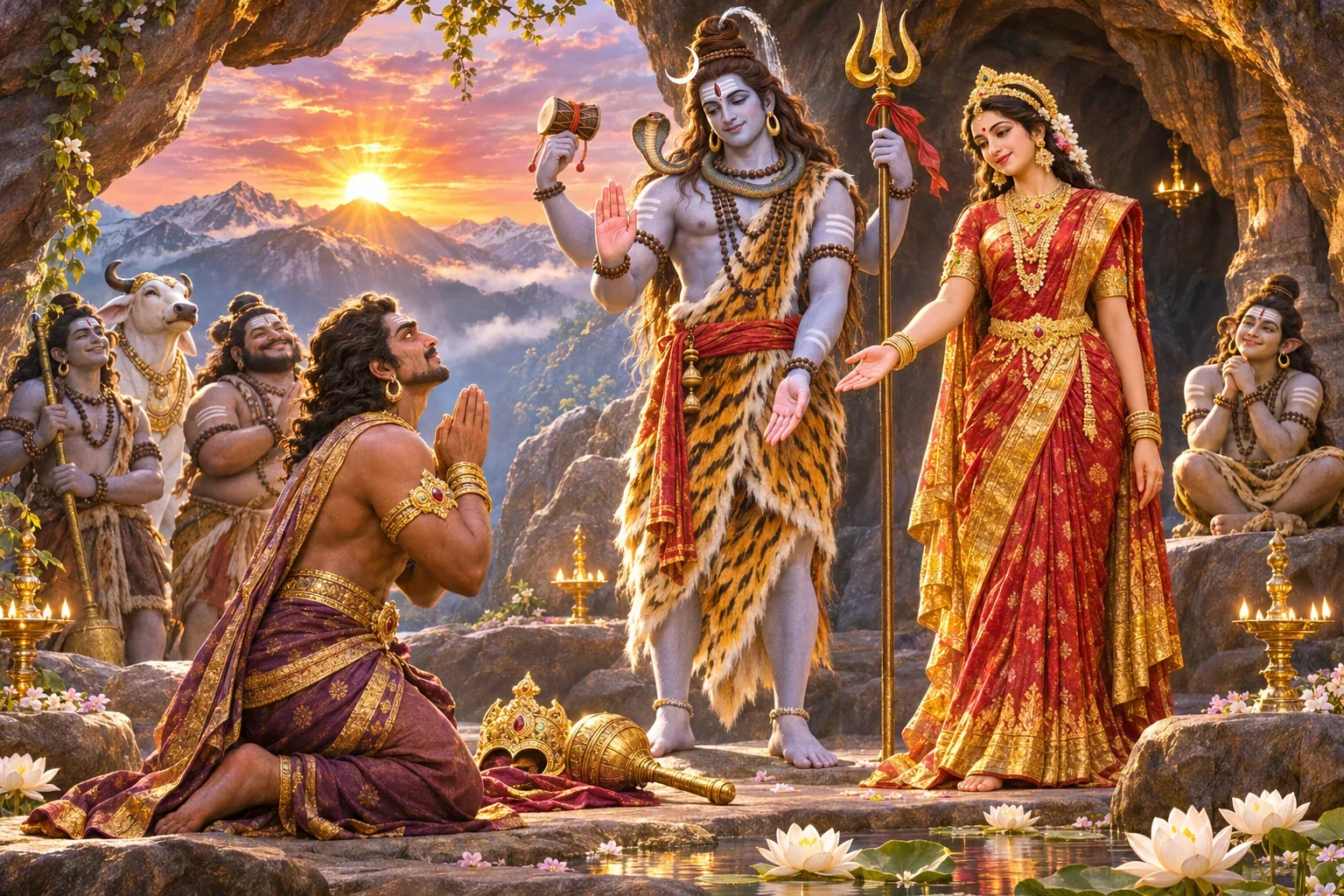
Andhaka does not ask to resume his former conquest. He acknowledges delusion, seeks forgiveness and asks that his hostility fall away. Most importantly, he asks to see Parvati as mother.
He also asks for steady devotion and a place among Shiva’s attendants. The request reverses his earlier movement: he no longer tries to seize the threshold; he asks to belong through service.
Shiva accepts him, and Parvati gives her consent. Andhaka enters the company of the Ganas—not because power has made him entitled to it, but because recognition, repentance and a changed relation have opened another path.
EDITORIAL REFLECTION / PAUSE & REFLECT
Seeing is more
than possessing sight.
The story never makes physical blindness a moral fault. Andhaka receives sight before pride and desire overtake his judgment. Its ethical question is separate: can a person recognise another’s dignity, accept a boundary and change after causing harm?
TEXT & INTERPRETATION
Transformation is not
an escape from consequence.
This reader follows Yuddha Khanda chapters 42 and 44–49. It condenses the graphic battle, the multiplication motif and chapters 47–48’s extended Shukra episode so the central arc remains visible.
The ending is grounded in Andhaka’s own requests: to relinquish enmity, recognise Parvati as mother, become devoted to Shiva and live among the Ganas. “Ignorance” here means a failure of recognition—not disability, lack of intelligence or a label for another person.
The paintings are contemporary devotional interpretations, not historical reconstructions. The scenes keep the conflict non-graphic and make the relinquished crown and mace visible signs of changed direction.
Read the chapter references and edition notes