
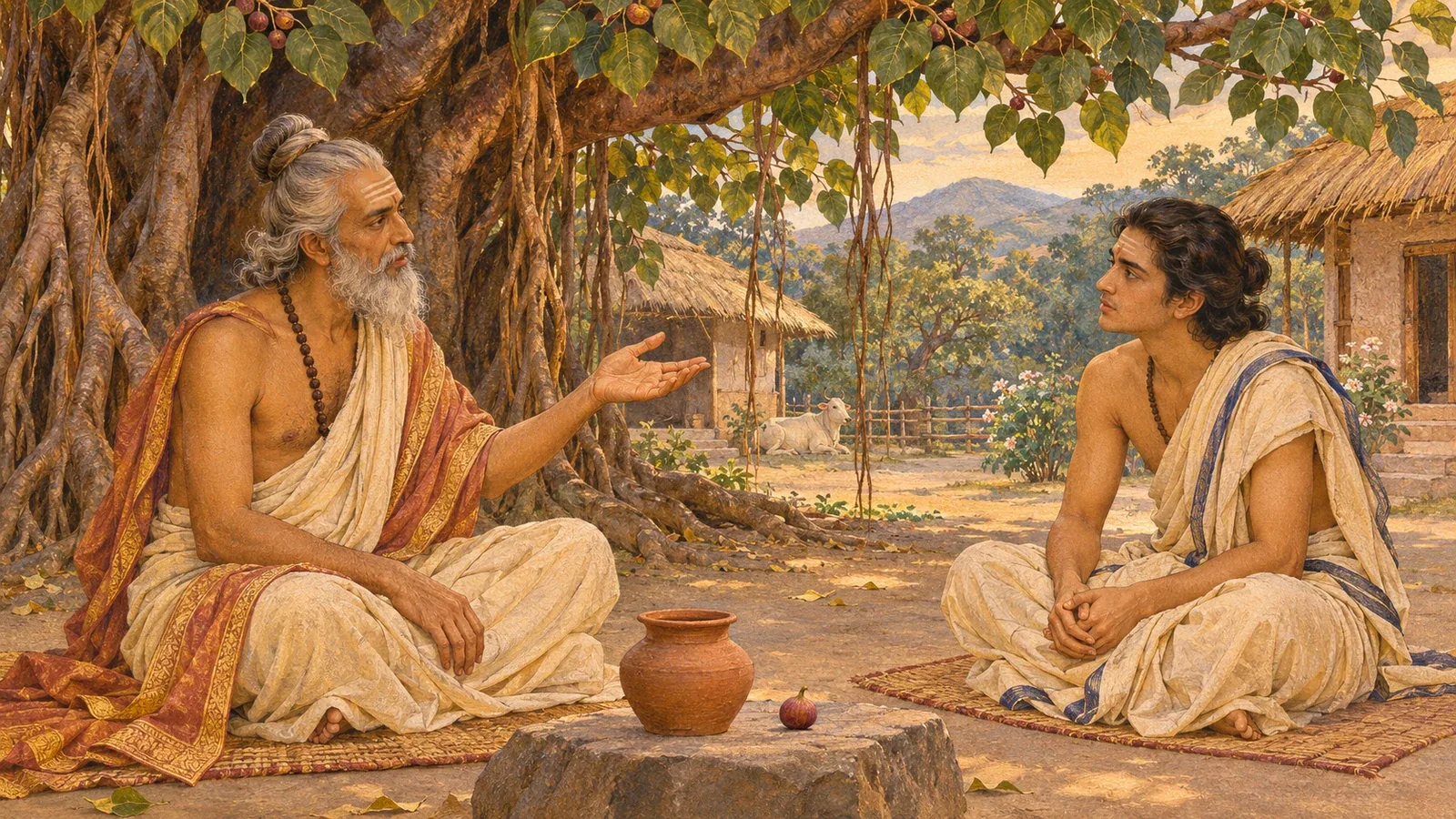
The learned son returns
When Shvetaketu is twelve, Uddalaka sends him to study. No one in their family, he says, should be learned only by name. Twelve years later the son returns, accomplished in the Vedas—and visibly proud of what he has mastered.
Uddalaka does not dismiss that education. He asks whether Shvetaketu’s teachers gave him a particular instruction: the knowledge through which what has not been heard becomes understood, and what has not been thought or known becomes intelligible.
Shvetaketu’s certainty pauses. He asks his father to teach him.
The knowledge behind forms
Uddalaka begins with clay. By knowing clay, one understands that cups, jars and dishes are different forms and names while their material reality is clay. He turns to metal in the same way: many fashioned objects can be understood through the substance from which they are made.
The point is not that differences are useless. A vessel still holds water and a tool still has its work. The examples ask Shvetaketu to look through changing names and forms toward what makes them possible.
Being, one without a second
Before these many forms, Uddalaka teaches, there was Sat—Being, alone, without a second. He rejects the proposal that being could simply arise from non-being: how could what exists emerge from what does not?
The chapter describes an unfolding through heat, water and food, and then their presence in living bodies. It is a compressed Upanishadic account of cause, manifestation and embodied life—not a modern scientific chronology.
Uddalaka keeps returning from the complexity of the world to its ground. The many are not cut away from their source.
Mind and nourishment
To make the teaching experiential, Uddalaka asks Shvetaketu to remain without food for fifteen days while continuing to drink water. When the fast ends, Shvetaketu cannot recite what he has learned. After eating, his memory returns.
The example supports the chapter’s teaching that mind is nourished by food, breath by water and speech by heat. Its purpose here is philosophical, not medical instruction or a practice for readers to imitate.
Learning may feel independent and self-owned. Uddalaka makes his son notice how deeply even memory depends upon conditions that sustain the body.
Return to the root
Deep sleep offers another doorway. In sleep, Uddalaka says, a person returns to the real without consciously reporting, “I have reached it.” Like a bird tied by a cord that flies in every direction and finally settles at its bond, mind ranges widely and comes to rest in life-breath.
Hunger and thirst are traced backward through food, water and heat. Follow each effect to its root, the teaching urges, and then follow the root further still. All beings are rooted in Sat, dwell in Sat and return to Sat.
Here the refrain first arrives: the subtle essence is the Self of all; it is the Real. Tat Tvam Asi, Shvetaketu—“That you are.”
Honey, rivers and the tree
Bees gather nectar from many plants. In honey, the gathered nectars no longer announce which flower each came from. Rivers flow east and west, carrying different names, but on entering the ocean they no longer claim those separate identities.
A living tree offers a different angle. Cut one part and sap still flows; life remains throughout it. If life leaves the tree entirely, it dies. The subtle living principle is not confined to one visible branch.

After each example, Uddalaka returns to the same teaching. The refrain does not erase the world’s variety; it redirects attention to the shared reality that separate names do not reveal.
The seed and the salt
Uddalaka asks Shvetaketu to break open a banyan fruit, then one of its tiny seeds. What does he see inside? Nothing, Shvetaketu answers. Yet from what the eye cannot discern, the great banyan tree arises.
Next, salt is placed in water and left overnight. In the morning it cannot be lifted out, but water tasted from the surface, middle and bottom is salty throughout. What is unseen has not therefore ceased to be present.
These examples do not turn the Self into a physical seed or dissolved substance. They train attention: reality need not be absent merely because the senses cannot isolate it as an object.
Led home by knowledge
Uddalaka compares a person without this knowledge to someone carried blindfolded from Gandhara and left in an unknown place. Once the blindfold is removed and a direction is given, the traveller can ask from village to village and find the way home. Instruction guides; understanding must still be lived.
The final examples approach death and truth. Speech is gathered into mind, mind into breath, breath into heat and heat into the highest reality. The image of the heated axe distinguishes the one grounded in truth from the one bound by falsehood.
Again the father repeats: the subtle essence is the Self of all; it is the Real. Tat Tvam Asi. The dialogue closes not with Shvetaketu winning an argument, but with a proud student learning how to see.
EDITORIAL REFLECTION / PAUSE & REFLECT
What do names reveal—
and what do they conceal?
Uddalaka’s examples do not ask Shvetaketu to despise the visible world. They ask him to notice the reality that a name or surface cannot exhaust. Where might certainty be preventing you from looking again? This is an editorial invitation, not a translated verse.
TEXT & INTERPRETATION
Three words.
A living field of interpretation.
Tat Tvam Asi is often rendered “That thou art” or “You are That.” In this supplied edition, Shankara reads the repeated sentence through Advaita Vedanta. Other Vedanta traditions interpret the relation among “That,” “you,” Brahman and the individual self differently. This reader follows the chapter’s sequence and does not claim that one short English gloss settles those debates.
The fasting episode belongs to the text’s teaching about nourishment and mind; it is not health advice. The teacher, student, hermitage, clothing and objects in the illustrations are imagined. The salt, seed, rivers and clay are visual metaphors from the passage, while ultimate reality is deliberately not personified.
Read the passage map and edition notes