
A gift without value
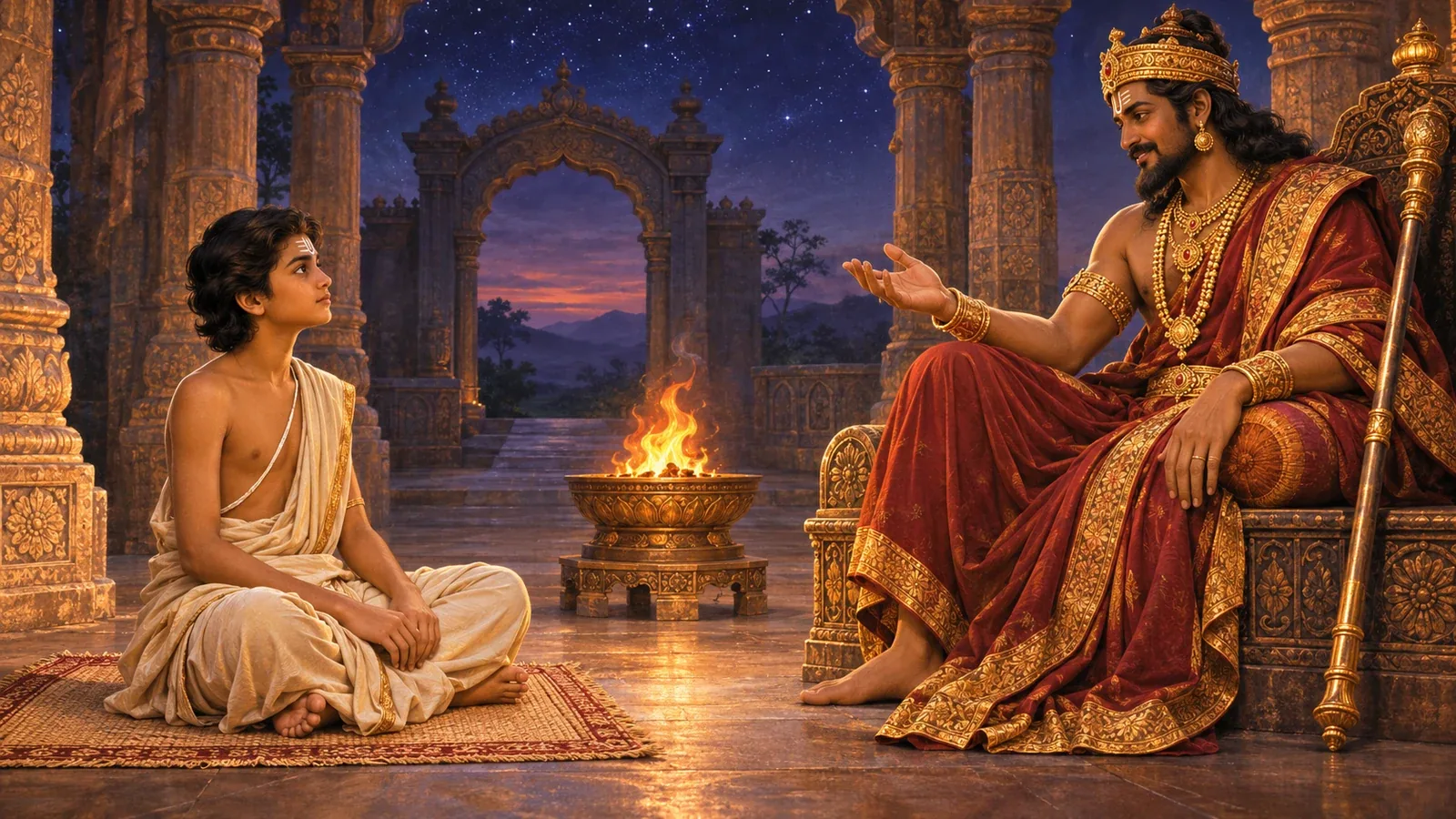
Vajasravasa undertakes a sacrifice whose gifts are meant to include all he possesses. Nachiketa watches the cows being led away. They have drunk their last water, eaten their last grass, given their last milk; their strength is spent.
The boy sees more than poverty in the offering. A sacred act has become divided from its purpose. If generosity gives only what no longer serves the giver, what has truly been surrendered? Concern enters Nachiketa—not contempt for his father, but a young conscience unwilling to look away.
“To whom will you give me?”
Nachiketa approaches his father. “To whom will you give me?” he asks. The question returns a second time, then a third. In anger, Vajasravasa answers that he gives the boy to Death.
Nachiketa does not treat the words as empty. Human beings ripen and fall like grain, he reflects, while new grain rises again. He prepares to go to Yama’s dwelling, trusting that truth cannot be honoured only when it is convenient. The Upanishad leaves no travelogue; it carries him directly toward the house of Death.
Three nights at the threshold
Yama is away. Nachiketa waits without food for three nights. When the lord of the house returns, his household warns that an honoured guest has remained unattended. Hospitality is not a small social courtesy here: the unreceived guest is compared to fire entering a house.
Yama welcomes Nachiketa and offers three boons, one for each night. Before the teaching begins, the story establishes the seeker’s steadiness. He has crossed into uncertainty and waited without abandoning his purpose.
The first two boons
Nachiketa’s first wish is for reconciliation. When he returns, may his father be free from anger, recognise him and sleep in peace. Yama grants it. The first boon turns not toward escape, but toward a wounded relationship made whole.
For the second, Nachiketa asks about the fire by which the heavenly state is reached. Yama teaches him its arrangement and praises how precisely he receives it. The fire will bear Nachiketa’s name. Knowledge here is not vague admiration: it is listened to, remembered and understood.
The question no gift can replace
For his third boon, Nachiketa asks the question that brought him to Death: when a person dies, some say the person continues and others say not. What is the truth?
Yama hesitates. Even the devas have wondered about this subtle matter, he says. He offers another boon instead—children and grandchildren, cattle and wealth, long life, wide dominion, music and pleasure. Nachiketa refuses. Possessions wear out the senses, and even the longest life is brief before death. Let Yama keep the passing gifts. Only the question remains.
Shreyas and preyas
Yama begins by distinguishing shreyas, the truly beneficial, from preyas, the immediately pleasant. Both approach a person. The discerning examine them and choose what leads toward lasting good; the unreflective are carried by what is attractive now.
Nachiketa has already enacted this distinction by refusing Yama’s display. Yama also warns that ignorance may imagine itself wise. This knowledge is difficult to reach through argument alone: the student must be prepared, the teacher must truly know, and listening must become inward understanding.
The chariot and the inward road
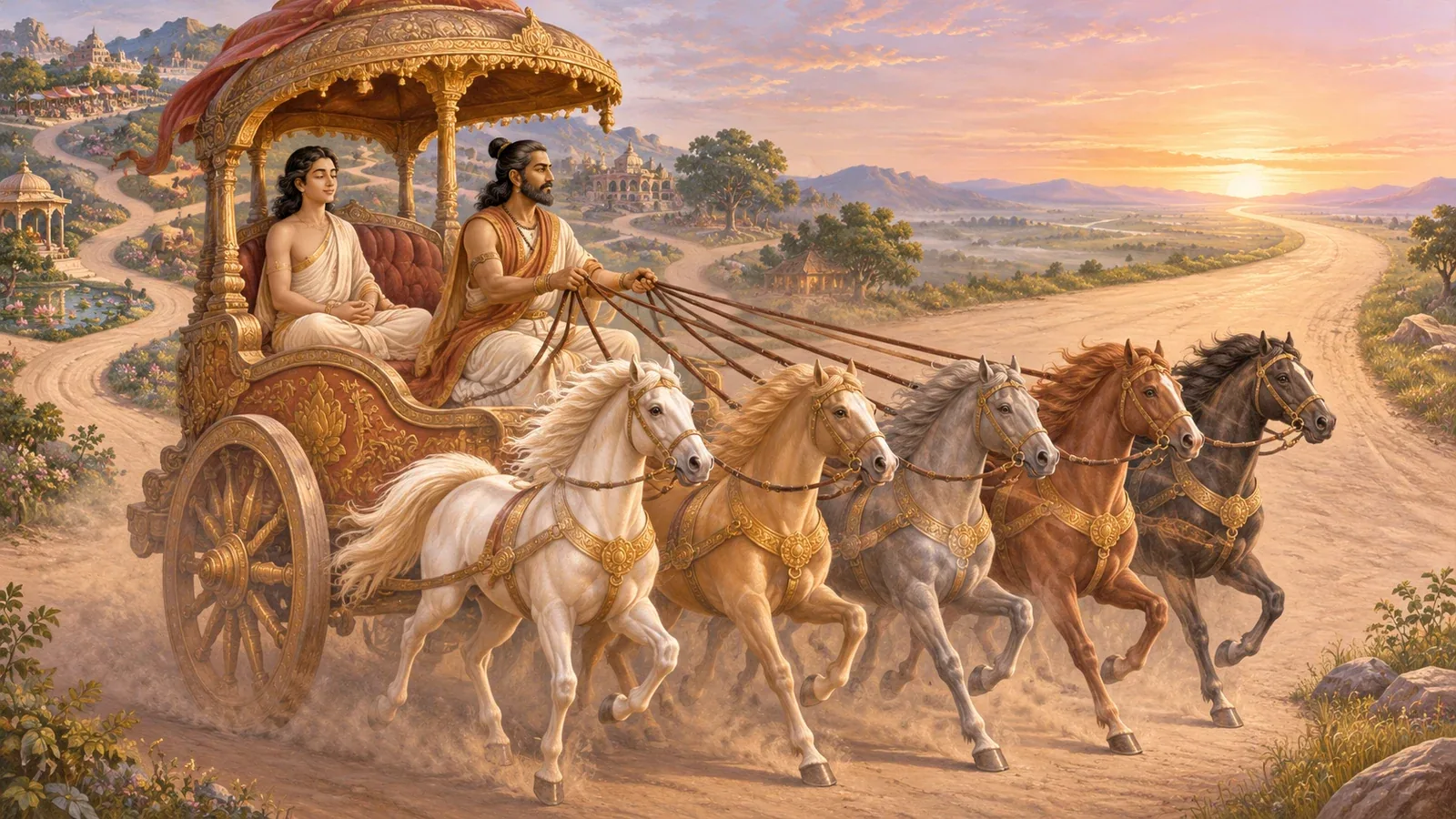
Yama gives the teaching a memorable form. Know the body as a chariot, the Self as its passenger, discernment as the charioteer and mind as the reins. The senses are the horses; the objects they pursue are the roads before them.
When discernment is unclear and the mind ungoverned, the senses run like untrained horses. When understanding is steady and the mind gathered, they can carry the traveller toward the journey’s end. The image does not condemn the body or senses. It asks what guides them—and whether the passenger has been mistaken for the vehicle.
What death cannot take
Yama’s answer does not promise that the ordinary personality simply carries on unchanged. He directs Nachiketa toward Atman, the deepest Self: unborn, enduring, not slain when the body is slain. Smaller than the small and greater than the great, it is hidden in the heart and known through inward clarity.
The teaching moves beyond information toward realisation. Speech, intellect and much hearing do not by themselves possess the Self. Desire must loosen; the knots of the heart must open. The disciplined seeker turns inward through the senses and mind, beyond changing appearances toward what is not born and does not die.
Having received Yama’s instruction and the discipline of yoga, Nachiketa reaches the text’s promised freedom. The Upanishad closes by extending that possibility to another who knows in the same way. Death has answered the boy not with a description of another place, but with a transformation in what he understands himself to be.
EDITORIAL REFLECTION / PAUSE & REFLECT
Which question
would you not trade away?
Nachiketa recognises that a pleasant distraction can still leave the central question untouched. What matters enough that comfort should not make you forget it? This is an editorial invitation, not a translated verse.
TEXT & INTERPRETATION
One Upanishad.
More than one Vedanta reading.
This reader follows the supplied Gita Press edition with Shankara’s commentary. Its language of Atman, Brahman, knowledge and liberation has been interpreted differently across Vedanta traditions. The page therefore does not claim to exhaust every school’s account.
The dialogue is a sacred teaching, not a modern clinical description of death or evidence about an afterlife. Yama’s dwelling, the fire, clothing and chariot in the images are artistic interpretations. Nachiketa’s precise age and appearance are not established by the supplied text.
Read the passage map and edition notes