
A question from Yudhishthira
Vana Parva 52 · Gita Press Mahabharata, Volume 2
After the dice game and the loss of his kingdom, Yudhishthira lived in the forest with his brothers and Draupadi. The humiliation of defeat was difficult to bear, and he wondered whether any other king had suffered such a reversal. The sage Brihadashva came to the Pandavas and heard his grief. Rather than telling Yudhishthira that misfortune was small or easily forgotten, the sage began the story of another ruler who had once lost much more than a throne.
His name was Nala, son of Virasena and king of Nishadha. Nala was admired for his generosity, skill with horses and love of virtue; he was also drawn to the game of dice. The woman whose life would become inseparable from his was Damayanti, daughter of King Bhima of Vidarbha. Their story, Brihadashva explained, held both the dangers of an uncontrolled passion and the possibility of recovery.
The swan that carried a message
Vana Parva 53 · Gita Press Mahabharata, Volume 2
Nala had heard about Damayanti's beauty and character, and she had heard of his. Though they had not yet met, each was drawn toward the other. One day Nala caught a golden-winged swan in a garden. The bird begged to be released and offered a curious promise: it would fly to Damayanti and speak of Nala so persuasively that she would choose no other husband.
Nala freed it. In Vidarbha the swan came among Damayanti and her companions. When the princess approached, it praised the king of Nishadha, saying that a union with him would be worthy of them both. Damayanti sent it back with her own message. What passed between them was not a secret meeting but an exchange carried by the bird. Their attachment grew before either stood in the other's presence.
A choice among the gods
Vana Parva 54–56 · Gita Press Mahabharata, Volume 2
King Bhima arranged Damayanti's svayamvara, a gathering where she would choose her husband. Kings came from many lands. Hearing of the occasion, Indra, Agni, Varuna and Yama also set out. Along the road the four gods encountered Nala and asked him to act as their messenger. They wished him to tell Damayanti that she should choose one of them.
Nala was troubled: he loved Damayanti himself. Yet he had agreed to carry their words. Through the divine power of his messengers he reached the guarded women's apartments and gave the gods' message. Damayanti did not conceal her decision. She had already set her heart on Nala and said that she would choose him at the assembly. Nala repeated the duties of a messenger, but she remained resolved.
Her answer placed a human choice beside the claims of heaven. Nala returned and faithfully reported what she had said. The gods were not absent from what followed; they would stand within the svayamvara itself.
Damayanti recognizes Nala
Vana Parva 57 · Gita Press Mahabharata, Volume 2
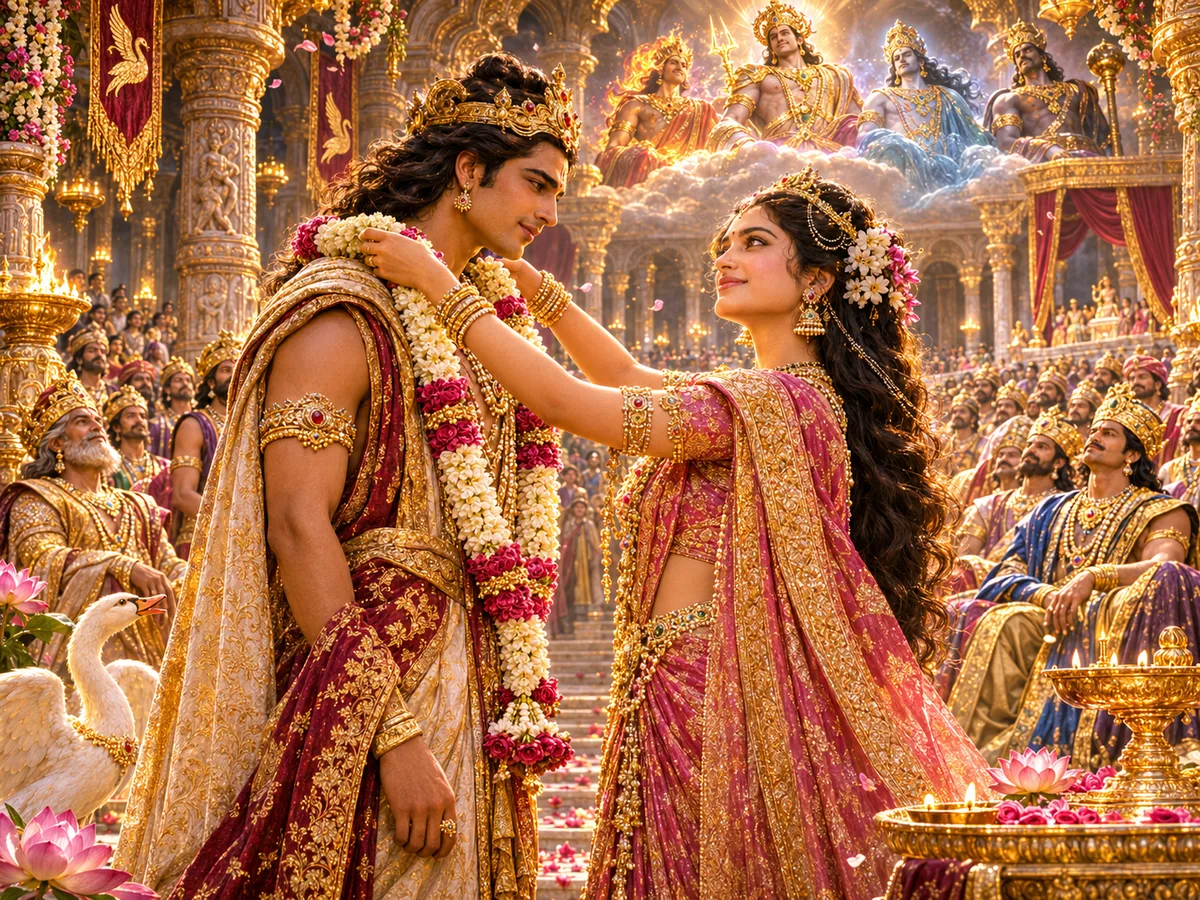
In the assembly Damayanti saw five figures bearing Nala's likeness. The four gods had assumed his appearance, making her decision difficult. She prayed that they would allow her to recognize the man to whom she had pledged herself. Their divine signs became distinguishable: the gods did not show the ordinary marks of mortals, while Nala stood before her as a human being.
Damayanti placed the wedding garland on Nala. The gods accepted her choice and bestowed blessings on the couple. Nala and Damayanti married, and the account turns from the joy of their union toward the responsibilities of married life. They later had two children, a son and a daughter, both named in the text as Indrasena in different grammatical forms.
Their happiness was real, but the story does not describe it as a guarantee against future loss.
Kali enters the dice game
Vana Parva 58–59 · Gita Press Mahabharata, Volume 2
Kali, a personified force of discord and the age of strife in this episode, arrived too late to seek Damayanti's hand. When he learned that she had chosen Nala in the presence of the gods, he was enraged. He resolved to break the marriage and waited for an opportunity. The narrative describes him finding an opening in a lapse of ritual purification and entering Nala.
Kali then drew Pushkara, Nala's brother, into a contest of dice. Game followed game. Nala lost wealth, possessions and the resources of his kingdom, yet he could not turn away. Damayanti and the ministers urged him to stop; the king seemed unable to hear them. The text presents his downfall as both an inward seizure and an outward succession of disastrous choices.
Damayanti saw the danger before the last throw. She arranged for their two children to be taken safely to her father's house in Vidarbha. When Nala's kingdom was finally lost, he and Damayanti left the city together, deprived of the protection and abundance that had once surrounded them.
The road beyond Nishadha
Vana Parva 60–61 · Gita Press Mahabharata, Volume 2
The king and queen walked into the forest without the household that had served them. Hungry and exposed, they struggled to find food and rest. When Nala saw birds gathering, he tried to cast his garment over them, hoping to catch a meal. The birds flew off with the cloth, leaving him poorer still. In the narrative they reveal themselves as the dice that had already taken everything from him.
Damayanti would not leave Nala. He suggested roads that might lead her toward her relatives and safety, but she asked why she should abandon him in his misery. He did not cease to feel affection for her; nevertheless, the force working within him and his own anguish brought him toward an act that the story never makes painless.
At last Damayanti slept, exhausted by the journey. Nala stood beside her, divided between love and despair. He cut a piece from the garment they shared and departed, leaving her alone among the trees.
Damayanti walks on alone
Vana Parva 62–65 · Gita Press Mahabharata, Volume 2
When Damayanti awoke, she searched for Nala and called his name. Fear, anger and grief followed one another; she feared what the forest might do to him and could not understand why he had gone. As she wandered, a great serpent seized her. A hunter rescued her, but afterward threatened her. The text relates that Damayanti's condemnation brought about his death. She continued alone.
She encountered ascetics, travelled with a merchant caravan and hoped to learn where her husband had gone. Disaster struck when wild elephants rushed upon the caravan at night. Some travellers died, and others blamed Damayanti for the calamity. She escaped again, carrying uncertainty with her rather than receiving a swift rescue.
Eventually she reached the land of Chedi, where the queen mother recognized her bearing but did not know her identity. Damayanti agreed to remain in the royal household under conditions meant to protect her dignity. Even in a place of shelter, she did not stop searching for Nala.
A serpent, a disguise, and a new name
Vana Parva 66–67 · Gita Press Mahabharata, Volume 2
Elsewhere Nala came upon a fire in the forest and heard the serpent Karkotaka calling for help. He carried the serpent out of danger. Karkotaka then bit him, but not as an ordinary enemy would: the bite altered Nala's appearance and would cause suffering to the force of Kali hidden within him. Karkotaka explained the purpose of the transformation and gave Nala garments by which he could later recover his former appearance.
With his form changed, Nala travelled to Ayodhya and entered the service of King Rituparna. Calling himself Bahuka, he became known for extraordinary skill in driving and tending horses. He also cooked with exceptional ability. These accomplishments survived the loss of his visible royal identity.
Day after day Bahuka carried out his duties. Yet he remembered Damayanti and spoke of a woman separated from her husband. The disguise protected him from recognition, but it could not remove his regret.
Messages sent across kingdoms
Vana Parva 68–70 · Gita Press Mahabharata, Volume 2
King Bhima of Vidarbha sent learned brahmanas in many directions to look for his daughter and for Nala. A messenger named Sudeva eventually found Damayanti in Chedi and recognized her. She returned to her parents and children, but she still refused to abandon the search for her husband.
She devised a message recalling a woman deserted in the forest by the person she trusted most. The words were carried from court to court, and the messengers listened for whoever might respond. One of them, Parnada, returned with news of a man called Bahuka at Rituparna's court whose reply showed an intimate knowledge of the story.
Damayanti could not prove from the report alone that Bahuka was Nala. She needed a way to bring him within reach so that truth could be tested rather than merely wished for.
The journey that had to be made in a day
Vana Parva 70–72 · Gita Press Mahabharata, Volume 2
Damayanti arranged for a message to reach Rituparna: a second svayamvara for the princess would take place in Vidarbha the next day. The claim was a deliberate device, not a genuine abandonment of her marriage. Rituparna was eager to attend and called upon Bahuka, the only charioteer whose skill might make the extraordinary journey possible.
The horses flew along the road. Rituparna demonstrated his astonishing ability to count the fruit and leaves of a tree; Nala was moved by a knowledge he did not possess. Their exchange linked two arts: Rituparna taught Nala the science of dice, and Nala shared his mastery of horses. With that knowledge Kali's hold on Nala came to an end.
They arrived in Vidarbha. There was no great crowd of suitors awaiting them. Rituparna was received as a guest, while Bahuka's presence brought Damayanti nearer to an answer.
The face beneath Bahuka's disguise
Vana Parva 73–76 · Gita Press Mahabharata, Volume 2
Damayanti asked her attendant Keshini to observe Bahuka. His manner, his knowledge and his uncommon powers as a horseman and cook all stirred recognition. She arranged further tests and had her children brought before him. Bahuka's love for them broke through the composure of his disguise, but suspicion and pain remained on both sides.
When Damayanti and Nala finally spoke, the wound of their separation had to be faced. Damayanti explained the purpose of the false svayamvara announcement and affirmed that she had sought no other husband. The Mahabharata describes a divine testimony upholding her fidelity. It is part of the text's ancient narrative setting, not an editorial judgment imposed on readers today.
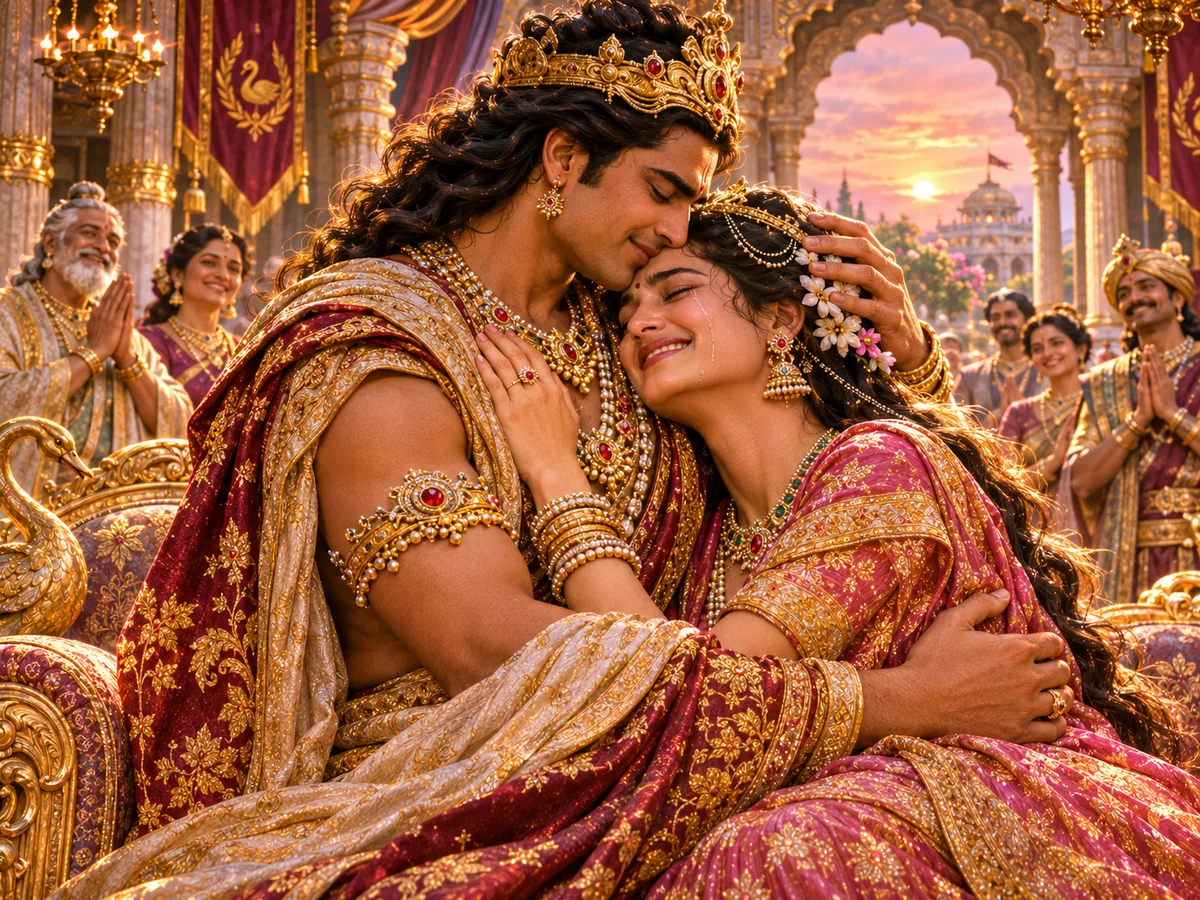
Nala used the garments given by Karkotaka and regained his familiar form. The couple recognized one another fully. Their reunion did not erase what had happened in the forest, but it ended the long uncertainty in which each had lived.
The kingdom regained, the brother spared
Vana Parva 77–78 · Gita Press Mahabharata, Volume 2
King Rituparna took leave after the exchange of arts, and Nala returned toward Nishadha with renewed mastery of the dice. He challenged Pushkara to another game. This time Nala won, and the kingdom he had lost came back into his hands.
Pushkara feared the consequences, but Nala did not kill him. He refused to place the entire blame for the first contest on his brother and spoke of the destructive influence that had worked through him. He returned Pushkara's life and possessions and allowed him to depart in peace.
The people of Nishadha welcomed their restored ruler. Damayanti and their children were brought back, and the broken household was reunited. Victory in this story does not end with the humiliation of a defeated brother. It ends with restoration and restraint.
What Brihadashva gave Yudhishthira
Vana Parva 79 · Gita Press Mahabharata, Volume 2
Brihadashva concluded by returning to the king who had asked for the story. Nala had endured defeat, exile and separation, and for a time he suffered without the comfort of his wife and companions. Yudhishthira, though greatly afflicted, was not alone. The sage urged him to resist despair and to remember that a kingdom once lost might yet be recovered.
He also taught Yudhishthira knowledge associated with the dice and with horses, placing practical counsel beside the example. The narrative did not ask the Pandava king to pretend that suffering was harmless. It gave him another life through which to examine his own.
Nala and Damayanti's story closes with a recovery of judgment, companionship and responsibility. What began with a swan's message passed through gambling, fear and a painful separation before it could return to trust.
EDITORIAL REFLECTION / PAUSE & REFLECT
When a choice is lost.
How is trust restored?
The story places loving loyalty beside the harm created by Nala's gambling and abandonment. What does repentance require beyond regret? How can wisdom, restraint and forgiveness lead toward a different future without pretending that past wounds never happened?
This reflection is editorial, not a verse from the Mahabharata.
TEXT & INTERPRETATION
The Nalopakhyana
This English reader is an original prose adaptation of the owner-supplied Gita Press Mahabharata, Volume 2 (Sanskrit text with Hindi translation), Vana Parva, Nalopakhyana Parva, chapters 52–79, PDF pages 377–557. It follows the sequence of the supplied edition without reproducing its translated text. Some dialogue and incident details are condensed, but the framing by Brihadashva, the svayamvara, gambling, Damayanti's independent search, Bahuka and the reunion are retained.
The narrative describes Kali as a personified force and includes divine testimony and other events within its scriptural worldview; they are not presented as independently verified history. The artwork is symbolic illustration, not a reconstruction of identifiable historical buildings or portraits.
Read the chapter map and edition notes